
Yes, even the BMW M2 couldn’t keep up.
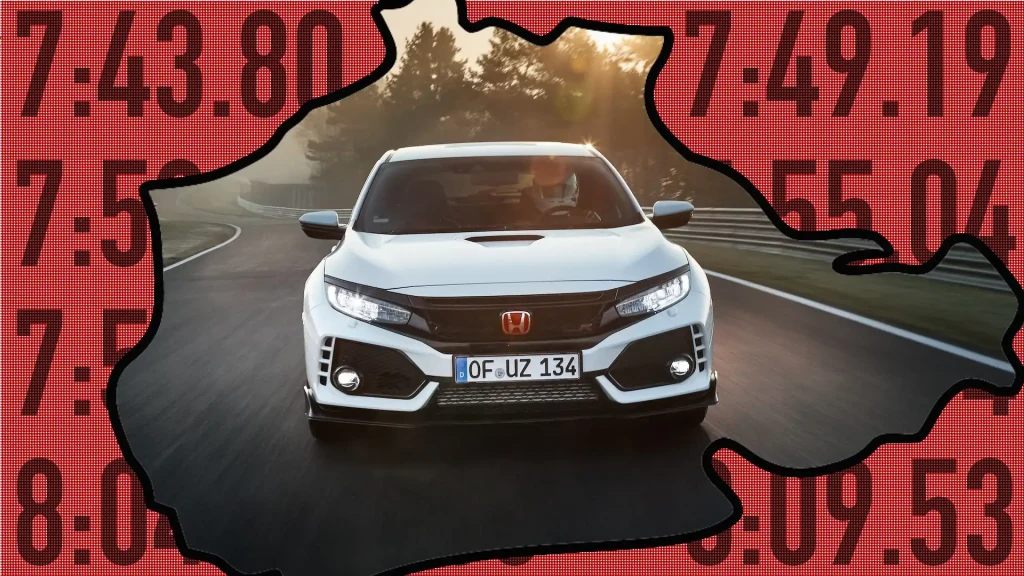
Nürburgring lap times have always been a source of debate and controversy—just ask manufacturers like Lamborghini—but they remain one of the most recognized benchmarks for measuring a car’s overall performance. That’s why Honda was eager to highlight the Civic Type R’s incredible 7-minute, 43.8-second lap around Germany’s legendary Nordschleife, also known as the “Green Hell.”
That time is seriously impressive, especially for a front-wheel-drive hot hatch. To put the achievement into perspective, here’s a look at just a handful of the many performance cars the Civic Type R can outrun based solely on their published Nürburgring lap times.
The results serve as a reminder that conquering the Nordschleife isn’t just about having the most horsepower. A well-engineered chassis, lightweight construction, suspension tuning, aerodynamics, and the ability to carry speed through corners can matter just as much—if not more—than outright power.
Table of Contents
7:47.19 – Volkswagen Golf GTI Clubsport S
The Volkswagen Golf GTI Clubsport S briefly held the crown as the fastest production front-wheel-drive car to lap the Nürburgring. Volkswagen initially recorded an impressive 7:49.21 before returning to the Nordschleife and lowering the benchmark to 7:47.19. That record stood as a testament to the Clubsport S’s finely tuned chassis and track-focused engineering—until the Honda Civic Type R arrived and claimed the front-wheel-drive lap record, cementing its place as the new king of hot hatches at the Green Hell.
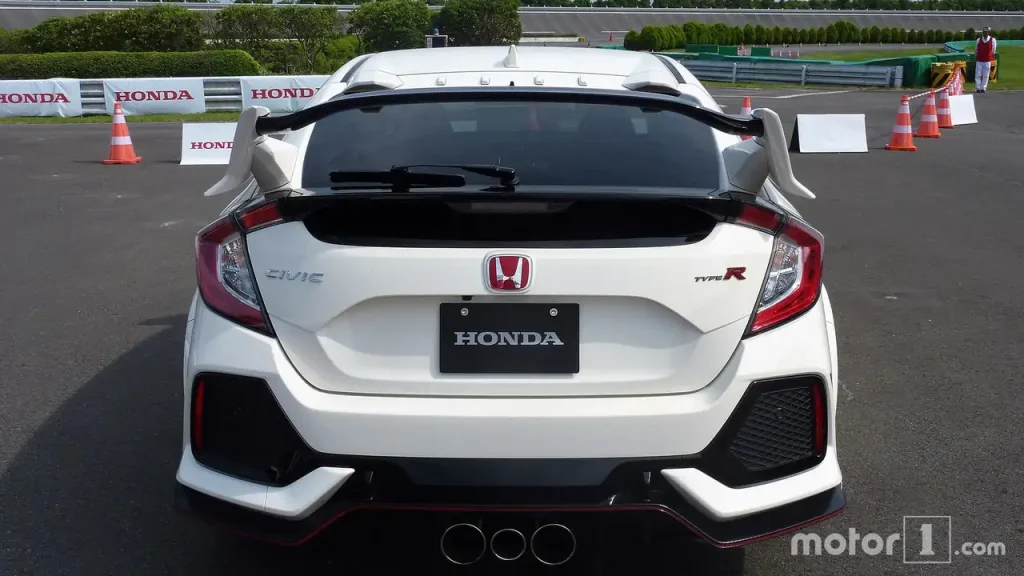
7:50.63 – Honda Civic Type R (outgoing model)
The old Type R, which was introduced in 2015, was already a scorcher at the Green Hell. But unsurprisingly, the new car is quicker – by a full seven seconds, impressive progress for the hot hatch.
7:55 – BMW M5
The BMW M5 may be a four-door luxury sedan, but it’s anything but slow. Although BMW never officially verified the lap, the twin-turbocharged super sedan is widely reported to have recorded a 7:55 Nürburgring time in 2012. Under the hood was a 4.4-liter twin-turbo V8 producing 560 horsepower (417 kW)—a massive advantage over the Civic Type R’s 306 hp (228 kW) turbocharged four-cylinder. Even so, Honda’s lightweight construction, razor-sharp chassis, and exceptional cornering ability allow it to match the pace of a car with nearly twice the power, underscoring just how capable the Type R is on a demanding circuit like the Nürburgring.
7:56 – Chevrolet Corvette Z06 (C5)
The C5-generation Chevrolet Corvette Z06 was a benchmark American sports car in the early 2000s, pairing a lightweight chassis with a naturally aspirated 5.7-liter LS6 V8 that produced 405 horsepower (302 kW). Its 7:56 Nürburgring lap made it one of the quickest production cars of its era. More than two decades later, the Honda Civic Type R manages to edge past it despite giving up nearly 100 horsepower. It’s a testament to how far chassis tuning, aerodynamics, tire technology, and suspension engineering have evolved, allowing Honda’s front-wheel-drive hot hatch to outperform a legendary V8-powered sports car.
7:58 – BMW M2
The original BMW M2 is widely regarded as one of the best modern driver’s cars, pairing a turbocharged inline-six with rear-wheel drive and near-perfect balance. Its reported 7:58 Nürburgring lap is impressive in its own right, but the Civic Type R still comes out ahead by more than 13 seconds. Despite giving up over 60 horsepower, Honda’s hot hatch makes the most of its lightweight chassis, sophisticated suspension, and exceptional front-end grip, proving that precise engineering can outweigh raw performance on one of the world’s toughest racetracks.
7:59 – Alfa Romeo Stelvio Quadrifoglio
The Alfa Romeo Stelvio Quadrifoglio redefined expectations for high-performance SUVs when it stormed the Nürburgring with a 7:59 lap. Powered by a 2.9-liter twin-turbocharged V6 producing 505 horsepower (377 kW) and equipped with all-wheel drive, the Italian SUV combines blistering acceleration with remarkable agility for its size. Even so, the Honda Civic Type R manages to edge it out around the Green Hell, showing that a lighter curb weight, finely tuned chassis, and exceptional cornering precision can overcome a significant power deficit.
7:59.74 – Porsche Cayenne Turbo S
The Porsche Cayenne Turbo S proves that SUVs can be astonishingly quick, posting an impressive 7:59.74 lap around the Nürburgring despite its size and weight. Packing a twin-turbocharged V8 with well over 500 horsepower and Porsche’s advanced all-wheel-drive system, the luxury SUV has no shortage of straight-line speed. Even so, the Honda Civic Type R completes the circuit several seconds quicker, highlighting how a lighter chassis, sharper handling, and track-focused engineering can outperform brute force on the demanding Nordschleife.
8:04 – Alfa Romeo 4C
The Alfa Romeo 4C was designed with one goal in mind: delivering a pure sports car experience. Its lightweight carbon-fiber monocoque, mid-engine layout, and razor-sharp handling made it a favorite among driving enthusiasts. Despite those credentials, the 4C’s 8:04 Nürburgring lap falls behind the Honda Civic Type R. Thanks to its advanced suspension, exceptional front-end grip, and confidence-inspiring stability, Honda’s front-wheel-drive hot hatch proves that cutting-edge engineering can rival—and even surpass—more exotic sports car designs.
8:06 – Ford Focus RS
The Ford Focus RS arrived with all-wheel drive, a turbocharged 2.3-liter EcoBoost engine producing 350 horsepower, and a drift mode that quickly made it an enthusiast favorite. It was one of the hottest hot hatches of its era, but its 8:06 Nürburgring lap still trails the Honda Civic Type R. Despite sending power to only the front wheels and giving up horsepower, the Type R’s lighter weight, sharper chassis, and remarkable cornering ability allow it to complete the Green Hell several seconds faster.
8:14 – Land Rover Range Rover Sport SVR
The Range Rover Sport SVR redefined expectations for high-performance SUVs when it stormed around the Nürburgring in 8:14, becoming one of the fastest luxury SUVs of its era. Powered by a supercharged 5.0-liter V8 producing 550 horsepower, it combines immense straight-line speed with sophisticated all-wheel drive and adaptive suspension. Even so, the Honda Civic Type R comfortably beats its lap time. Despite having nearly half the horsepower, the lightweight, front-wheel-drive Honda showcases the advantages of lower mass, superior agility, and track-focused engineering on one of the world’s most demanding circuits.
Why Is the Civic Type R So Fast?
The Civic Type R’s Nürburgring performance isn’t simply the result of horsepower. Several engineering factors work together:
- Sophisticated front suspension minimizes torque steer while maximizing grip.
- Adaptive dampers adjust continuously to maintain composure over bumps.
- Aggressive aerodynamics, including a functional rear wing and front splitter, generate meaningful downforce.
- Limited-slip differential helps deploy power efficiently exiting corners.
- Lightweight construction improves braking, agility, and tire longevity over a full lap.
Together, these features allow the Civic to maintain extraordinary corner speed, often compensating for rivals that produce significantly more horsepower.
Conclusion
The Honda Civic Type R’s Nürburgring performance is a perfect example of why lap times are about much more than horsepower. While many of the cars it outpaces feature bigger engines, rear-wheel drive, all-wheel drive, or exotic badges, the Civic relies on intelligent engineering, a lightweight chassis, exceptional suspension tuning, and incredible cornering ability to achieve its impressive pace.
The fact that a front-wheel-drive hatchback can challenge and defeat cars costing far more—and with significantly more power—shows just how far modern performance cars have evolved. The Civic Type R may not have the biggest engine or the most intimidating specifications, but around the Nordschleife, it proves that balance, precision, and driver confidence can be the ultimate performance advantages.
In the end, the Type R’s Nürburgring lap is more than just a number. It’s a statement that a well-engineered compact car can stand among some of the world’s most respected performance machines and come out ahead.