
Jeep keeps launch control disabled until the Trackhawk has been properly broken in, ensuring the engine and drivetrain are ready to handle full-throttle launches.
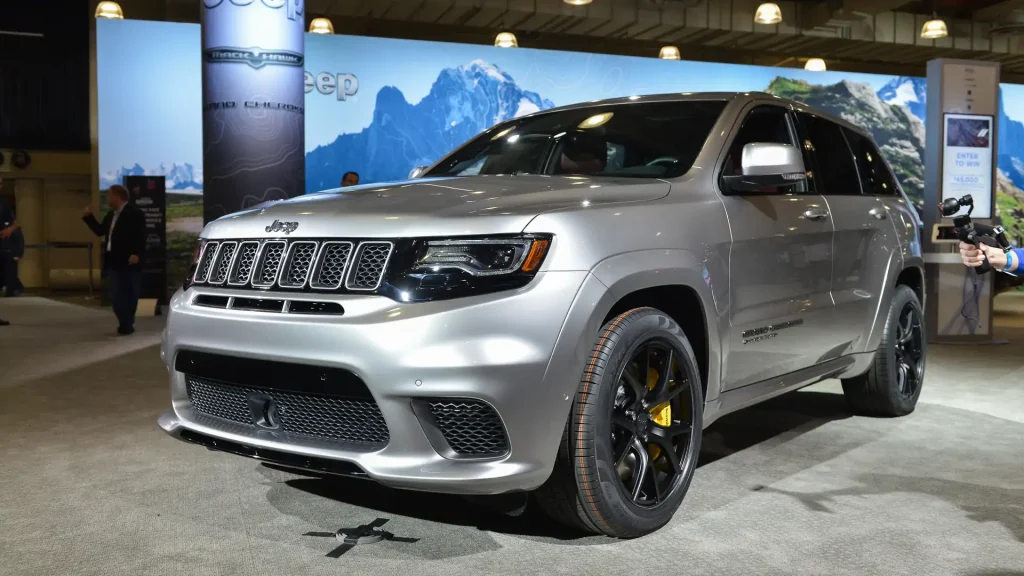
By now, you’re probably familiar with the basics of the Jeep Grand Cherokee Trackhawk. At its heart sits the supercharged Hellcat V8, squeezed into the Grand Cherokee’s engine bay to create one of the most outrageous performance SUVs ever built. But transforming a family SUV into a 700-plus-horsepower monster takes far more than simply swapping in a bigger engine.
To find out what really went into the Trackhawk’s development, I spoke with Darryl Smith, Director of SRT Engineering, and Paul Mackiewicz, the Trackhawk’s Vehicle Integration Manager. They explained the extensive engineering behind the SUV and revealed the many changes that make it capable of handling its extraordinary power.
Table of Contents
Launch Control Stays Locked Until The Engine Is Properly Broken In
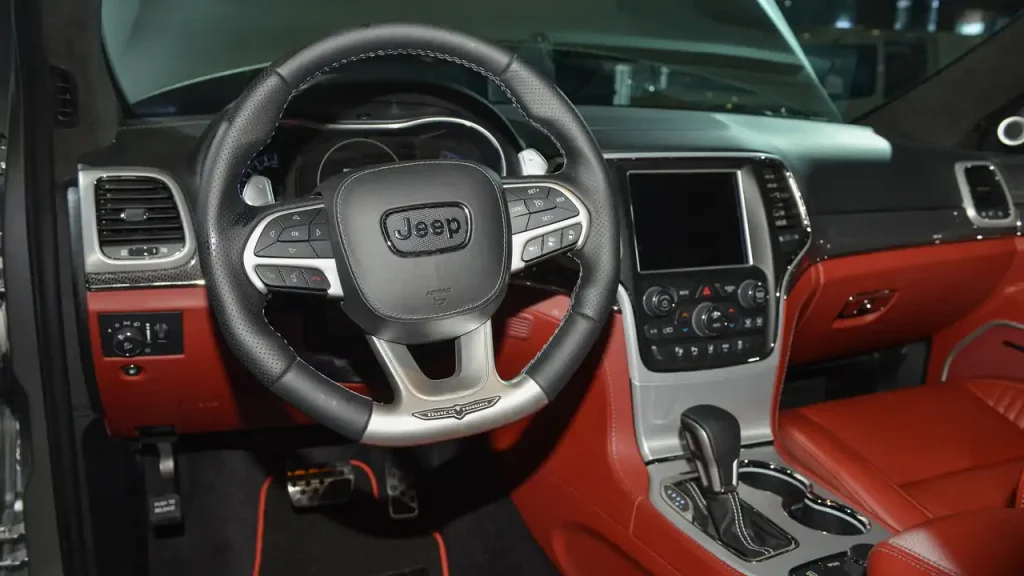
A prominent “LAUNCH” button sits on the center console, practically begging to be pressed. But no matter how tempting it is, the system won’t activate until the odometer reads at least 500 miles. It’s a sensible safeguard, as every new vehicle benefits from a proper break-in period before being subjected to maximum performance.
Interestingly, the supercharged Hellcat V8 isn’t exactly fresh out of the crate when it reaches the customer. Before installation, every engine undergoes a rigorous 42-minute dynamometer test to verify its performance, durability, and quality. Even so, Jeep still requires owners to complete the recommended break-in mileage before unlocking the Trackhawk’s launch control feature.
Launch Control Can Be Set As High As 3,500 RPM—But That’s Not Always The Best Choice
According to Mackiewicz, the sweet spot for most launches is around 2,200 rpm, even though the Trackhawk’s Launch Control system allows drivers to select an engine speed anywhere between 1,500 and 3,500 rpm through the infotainment touchscreen. Once your preferred launch speed is set, simply press the brake and accelerator pedals simultaneously, release the brake, and let the Trackhawk do the rest.
Like the Dodge Challenger SRT Hellcat, Charger SRT Hellcat, and Demon, the Trackhawk uses Torque Reserve technology. As you build revs on the starting line, the system preloads the supercharger and intake tract with pressurized air, ensuring maximum boost is available the instant you release the brake. The result is harder, more consistent launches and the quickest possible acceleration off the line.
The Top Speed Isn’t Electronically Limited
Unlike many modern high-performance vehicles, neither the 475-horsepower Grand Cherokee SRT nor the 707-horsepower Trackhawk is fitted with an electronic top-speed limiter. Instead, both SUVs reach their maximum velocity when aerodynamic drag overcomes their available power. That gives the Grand Cherokee SRT a top speed of 160 mph, while the far more powerful Trackhawk can storm all the way to 180 mph.
For comparison, the sleeker Dodge Charger SRT Hellcat is capable of 204 mph, while the Dodge Challenger SRT Hellcat tops out at 199 mph. Their lower, more aerodynamic profiles allow them to slice through the air more efficiently than the taller, boxier Trackhawk, despite sharing the same supercharged Hellcat V8.
The Exhaust Costs 5 Pound-Feet Of Torque, But Helps The Trackhawk Reach 199 MPH
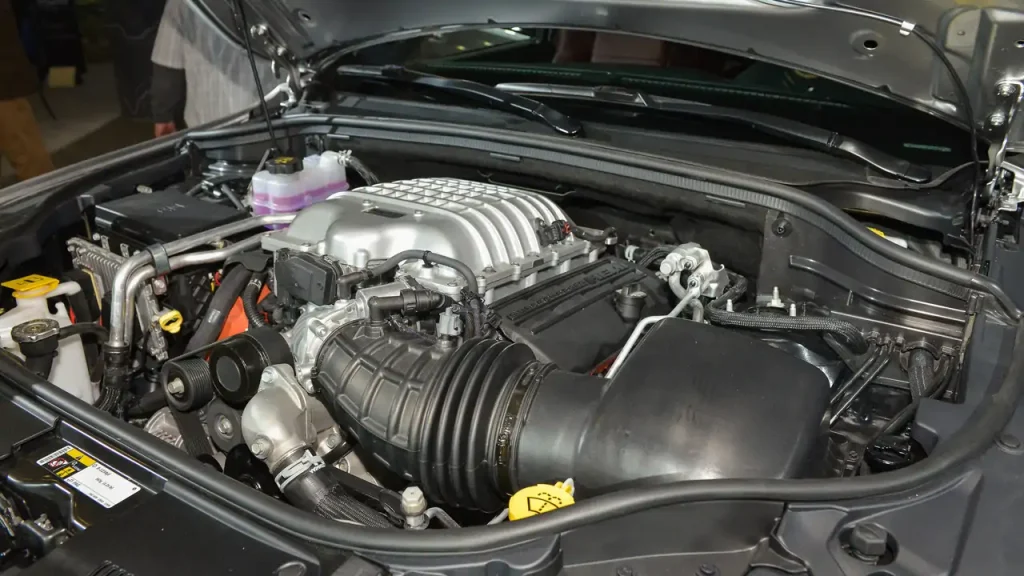
Under the hood, the Trackhawk’s supercharged 6.2-liter Hemi V8 produces the same 707 horsepower as the Dodge Challenger and Charger SRT Hellcat models. Torque, however, drops slightly to 645 pound-feet, down from 650 pound-feet in its Dodge siblings. The difference comes down to the Grand Cherokee’s more restrictive exhaust routing, which was necessary to fit the SUV’s platform.
In the real world, that minor sacrifice is hardly noticeable. Despite weighing 5,363 pounds, the Trackhawk can rocket from 0 to 60 mph in just 3.5 seconds, proving that five missing pound-feet of torque do little to blunt its astonishing performance.
The Biggest Front Brake Rotors Ever Fitted To A Jeep
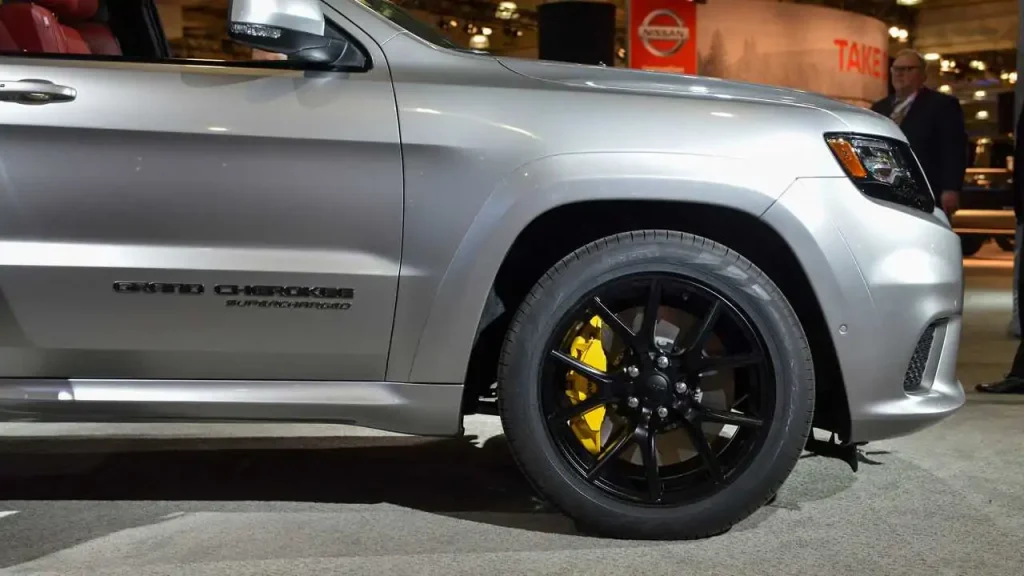
While they aren’t the largest brake rotors found anywhere in the Fiat Chrysler Automobiles lineup—heavy-duty trucks still claim that honor—they are the biggest ever fitted to a Jeep. Measuring 15.75 inches in diameter, the Trackhawk’s front rotors are significantly larger than the 15.0-inch units used on the Grand Cherokee SRT.
According to Mackiewicz, the larger brakes were necessary to handle the tremendous thermal stress generated when bringing the Trackhawk down from its 180-mph top speed. Simply put, repeatedly slowing a 700-plus-horsepower SUV from such extreme speeds creates an enormous amount of heat, and the oversized rotors provide the cooling capacity needed to maintain consistent stopping performance.
An Extra Oil Cooler Keeps Temperatures In Check
Mounted behind the driver’s-side opening in the front fascia, the Trackhawk’s oil-to-air cooler provides additional cooling for the supercharged 6.2-liter Hellcat V8. According to Smith, the engine simply generates more heat than the Grand Cherokee’s other powertrains, making the extra cooling capacity essential for maintaining consistent performance.
Cooling duties don’t stop there. The vented hood helps dissipate underhood heat, while the opening in the front fascia—introduced with the 2017 Grand Cherokee—was designed with the Trackhawk in mind, giving engineers the airflow they would eventually need for the high-performance SUV.
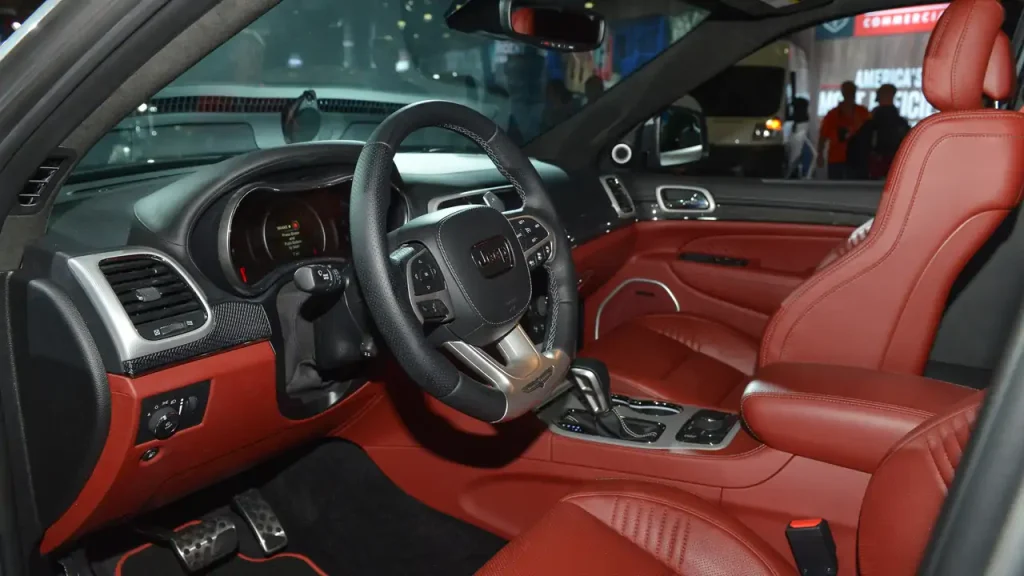
Active Noise Cancellation Comes Standard On Every Trackhawk
The system is designed to minimize unwanted exhaust noise, with its behavior changing to match the selected drive mode. In Tow mode, it suppresses droning and engine lugging for a more relaxed driving experience. Switch to Sport or Track, however, and the exhaust valves open up, delivering the aggressive soundtrack expected from a supercharged Hellcat-powered SUV.
The Entire Driveline Was Reinforced To Handle Hellcat Power
For starters, the Trackhawk uses ZF’s 8HP95 automatic transmission, which is an all-wheel-drive version of the 8HP90 used by the Dodge Hellcats. Its halfshafts are bigger and tougher, and the Magna all-wheel-drive system has also been upgraded.
Track Mode Unleashes The Trackhawk’s Full Potential
Track mode is where the Trackhawk delivers its most uncompromising performance. It’s the only drive mode that allows the electronic stability control to be fully disabled, giving experienced drivers complete control over the SUV’s behavior. It also sharpens every major performance system, selecting the most aggressive calibrations for the Bilstein adaptive dampers, engine, transmission, and power steering.
To maximize performance, the all-wheel-drive system also adopts a 30:70 front-to-rear torque split, sending more power to the rear wheels for improved balance, sharper handling, and a more engaging driving experience.
The Trackhawk Needed No Additional Aerodynamic Aids
Despite boasting a top speed roughly 20 mph higher than the Grand Cherokee SRT, the Trackhawk required no additional aerodynamic hardware. Its bumpers, spoiler, and other exterior aero components were carried over unchanged because the existing design already delivered the right balance of lift and downforce.
According to Smith and Mackiewicz, the Grand Cherokee SRT’s aerodynamic package was already stable enough for sustained high-speed driving, allowing the Trackhawk to reach its significantly higher top speed without the need for extra wings, splitters, or other aerodynamic enhancements.
Conclusion
The Jeep Grand Cherokee Trackhawk’s headline figures—707 horsepower, blistering acceleration, and a near-200-mph top speed—tell only part of the story. Its true achievement lies in the extensive engineering hidden beneath the surface. Nearly every major system, from the transmission and all-wheel-drive hardware to the brakes, cooling, suspension, and electronic controls, was upgraded to ensure the SUV could reliably harness the immense output of its supercharged Hellcat V8.
These 10 facts highlight why the Trackhawk remains one of the most remarkable performance SUVs ever built. Rather than relying solely on brute force, Jeep created a machine that balances breathtaking speed with stability, durability, and everyday practicality. Even years after its debut, the Grand Cherokee Trackhawk stands as a benchmark for high-performance SUVs and a testament to what thoughtful engineering can achieve.