
Can the new Defender take the off-road crown?
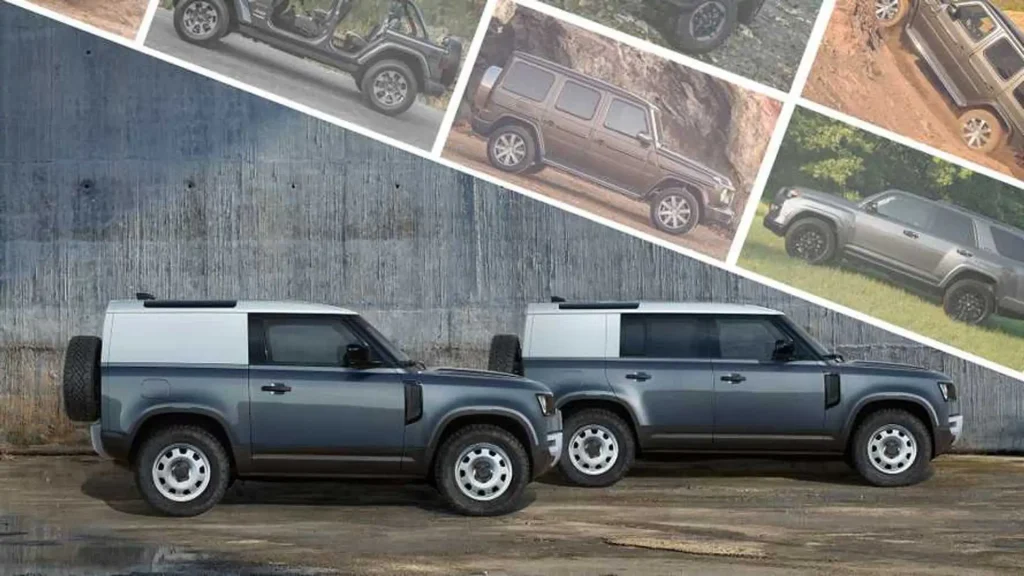
The return of the Land Rover Defender brings a familiar name back into the spotlight, but the modern version enters a very different market from the one its predecessors once dominated. The new Defender combines traditional off-road hardware with modern engines, advanced electronics, and a more sophisticated cabin, putting it in an interesting position against some of the best-known 4x4s on sale.
Finding a perfect rival isn’t easy. The Jeep Wrangler emphasizes trail capability and removable body panels, the Toyota 4Runner takes a more traditional SUV approach, and the Mercedes-Benz G550 adds serious luxury to its off-road credentials. They also occupy very different price brackets, making this less of a direct comparison and more of a look at how each vehicle approaches the same basic mission.
For the 2020 Defender, Land Rover offered the 90 and 110 body styles, with several powertrain choices depending on the market. The lineup included a turbocharged 2.0-liter four-cylinder diesel, a turbocharged 2.0-liter gasoline four-cylinder, and a 3.0-liter inline-six with mild-hybrid assistance. An eight-speed automatic handled shifting duties.
The Wrangler remained the most accessible option of the group. Its 2020 lineup included a 2.0-liter turbocharged four-cylinder and a 3.6-liter V6, with buyers able to choose between two- and four-door configurations. The Toyota 4Runner used a naturally aspirated 4.0-liter V6, while the G550 relied on a twin-turbocharged 4.0-liter V8. Unsurprisingly, the Mercedes delivered the most horsepower, but it also carried a six-figure price tag.
| Model | Starting Price | Engine | Horsepower | Torque |
| 2020 Land Rover Defender 110 | $50,925 | 2.0L I4 / 3.0L I6 mild hybrid | Up to 394 hp | Up to 406 lb-ft |
| 2020 Jeep Wrangler | $28,295 | 2.0L I4 / 3.6L V6 | 270–285 hp | 260–295 lb-ft |
| 2020 Toyota 4Runner | $36,020 | 4.0L V6 | 270 hp | 278 lb-ft |
| 2019 Mercedes-Benz G550 | $124,500 | 4.0L twin-turbo V8 | 416 hp | 450 lb-ft |
Numbers alone don’t tell the whole story. These SUVs differ considerably in size, configuration, and equipment, so comparing them requires looking beyond engine output and asking what each one is designed to do.
The Wrangler has an obvious advantage when the pavement ends. Its short-wheelbase two-door configuration and excellent approach angle make it particularly well suited to steep obstacles. The 4Runner is less extreme, but its body-on-frame construction and available four-wheel-drive hardware give it legitimate trail credentials.
The Defender takes a different approach. Its design may be considerably more modern, but Land Rover hasn’t abandoned the hardware that made the name famous. The SUV offers impressive ground clearance, strong departure angles, and sophisticated systems designed to make difficult terrain easier to tackle.
The G550 is arguably the odd one out. It remains a highly capable off-roader, but its price and luxury positioning mean owners are less likely to treat it like a dedicated trail machine. Still, underneath the leather and high-end technology is a serious four-wheel-drive system and a rugged chassis.
Table of Contents
Size And Off-Road Dimensions
| Model | Length | Width | Height | Wheelbase |
| Defender 90 / 110 | 170.2 / 187.3 in. | 82.8 in. | 77.5 / 77.4 in. | 101.8 / 118.9 in. |
| Jeep Wrangler | 166.8 / 188.4 in. | 73.8 in. | 73.6 in. | 96.8 / 118.4 in. |
| Toyota 4Runner | 190.2 in. | 75.8 in. | 71.5 in. | 109.8 in. |
| Mercedes G550 | 189.7 in. | 85.7 in. | 77.2 in. | 113.8 in. |
The dimensions highlight just how different these SUVs are. The Defender is notably wide, while the Wrangler remains comparatively narrow—an advantage when navigating tight trails. The G-Class is wider still, which can make some off-road situations more challenging despite its impressive hardware.
Off-road geometry is where things get especially interesting. The Wrangler’s 41.4-degree approach angle gives it a substantial advantage when climbing over rocks or steep embankments. The Defender counters with a departure angle of roughly 38 degrees, allowing it to clear obstacles behind the vehicle with confidence.
The Defender also offers up to 11.6 inches of ground clearance when equipped with its air suspension and appropriate off-road settings. That’s a significant increase over its standard clearance and gives the Land Rover plenty of room underneath when conditions get rough.
| Model | Approach Angle | Departure Angle | Ground Clearance | Towing Capacity |
| Defender 90 / 110 | 30.1° | 37.6° / 37.7° | 8.5 / 8.6 in. | 7,716 lbs. |
| Jeep Wrangler | 41.4° | 35.9° / 36.1° | 9.7 in. | 3,500 lbs. |
| Toyota 4Runner | 30° | 26° | 9.0 in. | 5,000 lbs. |
| Mercedes G550 | 30.9° | 29.9° | 9.5 in. | 7,700 lbs. |
The numbers reveal a clear split in priorities. The Wrangler is built around maximizing trail performance, while the Defender brings a broader range of abilities, including significantly greater towing capacity. The 4Runner remains a practical middle ground, and the G550 combines impressive capability with a level of luxury none of the others can quite match.