
Calm and composed—until you unleash the performance.
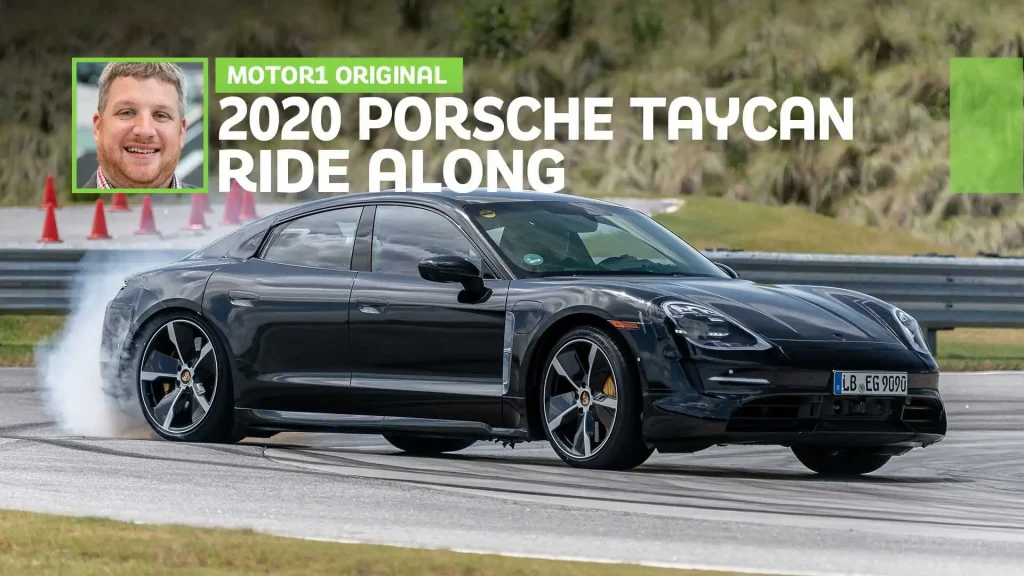
There had never been an electric vehicle quite like the 2020 Porsche Taycan. That conclusion wasn’t based solely on Porsche’s specifications or promises for its first production EV, but also on experiencing the car firsthand from the passenger seat while a professional German driver pushed it hard around Porsche’s own test track. The Tesla Model S might offer greater range, a lower starting price, or potentially even a slightly quicker sprint to 60 mph, but the Taycan’s combination of acceleration, handling, braking, and chassis control put it in a completely different performance category.
I experienced the Taycan during an embargoed background event at Porsche Cars North America’s headquarters in Atlanta, Georgia. From the passenger seat, I rode in a camouflaged Taycan around the Porsche Experience Center’s handling circuit, skid pad, and wet handling course. Even though the prototype was still wearing disguise inside and out, the short drive was enough to make Porsche’s first electric car one of the most anticipated vehicles on my list.
Get Low
The Taycan is slightly shorter and lower than the Panamera, measuring approximately 195 inches long and 54 inches tall compared with the Panamera’s 198.8-inch length and 56-inch height. Getting into the front seats is easy enough, but the low roofline makes the rear seats less accommodating. In the Taycan Turbo S I experienced, the rear bench was comfortable, although my hair was already brushing the headliner. Taller passengers may find the back seat restrictive, making the car’s low-slung design more beneficial to its appearance and handling than rear-seat practicality.
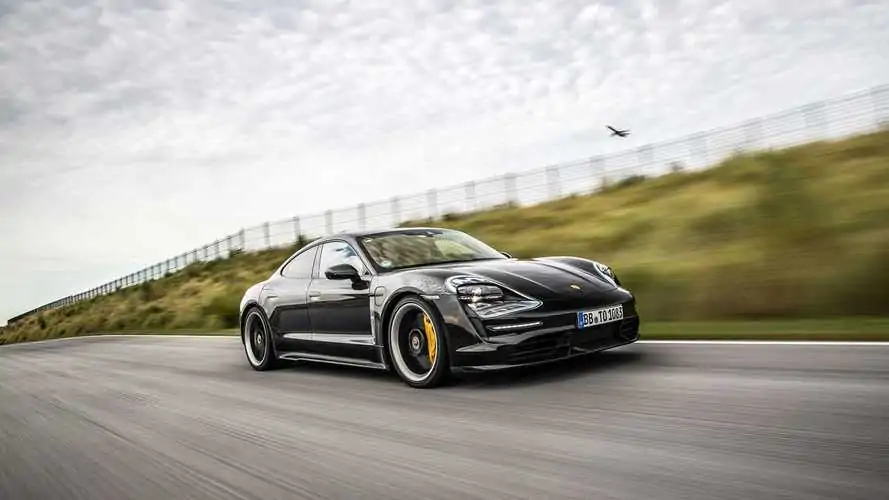
Up front, however, the Taycan feels excellent. Visibility is good, and Porsche clearly took inspiration from the 911 when developing the driving position. You sit remarkably low, even lower than in the Panamera, which immediately gives the car a sportier character. The seats were supportive and comfortable, despite the camouflage materials covering parts of the interior.
The cabin was still partially disguised, so there wasn’t much to say about the final controls or infotainment system. Porsche’s seating philosophy, however, remained familiar, with different configurations designed around comfort and sport. The Taycan was clearly intended to feel like a Porsche from the moment the driver settles behind the wheel.
A Gut Punch Of Acceleration
As we approached the track entrance at the Porsche Experience Center, my German driver stopped and looked over to ask, completely seriously, if I was ready. I gave him a quick yes, and moments later the Taycan Turbo S launched forward with enough force to pin me against the seat. The acceleration is almost difficult to process. It’s not just that the Taycan is incredibly quick; it’s how relentlessly it keeps pulling. There’s none of the ebb and flow you get from a gasoline engine. The power delivery is immediate, smooth, and brutally consistent, enough to completely reset your expectations for straight-line acceleration.
That instant response isn’t simply the result of the electric motors, either. The Taycan’s tires provide enormous traction, with 305/30 R21 rubber at the rear and 265/35 R21 tires up front. Their specialized compound manages to combine low rolling resistance with the grip needed for serious handling and braking. Porsche says the tires can add roughly 12 to 19 miles of range compared with conventional performance tires. Combine that grip with the traction advantage of two electric motors and all-wheel drive, and the Taycan can put its power down with almost no drama.
After a few corners at an easy pace, we reached another straight and the driver repeated the exercise. From the outside, the launches would probably look almost boringly smooth. From inside the car, however, the sensation is completely different. The scenery disappears in a blur while the G forces press you firmly into the seat.
The acceleration runs also demonstrated just how seamlessly the Taycan’s transmission works. The rear motor uses a two-speed gearbox, while the front motor gets a single-speed unit. In Sport and Sport Plus modes, the rear transmission starts in its shorter first gear before shifting at roughly 60 mph. Yet the huge, uninterrupted flow of torque masks the shift almost completely. There’s no obvious interruption in acceleration, even when the pedal is buried. Likewise, hard braking doesn’t produce a noticeable downshift sensation as we approached the skid pad.
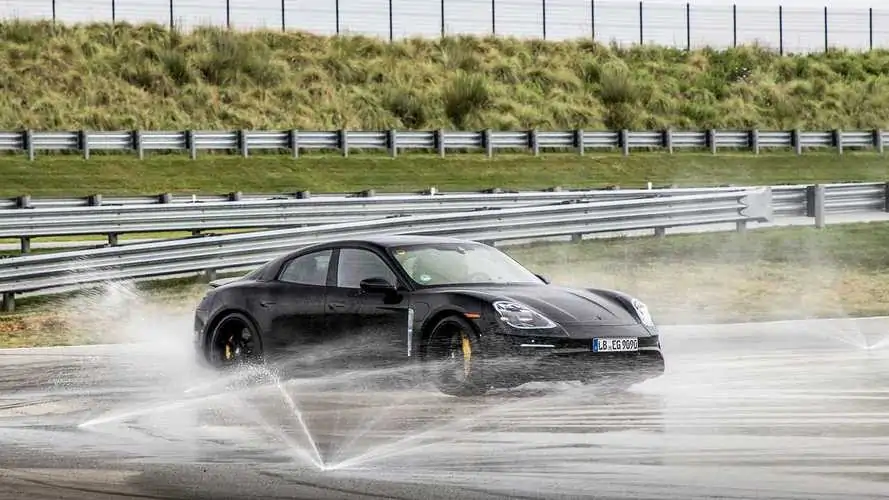
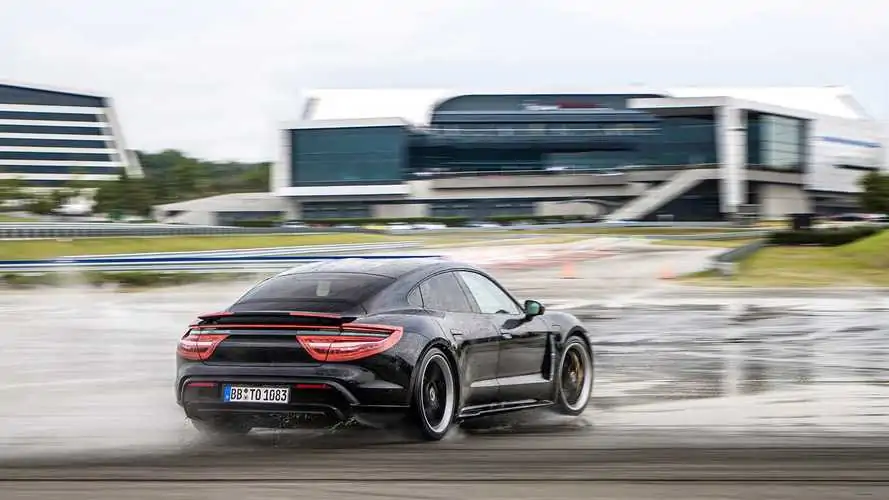
Strictly speaking, there isn’t much practical justification for drifting or doing donuts in an electric sedan. That didn’t stop the Taycan from doing both. With very little encouragement, the rear end can step out and the low-rolling-resistance tires can be turned into a cloud of smoke. I know because my driver demonstrated it several times.
Road-Legal Rollercoaster
After sending us through the spin cycle, my driver launched the Taycan down another straight. This time, however, he didn’t slow to a complete stop before diving left into a tight downhill corner that immediately transitioned back to the right. Despite the pace and aggression with which he attacked the section, the Taycan’s roughly 5,100-pound curb weight barely made itself known. The suspension handled the rapid changes in direction with remarkable composure, helped by optional active anti-roll bars as part of Porsche Dynamic Chassis Control and the four-wheel-steering system.
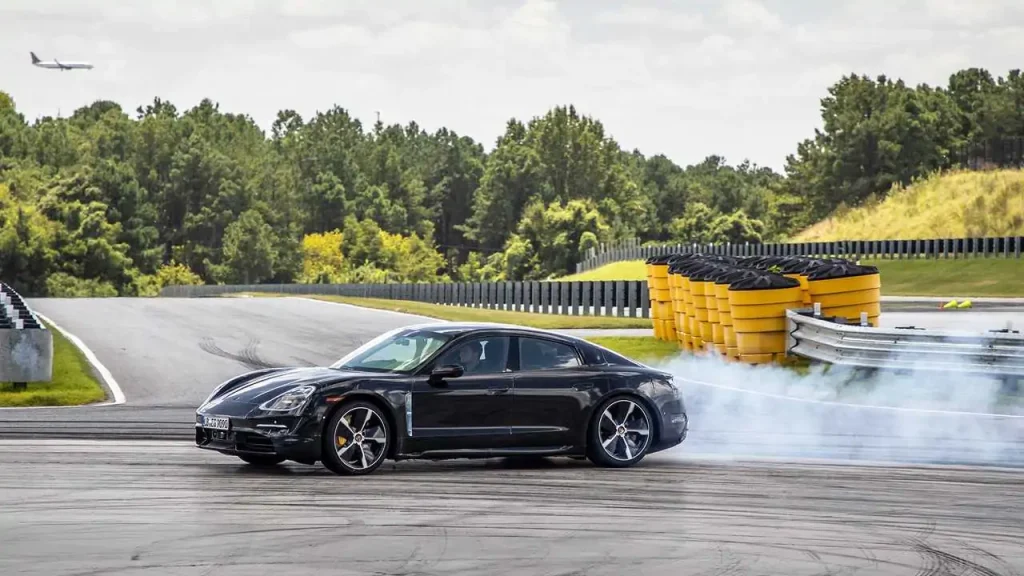
My driver attacked several more corners with the kind of confidence I’d normally associate with a 911 GT3, yet the Taycan Turbo S remained remarkably calm. What stood out just as much was how little correction he seemed to need behind the wheel. He was obviously skilled, but there was also an unmistakable sense that he completely trusted the car. During our laps, he even commented on how small the Porsche Experience Center track was, adding in his thick German accent, “I thought everything was big in America.”
From the passenger seat, his confidence made perfect sense. The Taycan’s body movements were remarkably controlled and predictable, even under hard cornering. Our Turbo S was fitted with the available chassis and handling upgrades, but the result was still impressive. After only a few laps, the car felt so approachable that I could imagine climbing behind the wheel and attacking the same track with considerably more confidence than expected.
The wet handling course provided another demonstration of the Taycan’s electronics. Even if I made a mistake, the car’s stability systems were more than capable of managing the enormous torque available from its electric motors. The wet slalom was surprisingly easy to negotiate, and even when my driver aggressively stabbed the accelerator, the electronic safety systems kept the Taycan composed and pointed in the right direction. In the rain, the car inspires much the same confidence as the latest 911, particularly with Porsche’s dedicated Wet driving mode.
Does It Feel Like A Porsche, Though?
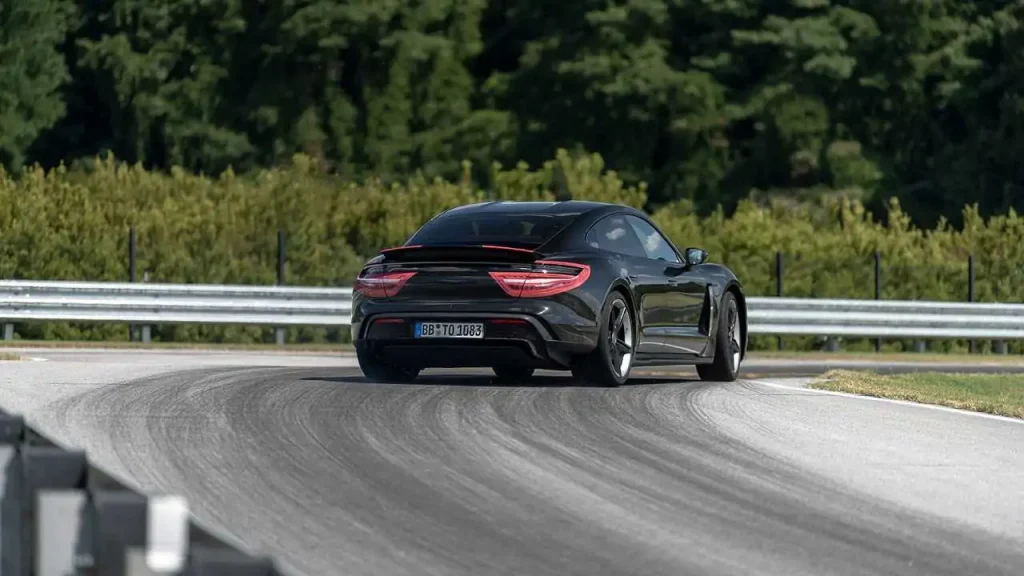
Absolutely. After such a short passenger ride, I found myself wondering why anyone would choose another Porsche. That’s obviously a premature conclusion based on only a few minutes in the passenger seat, but the Taycan Turbo S still left a powerful impression. Its performance is impressive, but what really stood out was how naturally Porsche’s familiar driving character translates to an electric platform.
The biggest question now is how much of that experience Porsche can bring to the less expensive Taycan models. If the company’s first EV can deliver this level of performance, control, and confidence across more of the lineup, Porsche could have something genuinely special on its hands.