
A closer look at David Kimble’s legendary technical illustration of the Ferrari that holds the record for the highest auction sale price.
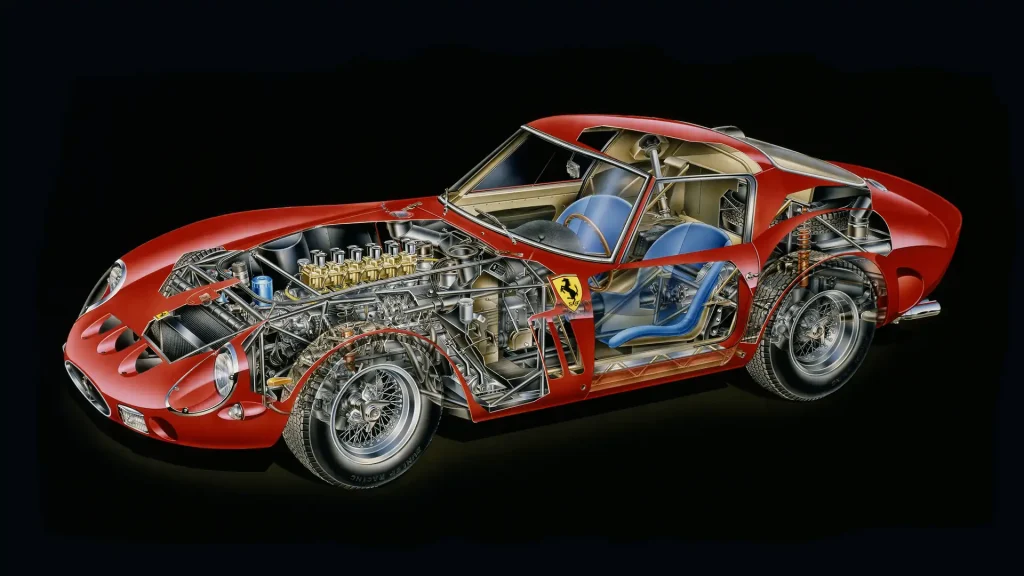
The Ferrari 250 GTO is one of the most revered and valuable cars ever built, making it an ideal subject for David Kimble’s intricate cutaway artwork. With just 39 examples produced, documenting one in detail was never going to be a straightforward assignment. Some examples have changed hands for nearly $40 million, with owners including automotive enthusiasts and celebrities such as Ralph Lauren.
This 1962 Ferrari 250 GTO illustration is the result of Kimble gathering information from multiple sources to accurately portray the legendary racer. In his book, David Kimble’s Cutaways: The Techniques and Stories Behind the Art, Kimble describes the challenges involved in bringing the project together and the painstaking work required to produce the finished drawing.
The idea actually began with an ambitious plan to combine technical illustrations of two significant Ferrari homologation cars: the 250 GTO and the much rarer 288 GTO. Ferrari supported Kimble’s effort to document the 288 GTO in Modena, but obtaining the information needed for the 250 GTO proved considerably more complicated. With so few cars in existence and limited access to original examples, recreating its mechanical details became a substantial research project.
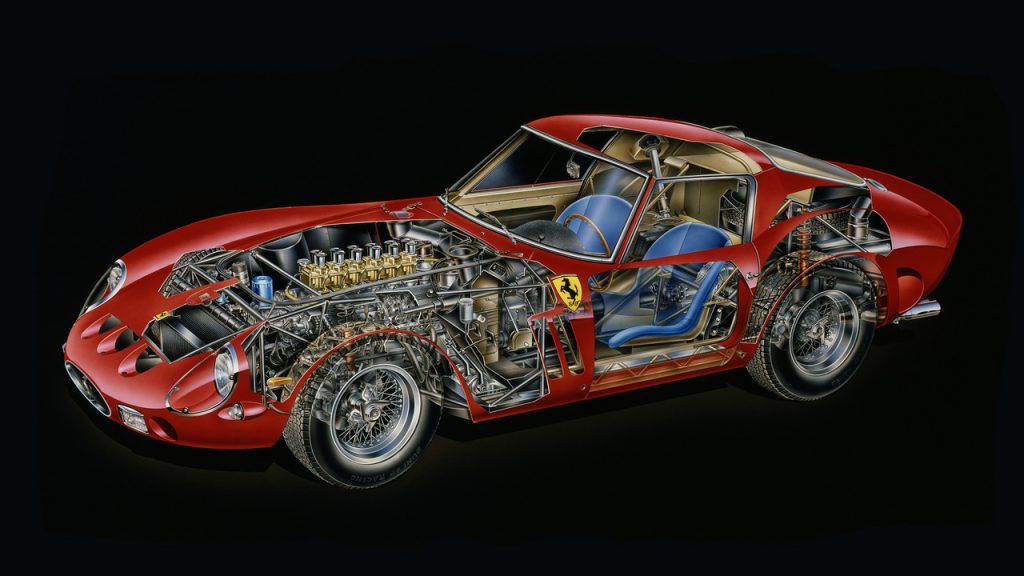
The story behind this 1962 Ferrari 250 GTO cutaway begins with an ambitious idea from technical illustrator David Kimble: combine two of Ferrari’s legendary homologation specials, the 250 GTO and the then-rarer 288 GTO, into a single artistic project.
Ferrari was willing to cooperate with the 288 GTO portion in Modena, but documenting the 250 GTO proved considerably more complicated. By 1987, the 250 GTO was already commanding more than $1 million among collectors, and with only 39 examples built, finding one that could be thoroughly examined was anything but straightforward.
Kimble eventually realized that Monterey Car Week could provide an answer. With numerous 250 GTOs gathering in one place, it offered an opportunity to study the cars in detail. Even then, getting the information required for an accurate three-dimensional cutaway wasn’t easy. There was no factory-owned example available, and owners understandably weren’t interested in dismantling their extraordinarily valuable cars.
One crucial breakthrough came when Kimble located a standalone Ferrari V12 engine. Having access to the engine separately was invaluable because it allowed him to study its construction from multiple angles without asking an owner to remove the powerplant—or even its valve covers—from an actual 250 GTO.
The finished illustration represents information gathered from several different sources, which was necessary given the rarity of the car. Kimble later documented the challenges involved in David Kimble’s Cutaways: The Techniques and the Stories Behind the Art, explaining how much detective work went into recreating one of Ferrari’s most famous machines.
A promising lead surfaced at a small Ferrari restoration shop in downtown Los Angeles, where Kimble discovered a V12 sitting on an engine hoist. It wasn’t from a 250 GTO, but rather a Ferrari 275 LM, which used a mid-mounted version of the same Tipo V12. Fortunately, the two engines were remarkably similar, meaning the few differences could later be established by examining the engine bay of the 250 GTO.
The bigger challenge was finding an actual GTO to study. Kimble knew Monterey Car Week was one of the best places to start, since at least one of the ultra-rare Ferraris typically appeared at the annual gathering. In 1987, he made the trip to Monterey in a brand-new C4 Corvette, with Chevrolet serving as the featured marque that year. His attention, however, was firmly fixed on Ferrari.
Once he reached the Monterey Historics, Kimble headed straight for the racing action. Among the remarkable collection of historic machinery attacking Laguna Seca’s famous Corkscrew, one car immediately stood out: a 1962 Ferrari 250 GTO finished in Rosso Cina.
When the day’s racing concluded and the vintage cars returned to the pits, Kimble had his opportunity. He approached the GTO’s owner and explained the project. The owner was enthusiastic about helping and agreed to make the Ferrari available once the weekend crowds had cleared.
When the high-speed sessions wrapped up and a procession of vintage race cars rolled back into the pits, Kimble saw his chance to approach a particular driver. The two struck up a conversation, and the car’s owner was enthusiastic about lending his vehicle to the project. With racing keeping everyone busy throughout the weekend, he invited Kimble to return for a full-day session once the crowds had cleared out. The follow-up visit went smoothly, with photography, measurements, and other data collection completed without a hitch. Kimble now had everything he needed to capture the Ferrari 250 GT’s exterior and most of its mechanical details in an illustration, with the engine being the one major exception.
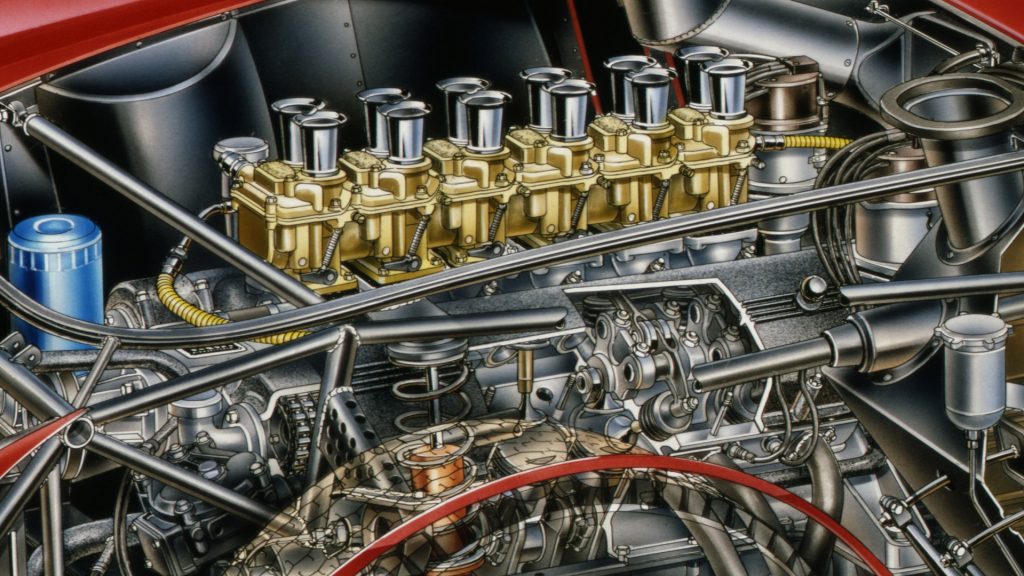
Ferrari’s High-Revving Heart
Performance engines of the era generally followed one of two formulas: enormous displacement or a smaller engine compensated for by adding more cylinders and revs. Ferrari chose the latter approach, creating compact V12s that delivered their power high in the rev range.
The 250 GTO used a 3.0-liter Tipo V12 derived from the architecture found in the 250 Testa Rossa. Mounted at the front, the all-aluminum engine shared its basic design with the mid-engine Ferrari V12 that Kimble had studied at the Los Angeles restoration shop. Its lightweight construction was well suited to racing, while the dry-sump lubrication system helped maintain reliability under demanding conditions.
Breathing through six Weber carburetors, each serving a pair of cylinders, the V12 featured twelve individual intake stacks and produced roughly 300 horsepower. Peak power arrived around 8,500 rpm, giving the 250 GTO the high-revving character for which Ferrari engines became famous.
The engine’s combination of performance, durability, and compact construction made it an ideal competition powerplant. The 250 GTO put that hardware to work in competition as early as the 1962 12 Hours of Sebring, where American racing legend Phil Hill drove one of the cars.
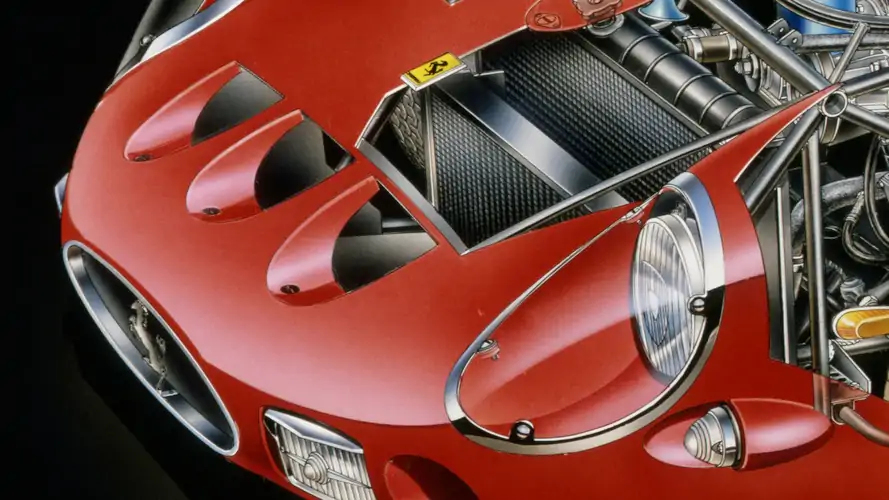
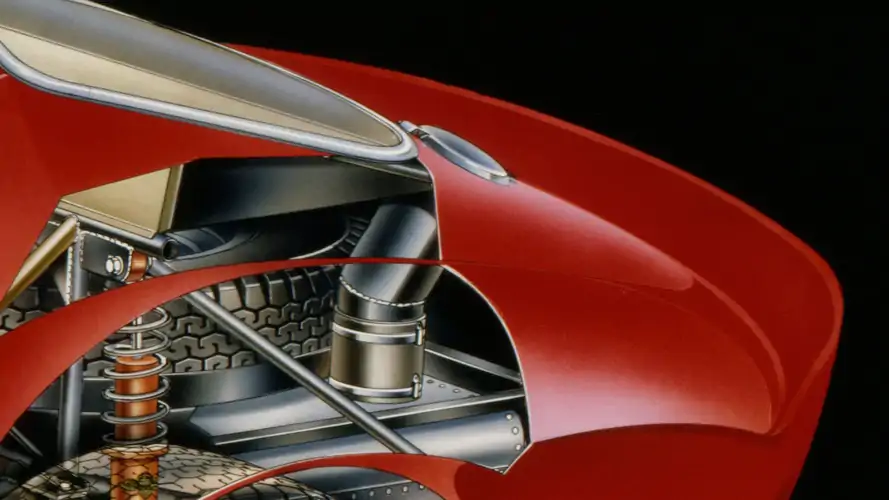
The 250 GTO’s Form Was Shaped By Function
No two Ferrari 250 GTOs were guaranteed to be exactly alike. Ferrari built only 39 examples, with each assembled by hand and subject to small differences requested by owners or teams. The model also represented a major technological step for Ferrari, incorporating advanced development methods for its era, including wind-tunnel work conducted at the University of Pisa.
The result was a shape dictated largely by aerodynamic requirements, yet the finished 250 GTO became one of the most celebrated Ferrari designs ever created. Giotto Bizzarrini played a major role in the early development, while Sergio Scaglietti and Mauro Forghieri became instrumental after Bizzarrini’s departure following his dispute with Enzo Ferrari.
The car’s defining visual feature is its long, low hood, pierced by three prominent air openings. Those openings could be fitted with covers for colder racing conditions, allowing teams to adjust airflow and gain an aerodynamic advantage.
The rear design wasn’t completely standardized, either. Early versions incorporated a rear spoiler, while the particular 250 GTO documented for Kimble’s illustration featured a clean rear deck. Because these cars were built for competition, owners and racing teams frequently requested modifications. After accidents or mechanical updates, bodywork specialists—including Scaglietti—could alter vents, intakes, and other aerodynamic details to suit individual cars and their racing requirements.
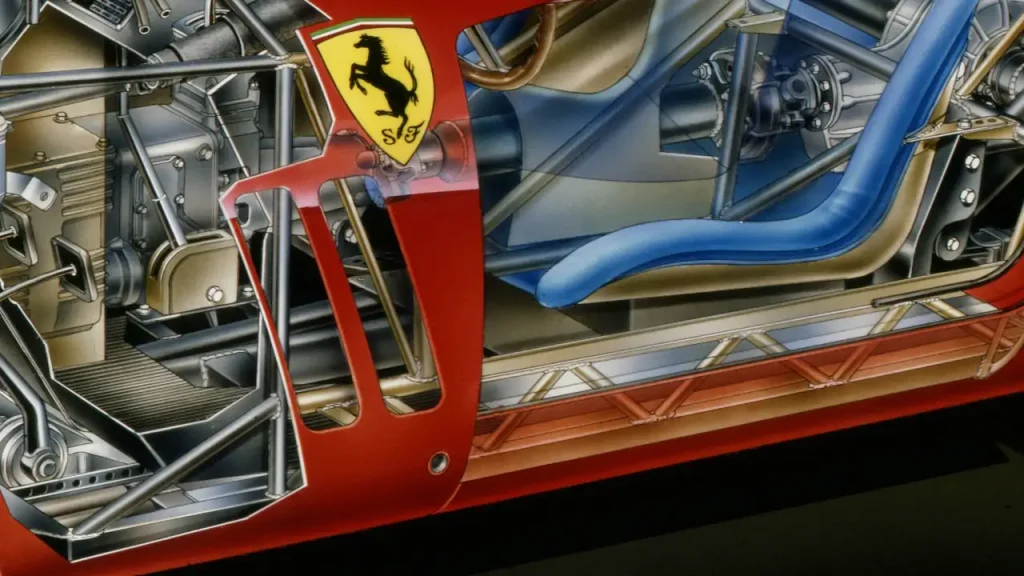
A Proven Formula With Carefully Chosen Updates
Ferrari didn’t see a reason to abandon a chassis architecture that had already proven itself on the track. While racing technology was advancing rapidly during the 1960s, the 250 GTO evolved from an established foundation rather than starting completely from scratch.
The car retained the front-engine, rear-wheel-drive layout of the 250 GT SWB, with a lightweight space frame made from hand-fabricated and welded tubing. Ferrari made targeted changes to the structure where necessary, including revisions to the suspension geometry that helped lower the car’s center of gravity.
Its suspension combined independent front A-arms with a live rear axle, a setup that delivered the balance and durability needed for serious competition. It wasn’t revolutionary, but Ferrari refined the formula with enough precision to make the 250 GTO an exceptionally effective racing machine.
The approach also marked the end of an era. Front-engine, rear-wheel-drive Ferraris were nearing the limits of their competitive potential, with the 250 GTO representing one of the final and most successful expressions of the layout before Ferrari fully embraced mid-engine race cars.
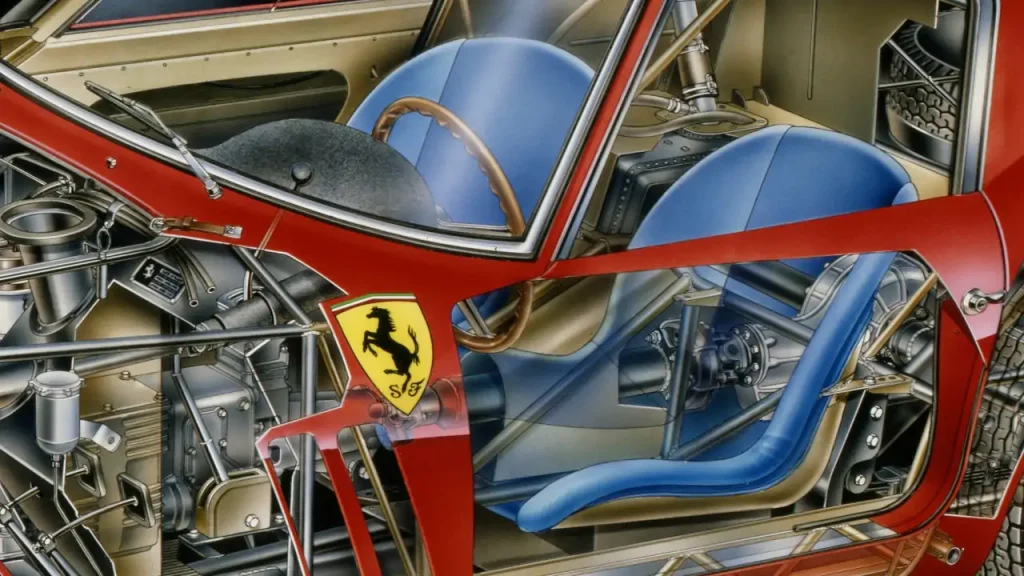
Inside The 250 GTO: Built For Racing, Not Relaxing
The Ferrari 250 GTO offered almost none of the comforts you might expect from a car of its legendary status. While American automobiles of the era were increasingly focused on convenience, technology, and plush interiors, Ferrari’s road-legal race car took an entirely different approach.
Two basic cloth bucket seats and simple lap belts were about as luxurious as things got. The cabin was stripped down to the essentials, with no speedometer and virtually nothing added purely for comfort.
There was no carpeting or headliner to soften the noise, either. Instead, the driver was surrounded by the mechanical soundtrack of the V12, making every journey feel much closer to a day at the racetrack than a conventional road trip.
Why The 250 GTO Remains A Collector’s Dream
Few Ferraris have built a reputation quite like the 250 GTO. Its competition history made it legendary, while its extreme rarity turned it into one of the world’s most coveted collector cars. Even celebrities and some of the wealthiest enthusiasts have competed for the opportunity to own one.
The numbers surrounding these cars are extraordinary. Chassis 3505GT, which was raced by Sir Stirling Moss, sold for $35 million in 2012, while chassis 5111GT reportedly changed hands for more than that in a private transaction in 2014. Those figures are almost impossible to reconcile with the car’s original price of roughly $18,000.
Even the GTO’s market history has had its twists. During the economic downturn of the early 1990s, values reportedly dropped by around $10 million, a reminder that even the most desirable collectibles aren’t immune to market swings.
Today, the 250 GTO sits among the most valuable automobiles ever built. Kimble’s cutaway illustration adds another layer to that legacy, revealing the engineering and construction hidden beneath the beautiful bodywork of a car that could command an extraordinary price whenever another example reaches the auction block.
For more than five decades, technical illustrator David Kimble has brought the inner workings of iconic cars and race cars to life through remarkably detailed hand-drawn cutaways. After graduating from the Pasadena Academy of Technical Arts, Kimble built his career around creating highly accurate illustrations using original engineering drawings, CAD data, and firsthand inspections, often documenting the process with photographs.
His work, which began in 1964, has appeared in publications including Motor Trend and Car and Driver. Based in Marfa, Texas, Kimble continues to create his intricate illustrations from his studio. Each piece can require months of painstaking work, all produced without relying on modern computer-based illustration techniques.