Remembering the unforgettable experience of getting behind the wheel of the legendary actor’s iconic Volvo.
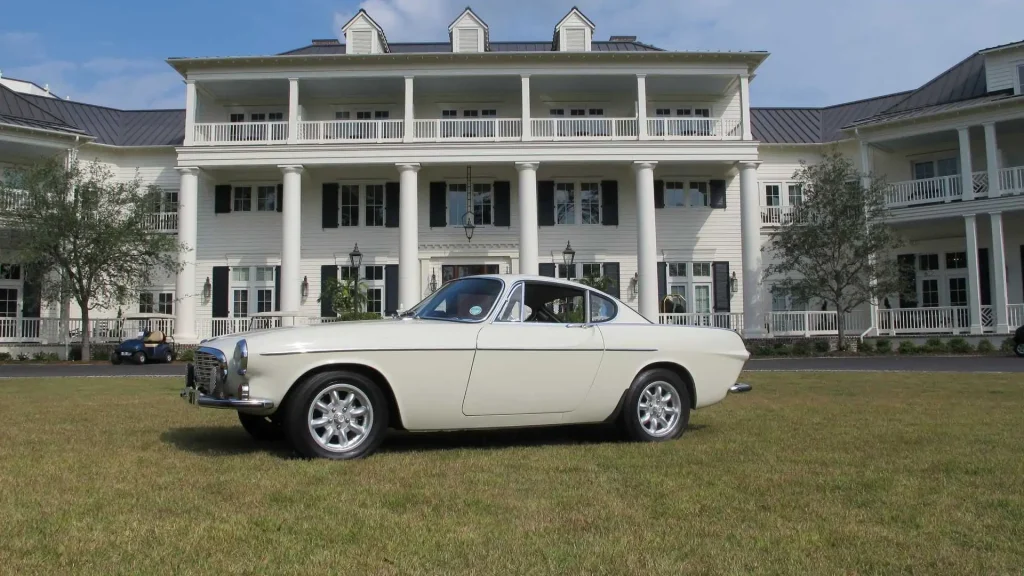
Some classic cars are admired for their styling. Others become legendary because of their performance. A rare few become unforgettable because they are connected to a moment in history. Roger Moore’s Volvo P1800 belongs in that final category.
It is not just a beautiful 1960s sports coupe — it is a piece of Hollywood history, a car forever linked to Moore’s rise to fame before he became one of the most recognizable actors to portray James Bond.
Getting behind the wheel of this particular Volvo was more than simply driving a classic car. It was an opportunity to experience the machine that Roger Moore himself drove, owned, and enjoyed for decades.
The sound of engines coming to life pulls me back toward the cars. I’m only about 50 feet away, coffee in hand, when the convoy begins to stir. Starters crank, engines settle into uneven idle, and the cars at the front begin rolling away. I secure the lid on my coffee and hurry toward my ride, but I have to stop for a moment before climbing in.
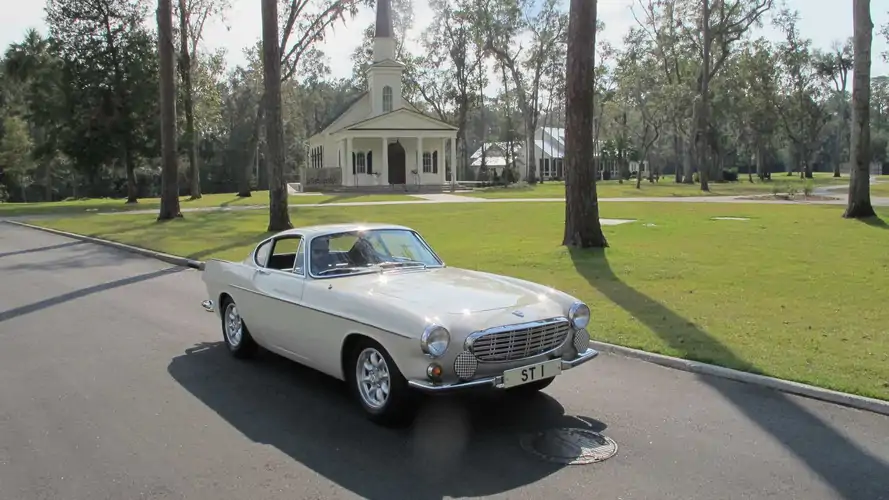
There it is: the Volvo P1800, one of the finest examples of 1960s European automotive design. Its long hood, compact two-seat cabin, and rear-wheel-drive layout give it the kind of effortless elegance that seems to demand a smoking jacket. Fortunately, nobody at the Hilton Head Concours is enforcing a dress code. In the South Carolina heat, with the sun overhead and humidity hanging in the air, shorts are the more sensible choice.
I hand my coffee to my co-pilot, Volvo communications executive and fellow enthusiast Russell Datz, then settle behind the wheel. The P1800’s three-point seat belt requires a little more attention than the effortless belts in a modern car. That extra effort is a reminder of just how advanced this equipment once was. Volvo introduced the modern three-point belt in 1959 and famously made the patent available to other manufacturers in the interest of safety.
More than six decades later, that decision remains one of the most consequential contributions in automotive history. The three-point belt is estimated to have saved roughly a million lives worldwide. Safety equipment rarely gets the same attention as horsepower or styling, but that number is almost impossible to comprehend.
Russ isn’t here simply to provide conversation during a pleasant South Carolina drive. He’s also the perfect passenger for this particular car because the thin wooden steering wheel I’m holding once belonged to Roger Moore. Its history stretches back to Moore’s days as Simon Templar in the 1960s television series The Saint, before he became one of the actors most closely associated with James Bond. Moore eventually bought the Volvo himself, making the car’s celebrity history considerably more personal.
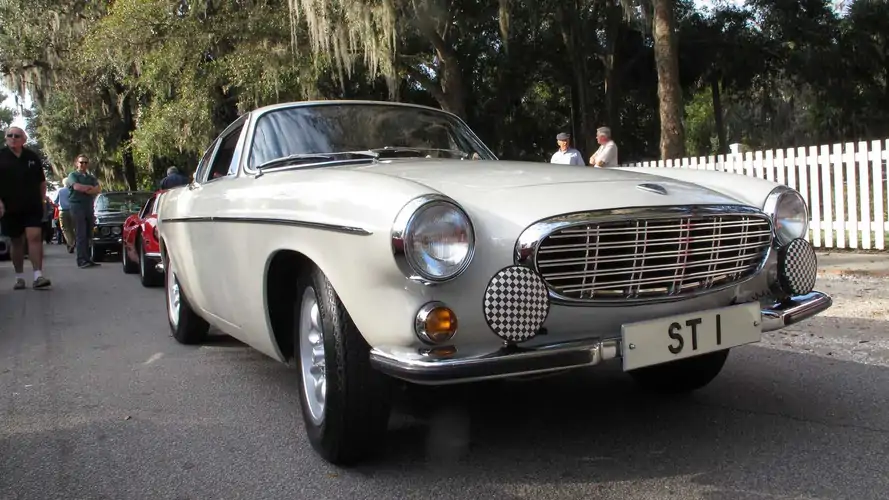
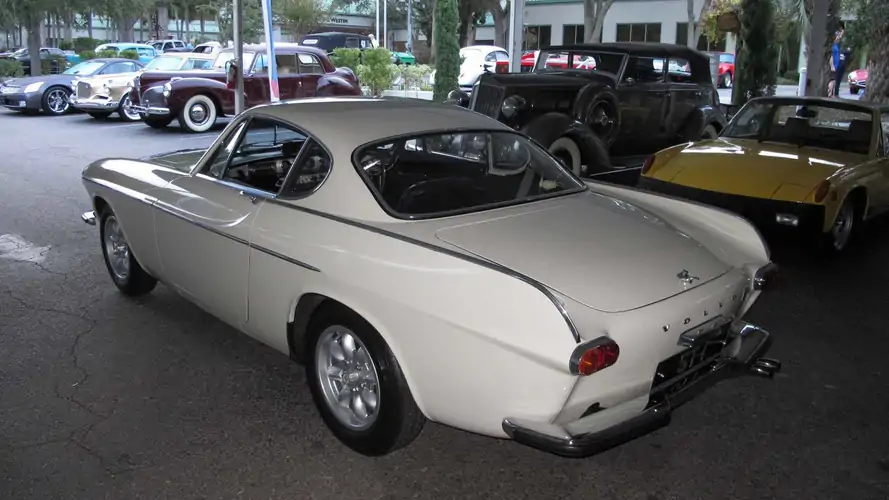
Now, decades later, I’m getting the chance to drive it as the first media member Volvo has allowed behind the wheel since acquiring the car.
There’s just one problem: I’m not completely prepared for it.
The P1800 is right-hand drive, and its manual transmission is operated with the left hand. Between the excitement of the morning and the distraction of wandering through a Concours filled with Ferrari Dinos, Jaguar E-Types, Porsche 356s, Fiat 124s and Lamborghini Diablo Roadsters, I never had much time to familiarize myself with the car. I’m fairly certain I pull away in third gear.
Thankfully, the mistake doesn’t last long. After a few clutch engagements and gear changes, the P1800’s rhythm begins to make sense. We crank down the windows, settle into about 30 or 40 mph, and eventually reach the highway where the car can stretch its legs a little.
But outright speed isn’t the attraction here.
The P1800 is about the experience of driving. There’s the mechanical chatter of the engine, the wind rushing through the open windows and the scenery passing by as we cruise through South Carolina. Palmettos, blue water and tree-lined roads create the kind of setting that makes you forget about lap times entirely. I’m wearing sunglasses and shorts, the temperature is climbing, and somehow none of it matters.
A car like this makes an ordinary drive feel like an occasion.
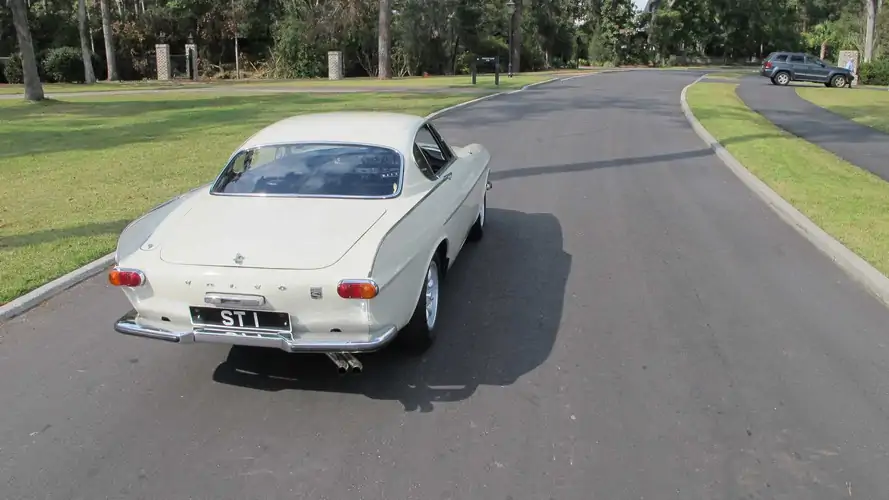
The exterior is a fascinating mix of design influences. The long nose recalls the sports cars of the era, while the high beltline and slender pillars give it an unmistakably 1960s profile. Then there are the small tail fins, a styling cue that feels borrowed from the previous decade. Somehow, all of these elements work together.
The details come in pairs: round headlights, Hella fog lamps, individual taillights and twin exhaust outlets. Nothing looks excessive. The P1800’s appeal comes from how naturally all those individual pieces fit together.
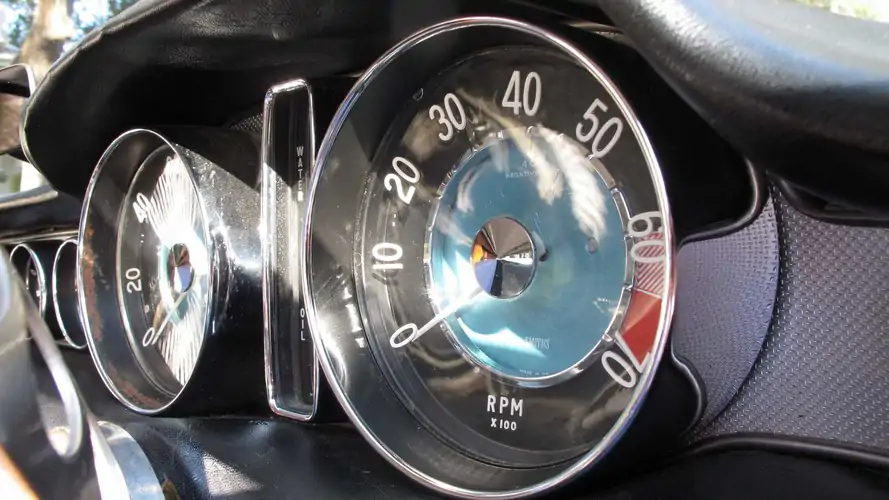
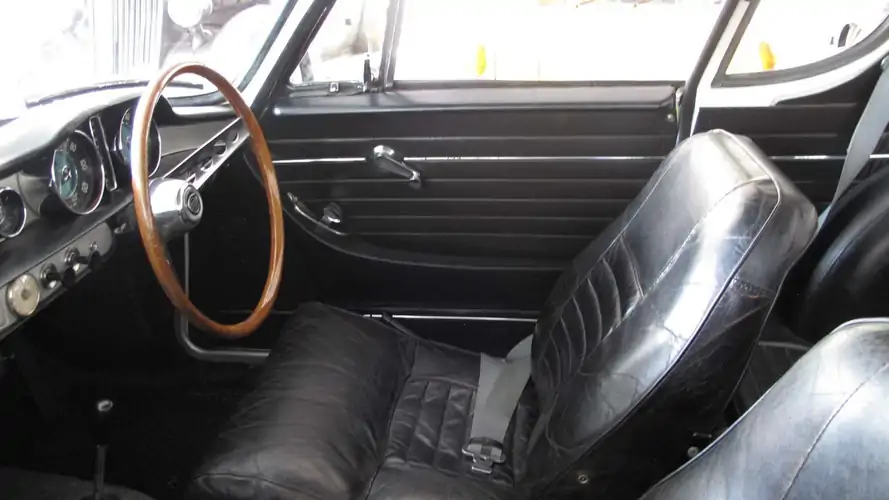
Inside, the atmosphere is just as distinctive. Smiths gauges sit neatly within the dashboard, with splashes of color adding character without overwhelming the cabin. The speedometer is almost comically restrained by modern standards, with large numbers appearing at 20-mph intervals and a 120-mph maximum. There is something charming about not needing to know whether you’re traveling 23 or 24 mph.
The tachometer reaches 7,000 rpm, although the redline arrives at 6,500. Oil and coolant temperature gauges sit prominently in the center, while the lack of modern conveniences is immediately apparent. There are no headrests, the rear-view mirror is mounted to the dashboard, and the cabin is otherwise refreshingly uncomplicated.
The seats are wonderfully soft, too. Rather than holding you tightly in place with aggressive bolsters, they surround you in thick foam. They feel more like comfortable furniture than modern performance seats. These are also the seats Roger Moore and numerous The Saint actresses would have occupied during the show’s run from 1967 to 1969.
Then there’s the shifter.
Its long lever rises directly from the floor, providing a wonderfully tactile connection to the four-speed manual gearbox. Modern transmissions are faster and more precise, but few give you quite the same sense that you’re mechanically moving the car from one gear to another. The P1800 doesn’t require constant shifting, either. The ratios are well suited to relaxed driving, and each change has a satisfying mechanical quality.
Not everything about the old Volvo has aged gracefully.
There’s no power steering, for starters. Once you’re moving, the steering is perfectly manageable, and changing lanes or carving through a corner requires little drama. Try maneuvering through a tight parking space, however, and you’ll quickly discover that your arms are part of the power-assist system.
Modern cars have made this sort of low-speed maneuvering almost effortless. The P1800 makes you work for every tight turn, which is both inconvenient and strangely rewarding.
For the moment, though, there is little reason to think about what the Volvo can’t do. We’re cruising at roughly 40 mph on a country road, with the breeze cutting through the heavy South Carolina humidity. The trees provide intermittent shade, and the scenery does most of the entertaining.
There’s even a small piece of Roger Moore’s personal history hiding behind the seats: a compact fan aimed toward the driver. Moore reportedly had it installed so he could stay cool between scenes while wearing the tailored suits required for The Saint. The fan remains in the car today, an amusing reminder that even movie stars needed a little help dealing with summer heat.
The P1800 has survived far more than changing automotive tastes. It has become a rolling piece of television history, but its greatest appeal isn’t its celebrity connection. It’s the way the car makes you slow down and appreciate the simple act of driving.
And on a beautiful day at Hilton Head, that’s more than enough.