
Ford’s extreme electric Mustang delivers a terrifying rush while showcasing what high-performance EVs can do.
Burning rubber fills the cabin with a sharp, acrid haze as the Mach-E throws us sideways under relentless G-forces. My five-point harness is pulled as tight as I can stand, while a Recaro racing seat digs into my hips and keeps me planted as the driver wrings every ounce of grip from the tires. Outside, the electric motors howl while the 1,400-horsepower crossover churns through tire smoke, building ever more speed and lateral force.
Calling this machine a Ford Mustang Mach-E is technically correct, but it hardly tells the whole story. This is the Mach-E 1400 prototype, a collaboration between Ford Performance and Gittin’s RTR Vehicles designed to explore the absolute limits of Ford’s electric Mustang. Seven electric motors, as much as 2,300 pounds of downforce, and adjustable power delivery that can switch between front-, rear-, and all-wheel drive make it an uncompromising laboratory for EV performance. It’s arguably the wildest electric vehicle this side of the record-setting Volkswagen ID.R—and I got the chance to experience it from the passenger seat alongside one of the people who helped create it.
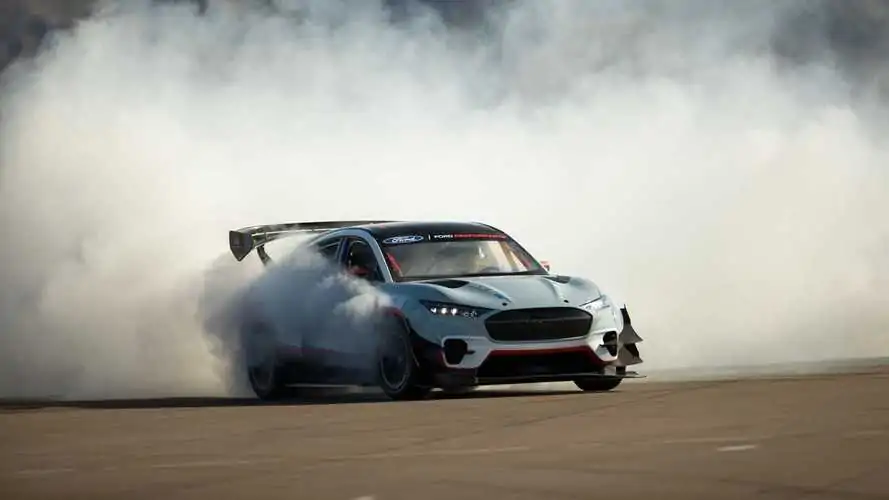
The Mach-E 1400 has a deceptive way of delivering its speed. My first proper acceleration run feels almost tame because I’m expecting the instant violence of a launch-controlled Porsche Taycan Turbo S. Instead, the Mach-E builds its momentum with surprising subtlety—until the G-forces suddenly pile on. The acceleration pushes me back into the seat, leaving that familiar breathless sensation in my chest as the prototype gathers speed. The run is over far too quickly, and Gittin lifts off to give me a moment to recover.
The view from the passenger seat is almost as surreal as the acceleration itself. The dashboard resembles the production Mach-E’s layout, although this prototype replaces much of it with carbon fiber, while the massive portrait-oriented touchscreen is carried over from the road-going EV. The racing seats and full roll cage are obvious departures from the street car, yet climbing aboard is surprisingly straightforward. One leg goes in, you use part of the cage for support, bring the other leg inside, and slide into the seat. Then comes the five-point harness, which requires getting rather close to the person helping strap you in Mustang Seating
Like the original Mustangs, the Mustang Mach-E 1400 uses a 2+2 seating configuration.
Ford and RTR envisioned the Mach-E 1400 as more than a one-off stunt car. It was built to serve as a rolling showcase for electric performance, traveling to events and giving people their first taste of what a high-performance EV can do. Since that means introducing the car to people one passenger at a time, the Mach-E 1400 retains a 2+2 layout, much like the original Mustang. A clear enclosure runs down the middle of the cabin, resembling a traditional transmission tunnel at first glance. In reality, it houses the seven inverters that control the car’s seven electric motors. Beyond the unusual sight of thick orange cables snaking throughout the cabin, the interior remains surprisingly recognizable as a Mach-E.
While I’m taking in the unusual setup, Gittin reaches for a few controls and changes the car from all-wheel drive to rear-wheel drive. There’s no obvious sensation when the system switches modes. That changes the instant he plants his foot on the accelerator and sends all 1,400 horsepower through the sticky Nitto NT555 tires. With the front drivetrain removed from the equation, this configuration is particularly well suited to drifting, although the front gearing hadn’t been removed in time for my ride. More importantly, the setup demonstrates just how much flexibility Ford and RTR engineered into the Mach-E 1400.
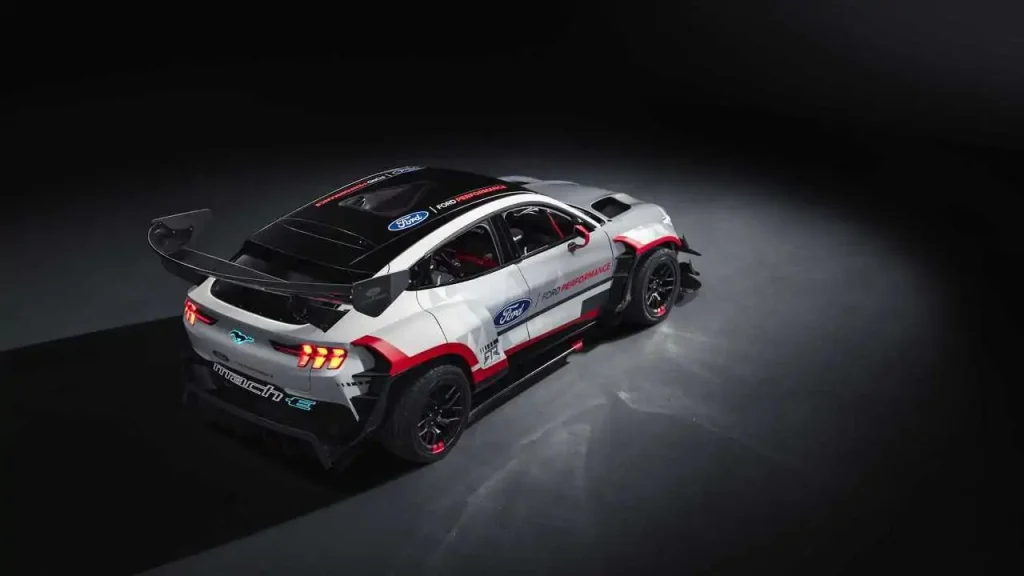
The exterior makes it clear that aerodynamic performance was a major priority. A gigantic rear wing dominates the back, while an enormous diffuser and an extremely wide front splitter give the car an almost cartoonish stance. The Mach-E also wears aggressive dive planes, all working together to generate more than 2,300 pounds of downforce at 160 mph. That much aero grip makes the Mach-E 1400 a serious road-course machine, but Ford and RTR didn’t design it solely for conventional cornering. Using computational fluid dynamics, they developed the aero package to remain effective even when the car is traveling sideways, helping give the Mach-E its impressive drifting ability.
On a road course next to the VDA, Gittin demonstrates just how much that aerodynamic package can do. Even without pushing the car particularly hard around the tight, undulating circuit, the Mach-E feels remarkably composed and responsive for something weighing roughly 5,000 pounds. It has the grip and balance to handle a road course, yet it’s equally entertaining when the rear tires are asked to do something less conventional. Back at the VDA, Gittin proves the point by grabbing the vertically mounted handbrake and spinning the Mach-E through a series of tight donuts, providing an appropriately dramatic finish to the ride.
The Mach-E’s Mission
Back in the makeshift paddock, I awkwardly climb out of the Mach-E 1400 and finally have a chance to think about what Ford and RTR have accomplished. Ford has made it clear that the Mustang Mach-E is supposed to be more than an electric crossover with a familiar badge. It wants the Mach-E to deliver the same emotional appeal as the traditional Mustang and earn its place within the family. After experiencing it firsthand, I’m convinced it has a legitimate shot at doing exactly that when it reaches showrooms.
Winning over die-hard Mustang enthusiasts, however, will be another matter. Press coverage and commercials drawing parallels between the electric Mach-E and gasoline-powered Mustangs aren’t going to settle the debate. Ford needs to demonstrate what an electric powertrain can bring to performance and show that a crossover body and five-door design don’t necessarily erase the character people associate with the Mustang name. That’s a difficult argument to make, but the Mach-E 1400 is an exceptionally persuasive way to make it. If you ever get the chance to ride in this wild electric Mustang, take it. Just don’t be surprised if you can’t keep yourself from screaming.