
Hidden inside a former Turin factory is an extraordinary collection of automotive history. The archives are packed with 1960s Lamborghini design sketches, original styling models, rare prototype parts, and even forgotten concept cars that have remained out of public view for decades.
Legendary Italian styling house Bertone closed its doors in 2013, although much of its historic collection had already been dispersed. A significant selection of its prized concept cars was sold in 2011, followed by another group of vehicles in 2015.
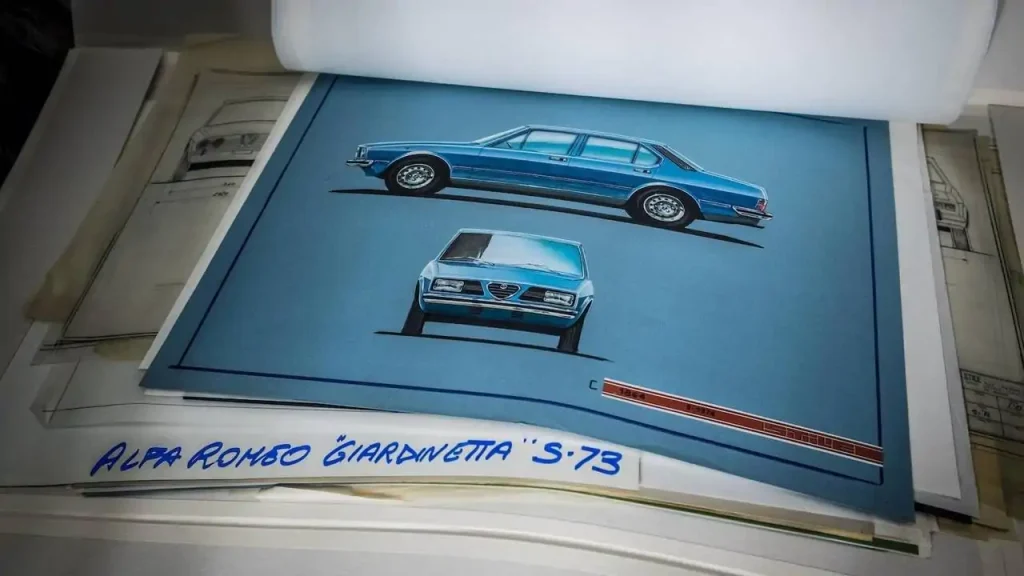
For a time, it seemed that the closure marked the final chapter for Bertone, one of Italy’s most influential coachbuilders with more than a century of history. But there was something almost nobody knew: Bertone Stile, the company’s design headquarters in northeastern Turin, still contained an enormous amount of original material. Inside were design drawings, styling models, rare parts, prototype equipment, and even complete concept cars.
It’s remarkable that the collection remained untouched for so many years. Now, however, the Italian court handling Bertone’s bankruptcy has ordered the contents of Bertone Stile to be sold. Italian auction house Aste Bolaffi was appointed to organize the sale.
See also…
- More on the Aste Bolaffi Bertone archive sale
- Top 10 Bertone concept cars
- Bertone cars for sale
Bertone Stile served as the design division of Carrozzeria Bertone, and its headquarters opened in 1972. The building itself is an extraordinary piece of design, featuring galleries, bridges suspended above studio areas, dark-wood meeting rooms, orange ceilings, angular exterior details inspired by Bertone’s concept cars, and elegant curved wooden surfaces.
The facility was closed and locked when Bertone went bankrupt, and much of it appears to have remained almost exactly as it was. It gives the impression that employees left one evening without knowing they would never return.
It’s a fascinating and slightly melancholy time capsule, although there are clues to the treasures inside as soon as you enter. Several styling models remain displayed in the lobby. Only a limited number of people, including archivists from major automakers’ museums, had previously been allowed inside, making access to the site an unusually rare opportunity.
Classic-car writer and historian Massimo Delbò was helping Aste Bolaffi with the project and led the exploration of the building. The search eventually reached the enormous basement, where the lack of electricity and water had left the space dark and extremely cold.
A few temporary lights powered by backup equipment made it possible to explore, but caution was necessary. During an earlier visit, Delbò discovered a Lamborghini V12 engine and gearbox hidden underneath a sheet. It may have come from an Espada, although there was also speculation that the components could have been associated with a concept car.
Delbò described the discovery as a hidden automotive treasure filled with unexpected finds. Opening a drawer could reveal nothing at all or uncover original material connected to some of the most important cars ever designed by Bertone, including early Lamborghini Miura projects and design files connected to the development of the BMW M1, Alfa Romeo GTV, and Fiat 850 Spider.
One of the first areas explored contained racks filled with 1:5 and 1:10 scale models. These smaller models were used by designers to study the proportions and styling of new projects before the considerable expense of constructing a full-size prototype.
Among them were models of the Lamborghini Countach, including one depicting the original LP500 in its distinctive shape and color, along with several Miura models and a beautiful Fiat Dino Coupé.
The collection also contained a model of the Alfa Romeo Canguro and a smaller representation of the Alfa Romeo Carabo.
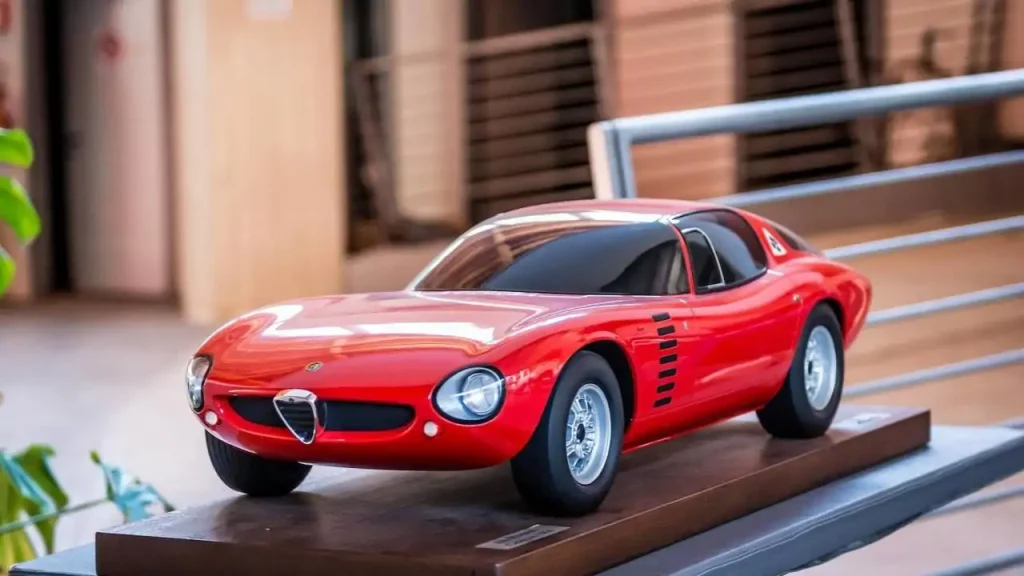
Models of production cars were generally easier to identify, while those representing projects that never reached a final version were more difficult to trace. Regardless of their origins, however, they remain important pieces of automotive design history.
Another particularly interesting discovery was an old drafting table believed to have been used by Marcello Gandini. Lorenzo Ramaciotti, who spent many years at Pininfarina before becoming head of design for the FCA Group, reportedly recognized the significance of the table when he visited the archive during a private preview.
The drafting table was an early counterweighted design. These were eventually replaced by spring-operated versions and later by pantograph systems. A similar counterweighted table associated with Aldo Brovarone remains at Pininfarina, while the Bertone archive contains the example believed to have been used by Gandini.
Then there is the “sample tree,” an unusual archive system containing boxes dedicated to individual vehicle projects. Each box could hold metal paint-color samples along with the paint supplier, identification code, and examples of the fabrics or leather used for seats, carpeting, and headliners.
For some vehicles, the archive also includes documentation from the earliest cars produced, with actual paint and interior material samples attached to the reports. The collection covers projects ranging from the Alfa Romeo 2000 and 2600 to Lamborghini and Iso Rivolta models from the 1960s and 1970s, as well as the Fiat 850 Spider and Volvo coupes produced through Bertone.
The number of manufacturers represented is enormous. The archive includes work connected to companies ranging from Bugatti and Maserati to Porsche, Volkswagen, Scania, Tata, Jensen, and Saviem.
After spending hours working through the basement, the team continued to uncover unusual treasures, including concept-car wheels and glass. There were even four unused Lancia Stratos seats still sitting in their original packaging.
The basement wasn’t the end of the story. Bertone Stile was also a prototype construction facility, with dedicated areas for building full-size models and experimental vehicles.
Among the discoveries was a full-size plaster model of the Aston Martin Jet 2. The model was created as a reference for a proposed small-production station wagon based on the Rapide. The project ultimately resulted in a one-off car built in 2013.
Bertone Stile also contained various components, tooling, and project material associated with the Jet 2. Aste Bolaffi planned to offer those items together as a single lot, potentially giving a skilled collector the opportunity to combine them with a Rapide rolling chassis and recreate the car.
The facility also housed remnants of the former Bertone Museum. Old display boards provided a glimpse of the wide range of vehicles that had once been exhibited there before the collection was dispersed. However, several important cars remained.
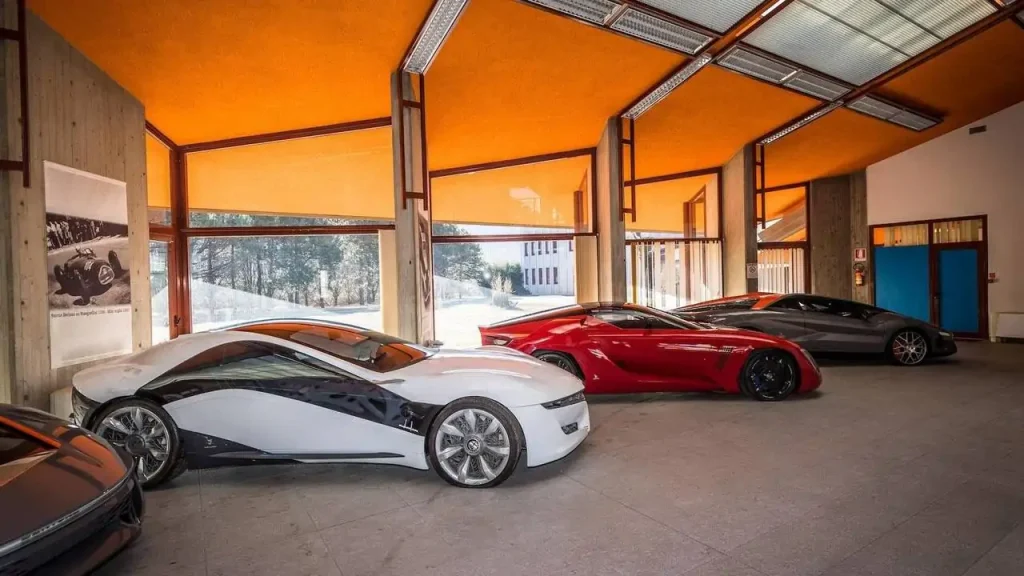
Among the most significant were the final two show cars built by Carrozzeria Bertone: the Alfa Romeo 8C Competizione Pandion and the Ferrari 430-based Nuccio.
The Pandion was unveiled at the 2010 Geneva Motor Show as part of Alfa Romeo’s centenary celebrations. Its most dramatic feature was its pair of enormous doors, which stretched almost the length of the car and rose dramatically into the air when opened.
Inside, Bertone created an elaborate structure centered around a skeletal tunnel, while the seats used illuminated fabric covered with soft foam. At the rear, the designers created a stylized interpretation of a classic Alfa Romeo front end using a hollow resin structure that could be illuminated with optical fiber.
The other final Bertone concept was the Nuccio, based on the Ferrari 430. It first appeared as a styling model at the 2012 Geneva Motor Show before being presented as a fully functioning car at the Beijing Motor Show later that year.
Created to celebrate Bertone’s centenary, the Nuccio incorporated styling cues from one of the company’s most famous creations, the original Stratos show car that ultimately influenced the production Lancia Stratos. The flat windshield was among the clearest visual connections between the two.
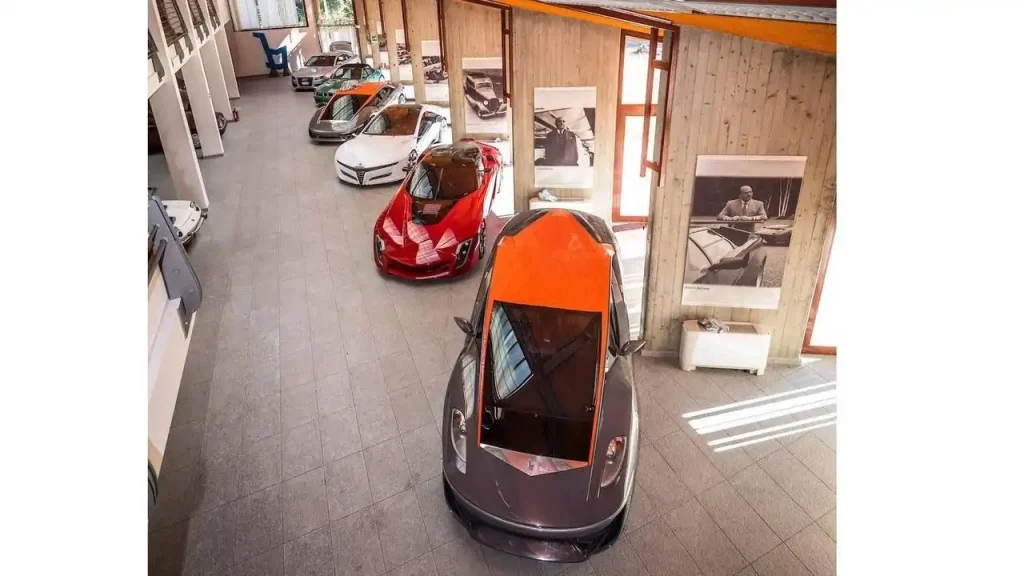
Because Ferrari had a close design relationship with Pininfarina, the Ferrari-based Nuccio was reportedly not particularly well received by Ferrari. Bertone consequently concealed the Ferrari identity of the rolling chassis, with the branding inside the engine bay covered.
Aste Bolaffi planned to preserve the history surrounding these two cars by offering each one together with its original design material, construction photographs, show trophies, and other documentation. The Nuccio’s lot was also expected to include its full-size styling model from the Geneva show and the original outfits worn by promotional models at the events.
Two other interesting vehicles were also part of the Bertone Stile collection. One was a barely used BMW Z3 M Roadster supplied by BMW for a proposed Bertone project that was ultimately never started. The other was an Alfa Romeo 90 that belonged to Nuccio Bertone himself. After his death in 1997, the car remained associated with the company and had been refinished in a deep metallic bronze and reupholstered in leather.
The sheer quantity of material hidden inside Bertone Stile made it impossible to catalogue and sell everything at once. Massimo Delbò and the Aste Bolaffi team were still uncovering historically important objects almost every day.
Aste Bolaffi therefore planned to divide the collection into multiple sales, with part of the archive offered alongside the company’s regular classic-car auction in May and additional Bertone material scheduled for a second sale in October.
For collectors and automotive historians, the discovery represents something far more significant than an ordinary auction. Bertone Stile preserved an extraordinary record of how some of the world’s most memorable cars were conceived, designed, modeled, and developed. After years behind locked doors, that remarkable piece of Italian automotive history was finally being brought back into the public eye.