
Explore the legendary plant that changed the way the world built cars.
The Ford Model T is widely recognized as the vehicle that helped put America on the road, but the car itself was only one part of Henry Ford’s much larger industrial revolution. The real breakthrough came from the way Ford built it. His manufacturing methods transformed the automobile industry, reshaped the American workplace, and established the foundation for modern mass production.
The introduction of Ford’s moving assembly line, followed by the groundbreaking $5-a-day wage program, changed the way products were manufactured and altered the relationship between companies and workers forever.
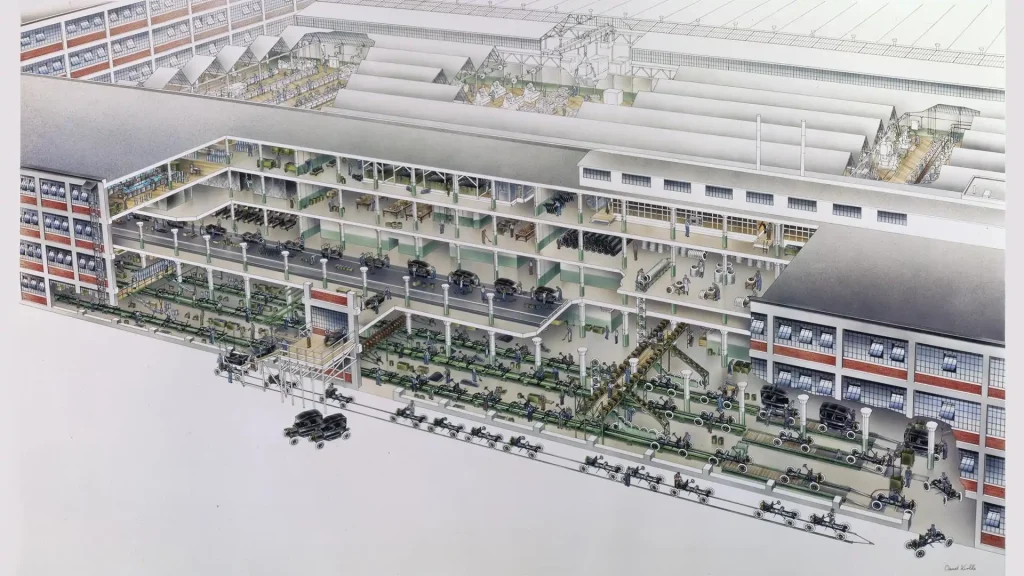
To capture this historic turning point, legendary automotive cutaway artist David Kimble was commissioned by National Geographic in 1987 to create a detailed illustration of Ford’s Model T factory as it appeared during the early stages of assembly-line production at the Ford Highland Park Plant in June 1913.
The project was unlike any other in Kimble’s career. Instead of cutting away a vehicle to reveal its mechanical secrets, he opened up an entire factory and brought to life the workers, machinery, and processes behind one of the greatest industrial achievements of the 20th century.
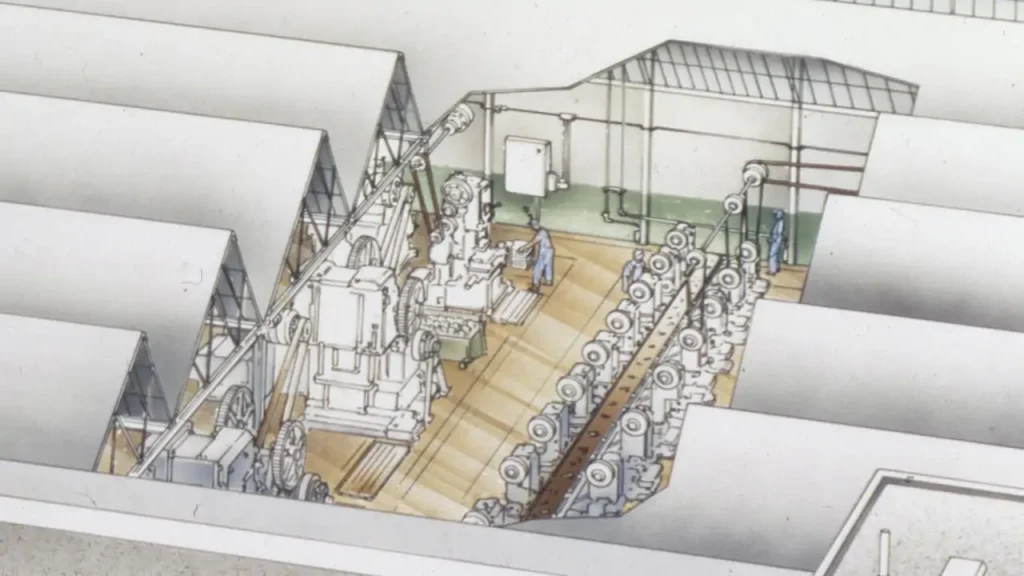
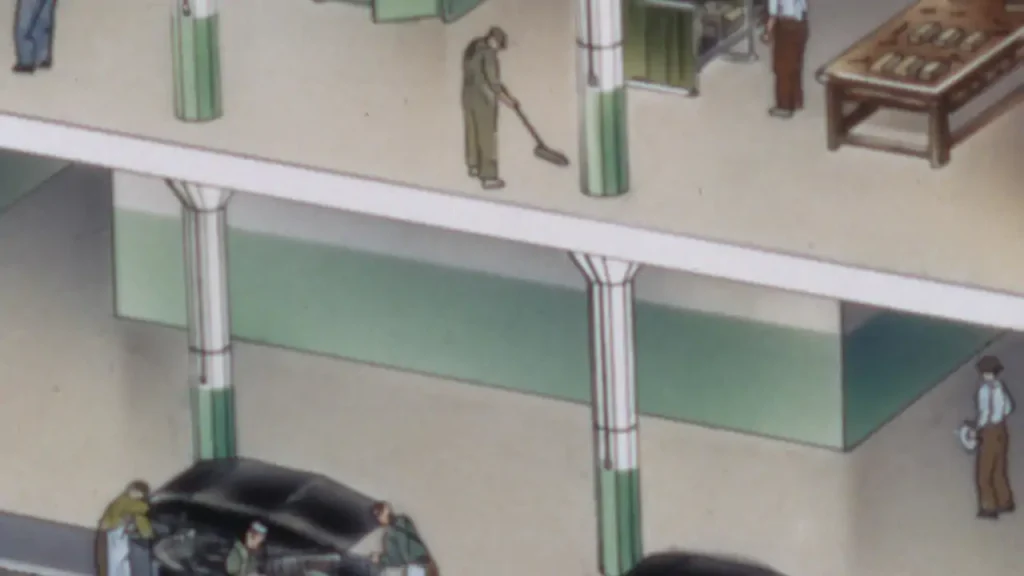
How could Kimble recreate the Highland Park factory so convincingly without ever seeing the scene as it existed in 1913? National Geographic gave him an important starting point: access to Ford’s archive of historic factory photographs. The images were only in black and white, but they provided valuable references. Kimble also studied photographs published in period magazines, allowing him to reproduce remarkably small details, from Model T subassembly stations to the workers’ clothing, suspenders, and hats.
The problem was that none of those photographs captured the entire facility from the sweeping perspective Kimble envisioned. Turning a collection of individual images into one accurate cutaway view required more than artistic skill. It also called for an understanding of how the factory was designed and operated. That’s where industrial archaeologist Dave Hounshell came in. Hounshell helped Kimble piece together the factory from floor to ceiling, creating a period-correct representation of a view that had never actually been photographed. Even seemingly minor details, including the brickwork and windows, were carefully matched to the original building.
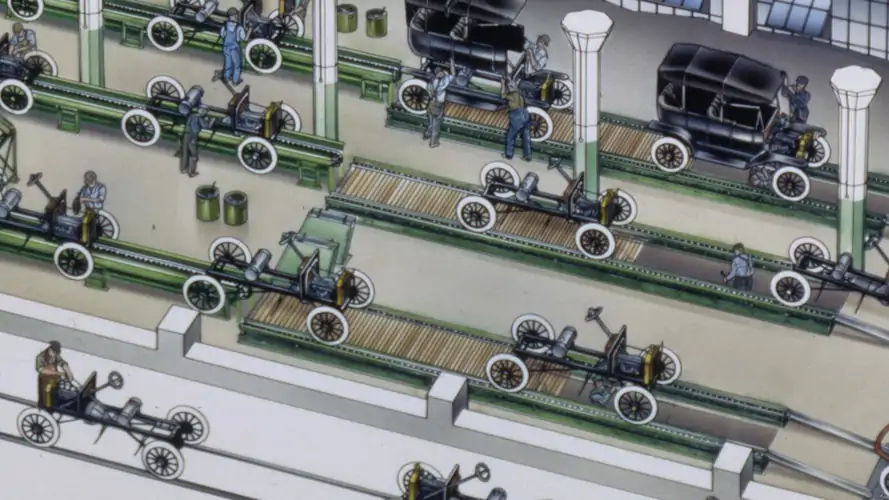
The Model Ts moving through different stages of assembly are equally impressive. Each car contains an extraordinary level of detail, despite the fact that Kimble wasn’t working from close-up photographs of actual vehicles being built inside the factory.
Interestingly, Kimble eventually did get to see the Highland Park facility for himself. The original factory, located at Manchester and Woodward Avenue, still stands and was designated a National Historic Landmark in 1978. In his book David Kimble’s Cutaways: Techniques & Stories Behind the Art, Kimble recalls “talking my way past the guards” to get inside.
His visit came roughly 75 years after the period depicted in the illustration—and about a year after he had already begun working on the cutaway. Still, the trip gave him an opportunity to see something the old photographs couldn’t show: the original mint-green paint on the factory walls. Remarkably, Kimble was able to reproduce that color in his illustration despite having relied primarily on black-and-white reference photos.
Kimble also needed a way to accurately depict Model Ts at different stages of production. Rather than taking apart valuable vintage cars, he turned to 1:18-scale plastic model kits. He purchased several kits that accurately represented the Model T’s body and chassis, then assembled each one to different points in the production process. Those miniature cars became practical references for recreating the vehicles moving through the factory.

The timing of the scene is significant. Just a few months after the period portrayed in Kimble’s illustration, in October 1913, Highland Park officially became the first automobile factory to use a moving assembly line. The innovation transformed Model T production, cutting assembly time from roughly 12 hours to just 90 minutes. That dramatic improvement in efficiency helped Ford lower the Model T’s price to around $350, making the automobile accessible to a much larger portion of the American public.
The assembly line may have revolutionized production, but factory work was still demanding, and employee turnover was a major problem. In 1914, Ford introduced the now-famous $5-a-day wage in an effort to retain workers. The higher pay is also widely associated with Ford’s desire to make it possible for employees to afford the cars they were building.
Whatever the motivation, the strategy worked. Worker turnover fell, Model T prices continued to decline, and automobile ownership expanded rapidly. Ford’s approach helped reshape American manufacturing while contributing to the growth of a broader working middle class.
It’s easy to focus on the cars and technology when looking at a remarkable piece of industrial history like Kimble’s illustration. But the image also serves as a reminder of the people whose labor made that transformation possible. Amid today’s road trips, barbecues, and increasingly automated workplaces, Kimble’s recreation offers a fascinating glimpse at an era when American industry was changing at an extraordinary pace.
For that, David Kimble’s work is more than an impressive automotive illustration. It’s a carefully reconstructed snapshot of a pivotal moment in American history—and a reminder of how much the country, its workers, and its automobiles have changed since then.