
An Automotive Masterpiece with a Zen-Like Sense of Balance.
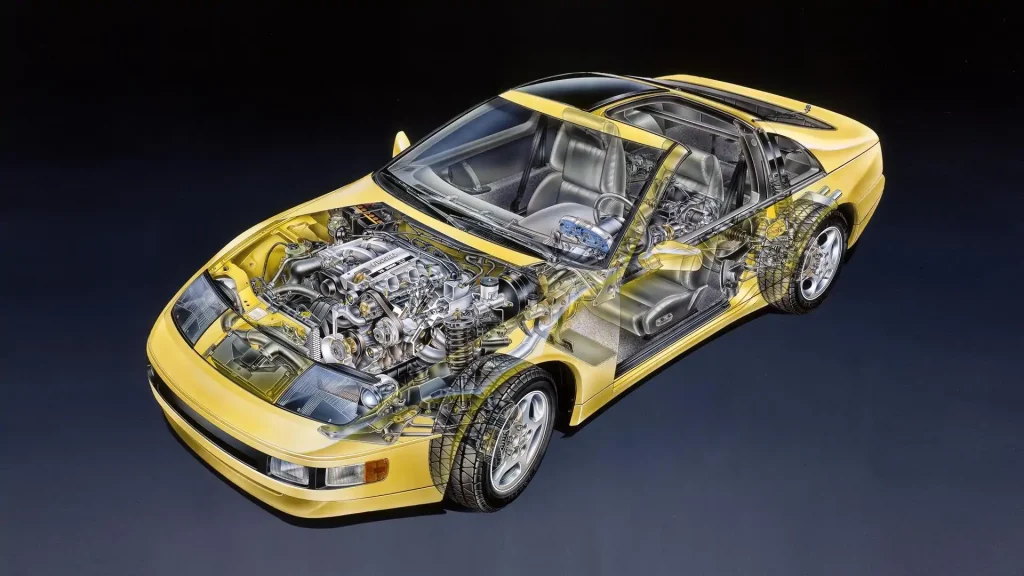
This marks the first time we’ve explored one of David Kimble’s legendary cutaway illustrations featuring a Japanese automobile, and it’s long overdue. While Kimble is best known for his breathtaking technical artwork of American muscle cars, NASCAR machines, Formula One racers, and exotic European supercars, he also produced an impressive collection of illustrations for Japanese manufacturers throughout his celebrated career.
Much of Kimble’s acclaimed book, David Kimble Cutaways: Techniques & Stories Behind The Art, showcases his work for American automakers and high-performance icons, alongside the occasional science-fiction masterpiece, including intricate cutaway renderings of famous starships. Yet hidden among those pages are equally fascinating illustrations of Japanese engineering—vehicles that demonstrated the country’s growing influence on the global performance car market during the 1980s and 1990s.
Among the finest examples is the second-generation Nissan Z32 300ZX, a car that perfectly embodied Japan’s engineering ambition during the golden era of Japanese sports cars. Kimble’s stunning cutaway strips away the sleek bodywork to reveal the remarkable complexity beneath, exposing every major component with extraordinary precision. From the sophisticated multi-link suspension to the twin-turbocharged V6 powertrain, the artwork highlights just how advanced the 300ZX was compared to many of its contemporaries.
Today, the Z32 300ZX has earned its place among the most respected Japanese performance cars ever built. Once an affordable used sports car, it has become increasingly sought after by collectors, enthusiasts, and investors alike. Clean, well-maintained examples—particularly Twin Turbo models with manual transmissions—have seen values climb steadily over the past several years as appreciation for 1990s Japanese performance machines continues to grow.
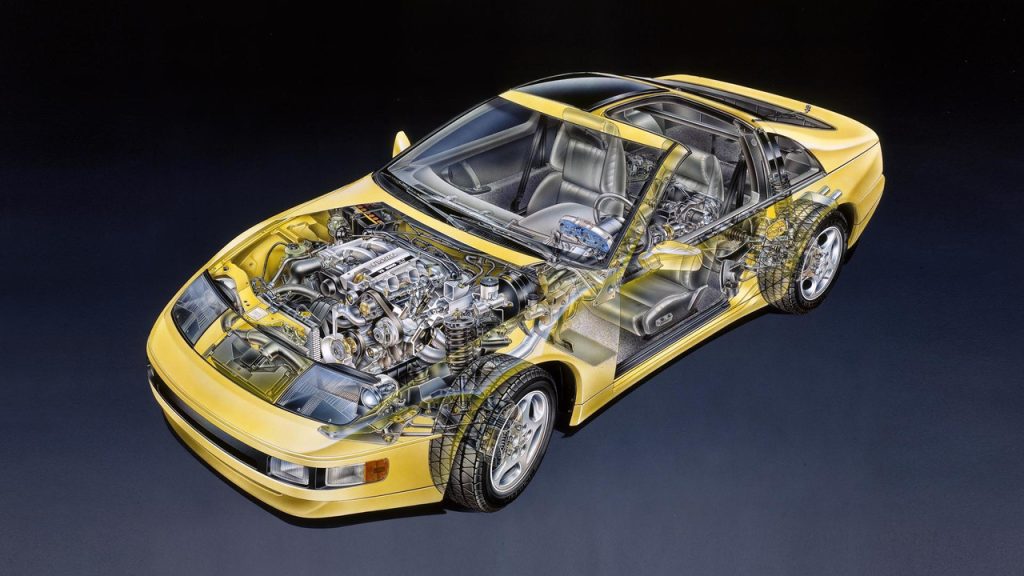
That makes this the perfect opportunity to peel back the bodywork and revisit what made the Nissan 300ZX so extraordinary. More than just a stylish grand tourer, the Z32 combined cutting-edge technology, impressive performance, luxurious refinement, and timeless styling into a package that challenged Europe’s best sports cars. It featured innovations that were years ahead of their time, helping Nissan establish itself as a serious performance brand on the world stage.
David Kimble’s cutaway reminds us that the Z32’s brilliance wasn’t limited to its beautiful exterior. Beneath its sculpted sheet metal lay an engineering masterpiece, where every component was carefully packaged to achieve an exceptional balance of power, handling, and reliability. As collectors continue to recognize its historical significance and market values rise, the Z32 is no longer simply an old Japanese sports car—it’s a bona fide modern classic whose influence can still be seen in today’s performance cars.
Few illustrations capture that achievement better than Kimble’s meticulous artwork, offering enthusiasts a rare chance to look beneath the surface and appreciate the engineering genius that helped cement the Nissan 300ZX’s legendary status.
This remarkable cutaway represents a milestone in David Kimble’s long relationship with Nissan and the Japanese automotive industry. Kimble’s first trip to Japan took place in 1983, when Nissan invited the renowned automotive illustrator to photograph the original first-generation 300ZX. While the assignment provided all the reference material he needed for his artwork, the experience offered something far more valuable: a firsthand look inside one of the world’s most disciplined automotive manufacturers. Kimble was deeply impressed by Nissan’s meticulous production standards, precision engineering, and highly organized, almost military-style approach to vehicle development—qualities that would come to define Japan’s global reputation for automotive excellence.
The visit clearly left a lasting impression on both Kimble and Nissan. Four years later, the company extended another invitation, this time granting him rare access to photograph and study an early development prototype of what would eventually become the iconic Z32 Nissan 300ZX. Long before the sleek sports car reached showrooms for the 1990 model year, Kimble was already documenting its engineering in extraordinary detail, making this illustration one of the earliest artistic records of Nissan’s groundbreaking new Z-car.
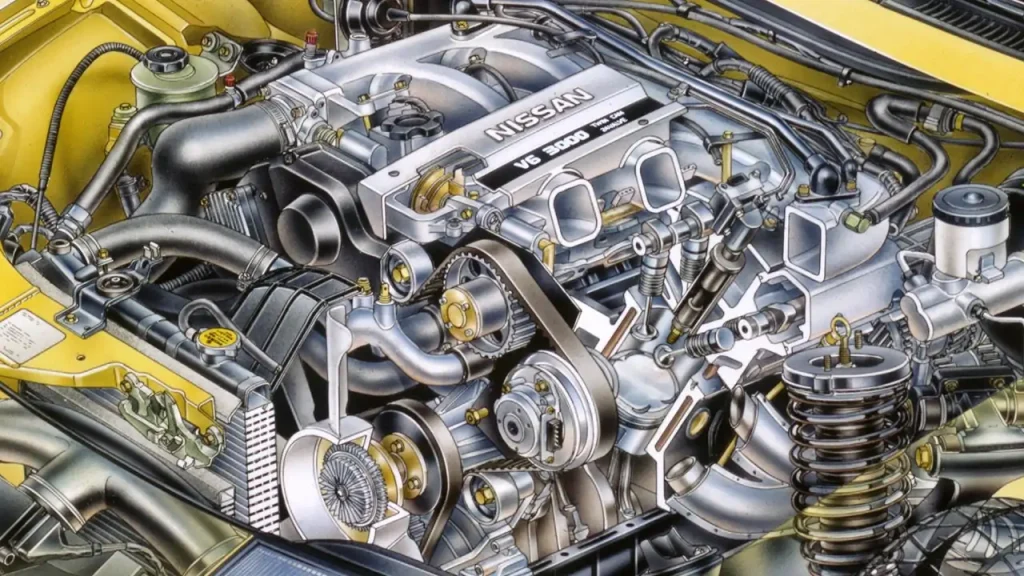
What’s particularly fascinating is how closely the prototype resembles the final production model. Aside from a handful of minor developmental changes, the vehicle is virtually identical to the 300ZX that enthusiasts would soon come to admire worldwide. However, one glance beneath the sculpted hood reveals that this isn’t the legendary twin-turbo flagship. Instead, Kimble’s cutaway showcases the naturally aspirated VG30DE—a sophisticated 3.0-liter dual-overhead-cam V6 producing a healthy 222 horsepower. While it lacked the twin-turbo model’s headline-grabbing 300-horsepower output, the naturally aspirated engine was praised for its smooth power delivery, refined character, and impressive reliability, making it a favorite among many Z enthusiasts.
Kimble’s rendering of the engine is especially noteworthy given the limitations he faced during the project. Rather than relying solely on traditional photographs, much of the artwork was created using detailed three-dimensional wireframe engineering drawings supplied directly by Nissan’s engineers. Transforming those technical schematics into a vivid, lifelike cutaway required exceptional artistic skill and mechanical understanding. The result is an illustration that not only captures the Z32’s striking design but also reveals the sophisticated engineering beneath its bodywork with remarkable accuracy.
Today, this cutaway stands as both an artistic masterpiece and an important historical document. It captures the birth of one of Nissan’s most celebrated sports cars while highlighting the close collaboration between David Kimble and the automaker. More than just an illustration, it offers a rare glimpse into the development of the Z32 300ZX before it became an icon, preserving a pivotal moment in Japanese automotive history through one of the finest technical artists of his generation.
Another subtle clue that this isn’t the flagship Twin Turbo model is what’s missing beneath the chassis. The naturally aspirated 300ZX lacks Nissan’s High Capacity Active Suspension (HICAS) four-wheel steering system—a sophisticated technology reserved exclusively for turbocharged variants. Although HICAS divided enthusiasts, with some praising its enhanced agility and others preferring the predictability of a conventional rear suspension, its absence immediately identifies this cutaway as the standard VG30DE-powered model.
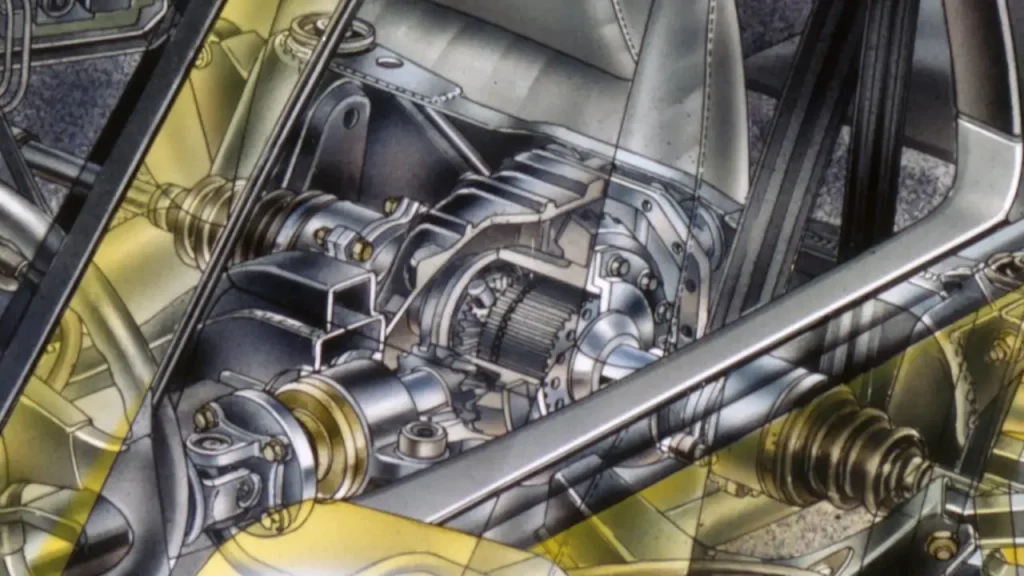
Even without HICAS, there’s no shortage of engineering brilliance to admire. Kimble meticulously illustrates the Z32’s fully independent rear suspension, revealing components that are normally hidden from view. The intricate arrangement of the control arms, hubs, and brake calipers tucked neatly behind the driver’s-side wheel showcases Nissan’s advanced suspension design, while one of the illustration’s most captivating details is the exposed limited-slip differential, complete with its finely rendered internal gears and visible ring teeth. It’s the kind of mechanical artistry that rewards careful inspection and demonstrates Kimble’s extraordinary understanding of automotive engineering.
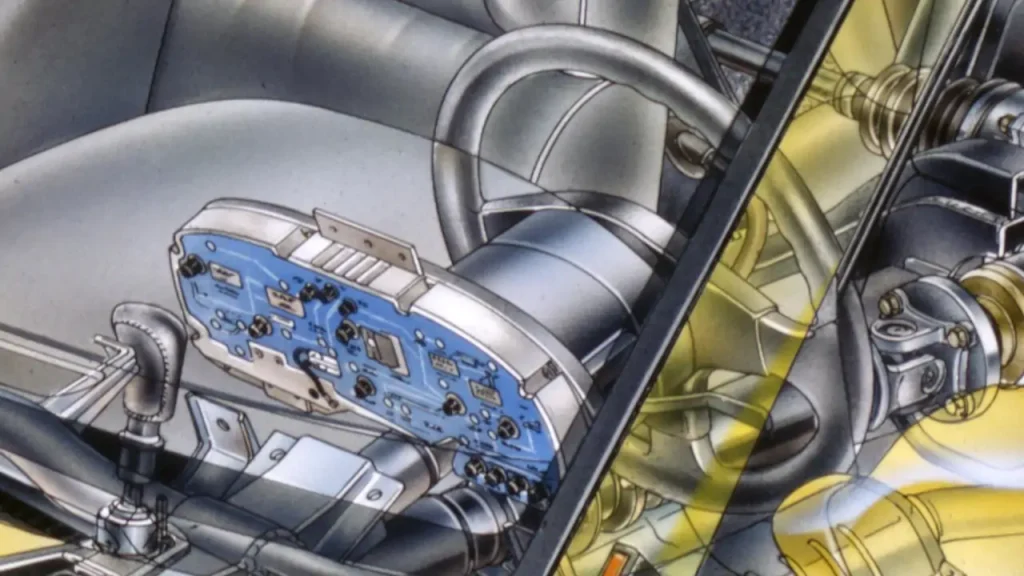
As with all of David Kimble’s finest cutaways, the closer you look, the more astonishing details emerge. Every square inch of the illustration is packed with painstakingly recreated components that most viewers would never notice at first glance. The vehicle identification plate mounted to the upper radiator support carries tiny, legible markings. Behind the dashboard, the instrument cluster exposes an intricate network of circuit boards, wiring, and electronic connections. The exhaust system even features the subtle deformation marks where the pipe gently bends around surrounding components near the accelerator pedal, a tiny manufacturing detail that few artists would ever think to include.
Perhaps most impressive is the engine bay near the firewall, where Kimble faithfully reproduces the seemingly chaotic maze of vacuum hoses, coolant lines, electrical wiring harnesses, connectors, and brackets. What appears at first to be an overwhelming tangle of components is actually an astonishingly accurate representation of the Z32’s complex mechanical layout. It’s these almost obsessive touches that transform the illustration from a simple cutaway into a technical masterpiece, inviting enthusiasts to spend hours discovering new details hidden within one of Nissan’s greatest sports cars.
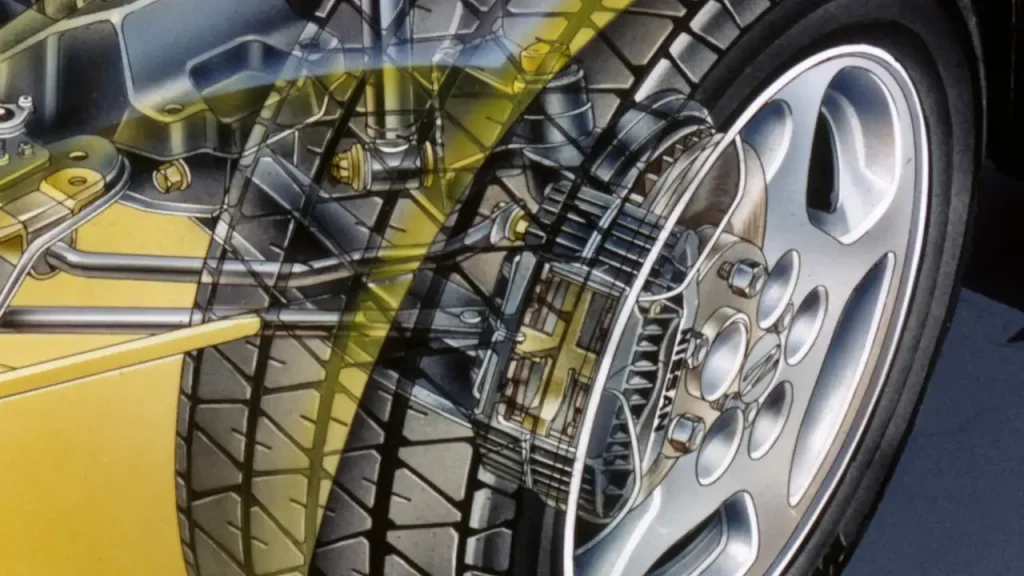
There is something uniquely balanced about this cutaway that sets it apart from many of David Kimble’s other works. While his illustrations of American muscle cars like the Dodge Viper or Shelby Cobra naturally draw your eye toward their massive engines, the Nissan 300ZX tells a different story. No single component dominates the composition. Instead, every mechanical system—from the drivetrain and suspension to the electronics and chassis—shares the spotlight, creating an illustration that emphasizes harmony rather than hierarchy.
It’s impossible to say whether this was a conscious artistic decision, but the cutaway seems to reflect the very philosophy behind the Z32 itself. During his time at Nissan, Kimble experienced the company’s famously disciplined engineering culture firsthand. He witnessed a development process built on precision, collaboration, and relentless attention to detail, where every component served a purpose within a carefully engineered whole. That experience may have subtly influenced the way he approached this illustration, giving it a calm, almost Zen-like sense of order that perfectly complements one of Japan’s greatest sports cars. Whether intentional or not, the result feels remarkably fitting.
When the second-generation Nissan 300ZX arrived for the 1990 model year, it represented a bold statement from Nissan. This wasn’t merely an affordable Japanese sports coupe—it was designed to challenge established performance icons like the Chevrolet Corvette. With sophisticated styling, advanced technology, a refined chassis, and available twin-turbo power producing 300 horsepower, the Z32 proved that Japanese engineering could compete with the world’s best. Even the naturally aspirated model, priced at roughly $30,000 when new, delivered an impressive combination of performance, comfort, and everyday usability that few rivals could match.
For many years, however, the Z32 remained one of the performance world’s best-kept secrets. While enthusiasts appreciated its engineering brilliance, resale values lagged behind its reputation. It wasn’t long ago that well-maintained naturally aspirated examples with relatively low mileage could be found for around $5,000, making them one of the greatest bargains in the sports car market.
Those days are largely gone. As appreciation for Japanese performance cars has surged, clean second-generation 300ZXs have steadily climbed in value. Naturally aspirated models now commonly sell in the neighborhood of $10,000 or more, while desirable Twin Turbo examples command significantly higher prices depending on condition, originality, and mileage. Even so, the Z32 remains comparatively attainable when measured against contemporaries like the Toyota Supra, whose most sought-after examples now routinely command six-figure auction prices.
Perhaps that’s what continues to make the 300ZX so appealing. It has never relied on hype or rarity to earn respect. Instead, its reputation has been built on exceptional engineering, timeless styling, and an understated brilliance that enthusiasts have gradually come to appreciate. Much like David Kimble’s extraordinary cutaway, the Z32 rewards those willing to look beyond the surface, revealing layer upon layer of thoughtful design and mechanical sophistication. More than three decades after its debut, it remains one of the unsung masterpieces of Japan’s golden era of performance cars—and that quiet excellence may be precisely why so many enthusiasts continue to admire it today.