
Kimble immortalized The King’s legendary race car at a time when NASCAR stock cars still closely resembled their production counterparts.
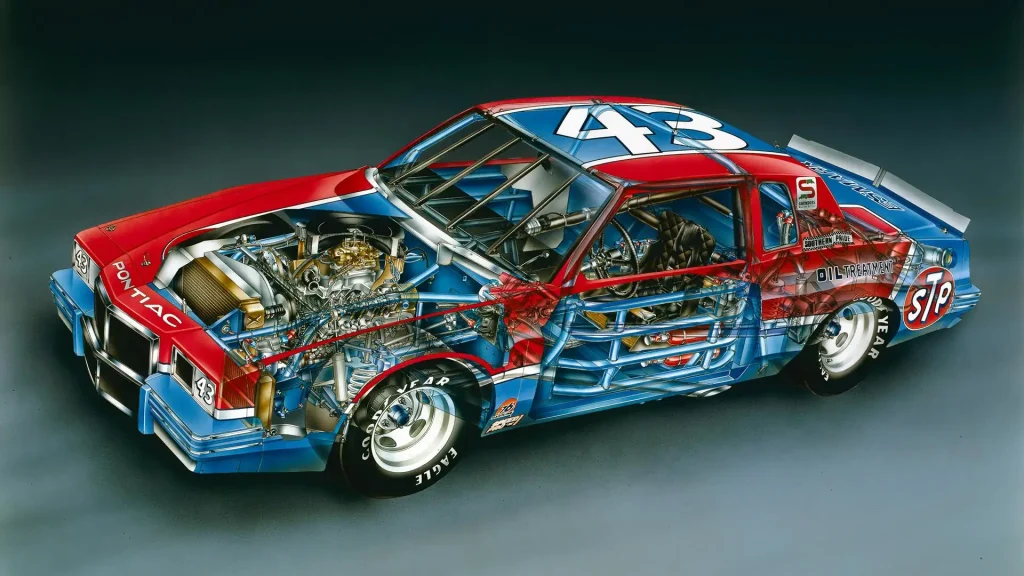
In November 1982, acclaimed automotive illustrator David Kimble and veteran automotive photographer Neil Nissing traveled to Petty Enterprises in Level Cross, North Carolina, to document one of NASCAR’s most recognizable race cars. The visit came shortly after Richard Petty drove his iconic No. 43 STP Pontiac Grand Prix to a 15th-place finish in the 1982 Atlanta Journal 500, providing Kimble with the perfect opportunity to study the car in detail before creating one of his celebrated cutaway illustrations.
At the Petty race shop, Kimble and Nissing photographed every angle of the Grand Prix, carefully documenting its chassis, engine, suspension, and bodywork. Beyond gathering the technical references needed for the illustration, the pair spent time talking with Richard Petty and the mechanics responsible for keeping the legendary No. 43 competitive throughout the 1982 NASCAR Winston Cup season.
Their visit also offered a rare glimpse into NASCAR royalty. With the Petty family home located next to the race shop, Kimble and Nissing met Lee Petty—Richard’s father, one of NASCAR’s founding legends, and the winner of the inaugural Daytona 500 in 1959. Conversations with both generations of the Petty family provided valuable insight into the sport’s history, its evolution, and the dedication that made Petty Enterprises one of NASCAR’s most successful organizations.
Looking back, November 1982 represented far more than just another assignment for Kimble. Without realizing it, he was documenting the closing chapter of an era when NASCAR race cars still shared a strong resemblance to the production vehicles sold in dealerships. Within just a few years, advances in aerodynamics, chassis construction, and racing technology would transform stock-car competition into a very different sport. Today, Kimble’s cutaway of Richard Petty’s 1982 No. 43 Pontiac Grand Prix stands as both an extraordinary technical illustration and a historical snapshot of what many fans regard as NASCAR’s golden age.
I’m not referring to the Petty legacy, which continued to thrive long after 1982. Petty Enterprises remained a NASCAR powerhouse from 1949 to 2008 before merging with Gillett Evernham Motorsports to form what is now known as Richard Petty Motorsports. Richard Petty continued racing full-time until 1992, adding several more victories to his legendary career, while his son, Kyle Petty, built a successful career as both a NASCAR driver and television commentator. Even today, the Petty name remains one of the most respected and recognizable in American motorsports.
When I talk about NASCAR’s golden age, however, I’m referring to the cars themselves—an era when stock cars still closely resembled the production vehicles they were based on, before purpose-built race machines changed the sport forever.
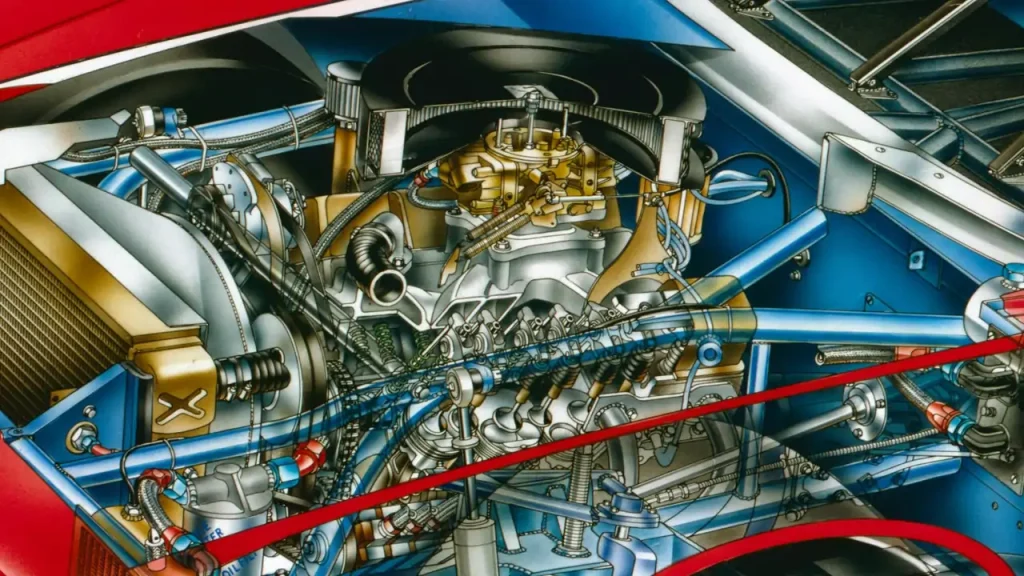
I know what many readers are thinking—and they’re not entirely wrong. At first glance, there’s nothing especially glamorous about a 1982 Pontiac Grand Prix. While Richard Petty’s NASCAR-spec No. 43 was powered by a thunderous 358-cubic-inch V8 built for the racetrack, the production Grand Prix was a very different machine. Buyers were limited to a pair of underwhelming V6 engines or the notoriously unreliable Oldsmobile 5.7-liter V8 diesel, an engine whose poor reputation severely damaged consumer confidence in diesel-powered passenger cars in the United States for years to come.
The magic wasn’t in the showroom model—it was in what NASCAR teams transformed it into. Beneath the familiar bodywork was a purpose-built race car that represented the final years of an era when “stock cars” still looked like the vehicles that inspired them.
Take another look at David Kimble’s illustration, created from photographs of the very No. 43 Pontiac Grand Prix Richard Petty raced at the Atlanta Journal 500 in November 1982. Strip away the STP decals, restore the cutaway sections, and remove every badge identifying its make and model, and its identity would still be unmistakable. The slim rear quarter windows, distinctive notchback roofline, sweeping beltline, long hood, and pointed front end with its unmistakable 1980s bumper guards all reveal the unmistakable shape of a G-Body Pontiac Grand Prix.
That was the beauty of NASCAR in the early 1980s. Even beneath the racing modifications, the cars retained the styling cues of their production counterparts. By comparison, today’s NASCAR race cars are purpose-built machines that share little more than a manufacturer’s badge and a general silhouette with the vehicles found in dealership showrooms.
A few years ago, I helped manage NASCAR sponsorships in the Truck and Nationwide Series. We were set to sponsor a Dodge Ram at Daytona, but when I arrived at the team’s shop, the “Dodge” was actually a Ford F-150 underneath. All it took was replacing the front body panels and decals to transform it into a Dodge. The race trucks were virtually identical.
That experience highlighted how much NASCAR has changed. In the 1980s, although the cars were built on purpose-made tube-frame chassis, each manufacturer’s body retained its own distinctive styling and closely resembled the production model it represented. The proportions, front-engine/rear-drive layout, and brand identity were all still intact. It was the era when the saying “Win on Sunday, sell on Monday” truly reflected the connection between the race car on the track and the car in the showroom.
David Kimble would go on to create many memorable NASCAR cutaways, but his 1982 Richard Petty Pontiac Grand Prix remains one of the most iconic. It captures a time when stock cars still closely resembled the production vehicles that inspired them.
During the photo session, Lee Petty recalled driving a 1946 Buick Roadmaster to NASCAR’s first official stock car race in 1949, racing it, and driving it home afterward. By 1966, NASCAR had adopted safer tube-frame chassis, a feature Kimble carefully incorporated into his illustration while preserving the unmistakable shape of the Grand Prix.
The November 1982 photo session came at the perfect time, as the Atlanta Journal 500 marked the final race for that particular car that season. With its racing duties complete, the Petty Enterprises crew began disassembling the Grand Prix, allowing David Kimble and Neil Nissing to photograph both the exterior and internal components in a single session. That rare access helped Kimble achieve the remarkable accuracy and detail that define this iconic cutaway illustration.
Several elements immediately draw the eye, including the heavy-duty driver’s side door bars and Richard Petty’s bold white No. 43 on the roof. Yet some of the illustration’s finest details are found toward the rear of the car. Kimble masterfully combines the Pontiac G-Body’s distinctive rear quarter windows and angular roofline with an intricate network of fuel lines, suspension components, and chassis structure. Tucked behind the driver’s seat are the live rear axle and differential, emphasizing the car’s race-ready mechanical layout. Even the braking system is accurately depicted—while the production 1982 Pontiac Grand Prix used rear drum brakes, Petty’s NASCAR machine is shown with the larger vented rear disc brakes required for the demands of stock car racing.
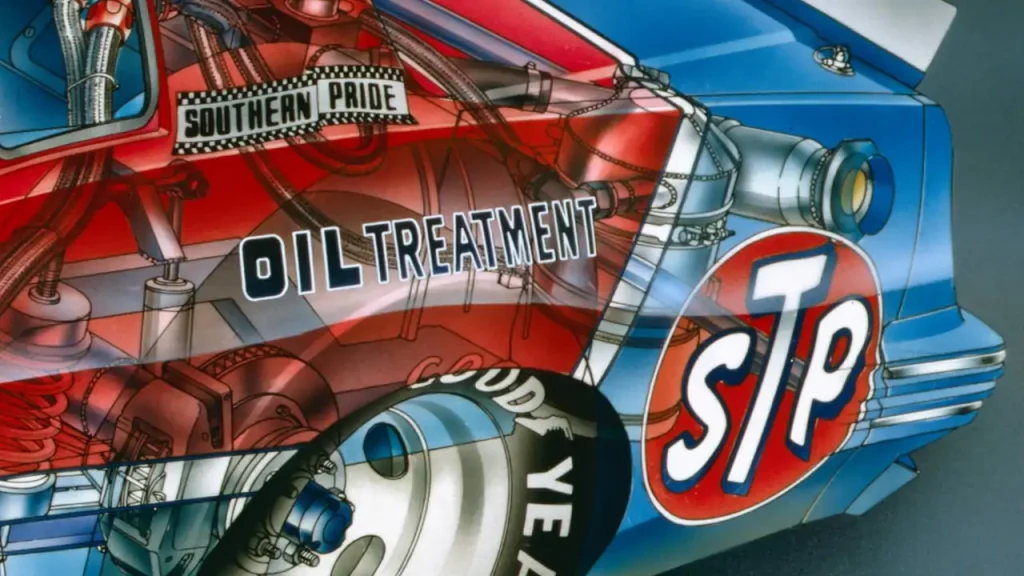
One of David Kimble’s biggest challenges wasn’t illustrating the mechanics—it was preserving the sponsor logos. He had to reveal the car’s internal structure without relocating or obscuring important decals. Careful shading, especially around the rear quarter panel, allowed both the hidden components and the sponsor graphics to remain visible. Richard Petty even advised Kimble on which logos were most important, helping him strike the right balance between technical accuracy and sponsor recognition.
When this illustration was created, NASCAR was entering a period of tremendous growth. Ironically, the sport’s expanding popularity also marked the beginning of the end for its traditional stock-car identity. By the late 1980s, General Motors introduced front-wheel-drive versions of the Pontiac Grand Prix and replaced the Chevrolet Monte Carlo with the front-wheel-drive Chevy Lumina, while their NASCAR counterparts continued to use rear-wheel drive and V8 engines. Ford stayed closer to its production models for a little longer with the Thunderbird, but eventually introduced a NASCAR version of the Ford Taurus that shared little more than its name and basic appearance with the showroom car, pushing the sport even farther from its stock-car origins.
By this point, NASCAR had reached the height of its popularity. Since then, the sport has undergone numerous rule changes and technical revisions that fans continue to debate. The introduction of the Car of Tomorrow in 2007 largely erased the visual differences between manufacturers by adopting standardized body templates. Although the Generation 6 cars introduced in 2013 restored some brand-specific styling, today’s NASCAR race cars are still distinguished more by their graphics and body wraps than by the unique design cues of the production vehicles they represent.
That is what makes David Kimble’s 1982 Richard Petty Pontiac Grand Prix one of his most memorable cutaway illustrations. More than a beautifully rendered race car, it preserves an era when manufacturer identity mattered, every brand had its own distinctive look, and NASCAR drivers were approachable heroes to millions of fans. The cars still reflected their production counterparts closely enough to truly earn the name “stock cars,” and Kimble’s artwork captures that spirit with remarkable authenticity.
David Kimble’s illustration of Richard Petty’s 1982 No. 43 Pontiac Grand Prix is more than a remarkable cutaway—it is a lasting record of NASCAR’s final years when stock cars still looked and felt like their showroom counterparts.
For more than five decades, David Kimble has been recognized as one of the world’s premier automotive technical illustrators. A graduate of the Pasadena Academy of Technical Arts, he began his career in 1964, producing meticulously detailed cutaways based on engineering drawings, CAD data, extensive photography, and hands-on vehicle inspections. His work has appeared in leading automotive publications, including MotorTrend and Car and Driver, earning praise for its precision and artistry.
Working from his studio in Marfa, Texas, Kimble continues to create these intricate illustrations almost entirely by hand. Each cutaway requires months of careful research and drafting, showcasing a level of craftsmanship that remains exceptional in an age dominated by digital design.