
We put our long-term Mazda3 up against Mazda’s taller crossover sibling.
Everyone at Motor1.com has been impressed by the Mazda3 hatchback. It combines sharp styling, engaging handling, and a surprisingly upscale interior, making it one of the more compelling choices in the crowded compact-car class. So when Mazda carried much of that same formula into a small crossover, the result was bound to get our attention.
The Mazda CX-30 takes many of the qualities that make the 3 hatchback appealing and raises them into a taller, more crossover-friendly package. The two models share much of their underlying hardware, including key chassis components and four-cylinder engines, and we’ve driven both extensively. Their driving characteristics are remarkably similar, but the differences in size, practicality, styling, and packaging are important considerations for anyone deciding between the two.
What’s Different?
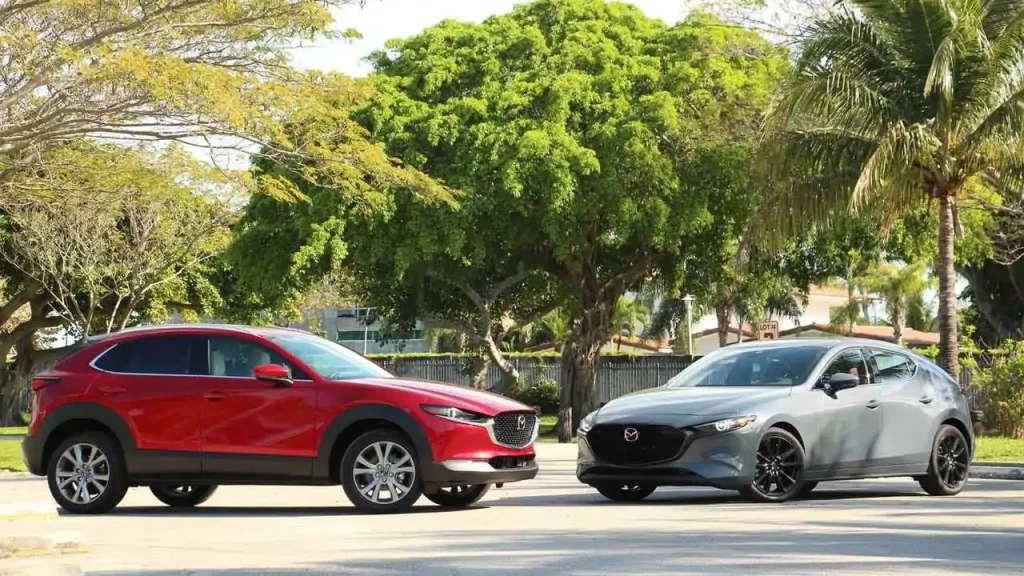
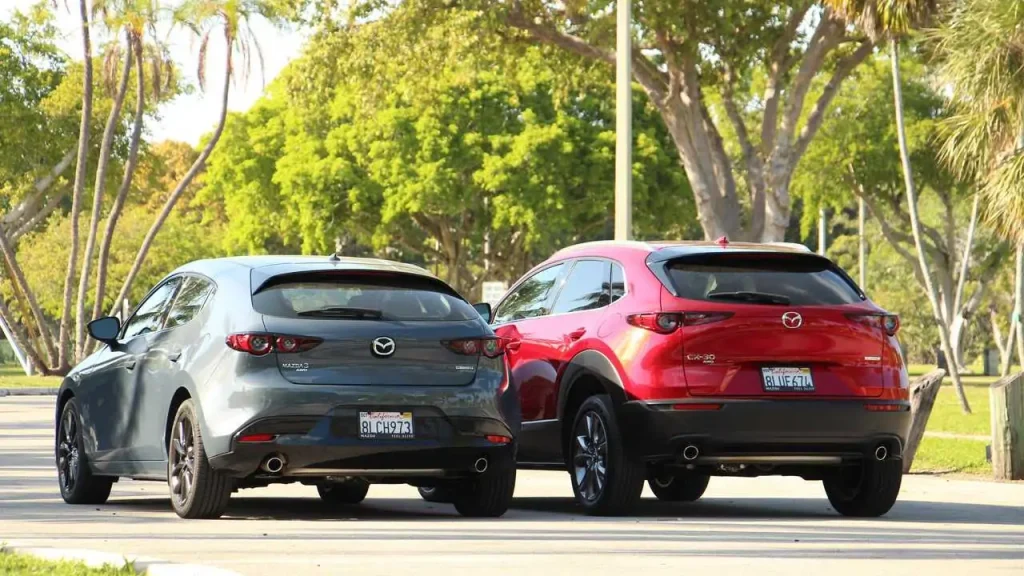
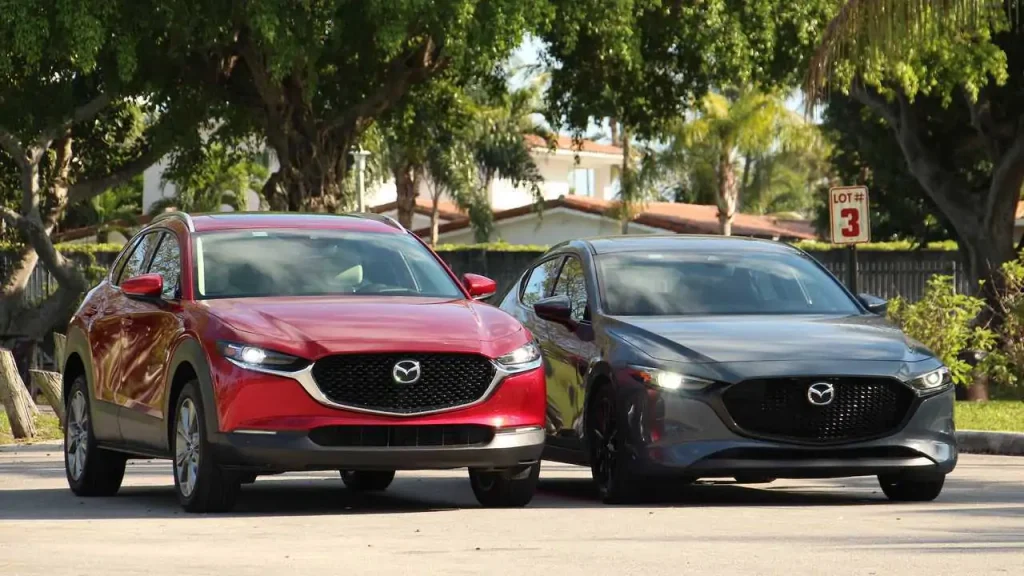
The differences between the two Mazdas are easy to spot. The CX-30 wears rugged body cladding around its wheel arches and offers 7.9 inches of ground clearance, while the Mazda3 keeps the lower, sleeker proportions of a traditional hatchback and sits just 5.5 inches off the ground. The Mazda3 shown here also features 18-inch gloss-black wheels and model-specific black trim around the grille. The CX-30 uses 18-inch wheels with a different spoke design and skips the Mazda3’s blacked-out grille treatment.
The two models aren’t identical in size, either. The Mazda3 has a wheelbase that’s roughly three inches longer than the CX-30’s, and it’s nearly two inches longer overall. The CX-30 makes up for that with a significantly taller profile, measuring 61.7 inches high compared with the Mazda3’s 56.7 inches. That extra height gives the crossover a more upright stance, while the lower Mazda3 maintains the proportions you’d expect from a compact hatchbackHere’s how the two stack up on dimensions:
Mazda3 Hatchback Vs. CX-30: Exterior Dimensions
| Dimension | Mazda3 Hatchback | Mazda CX-30 |
| Wheelbase | 107.3 inches | 104.5 inches |
| Length | 175.6 inches | 173.0 inches |
| Width | 70.7 inches | 70.7 inches |
| Height | 56.7 inches | 61.7 inches |
| Ground Clearance | 5.5 inches | 7.9 inches |
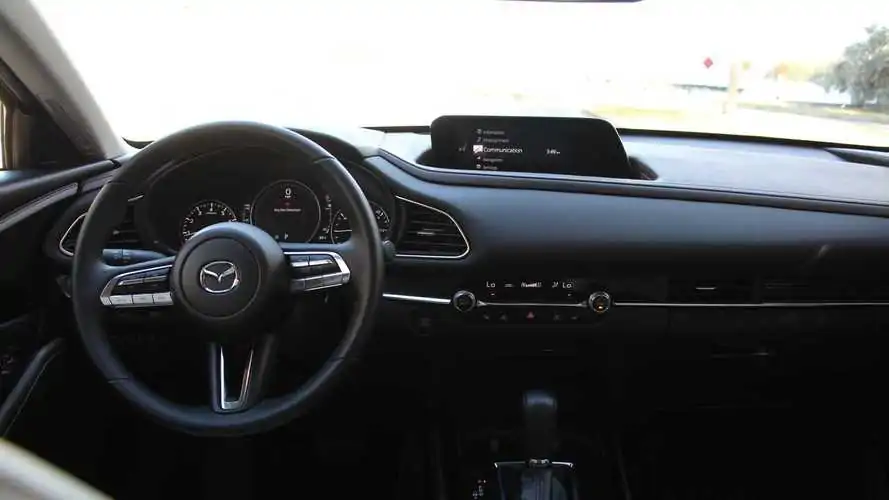
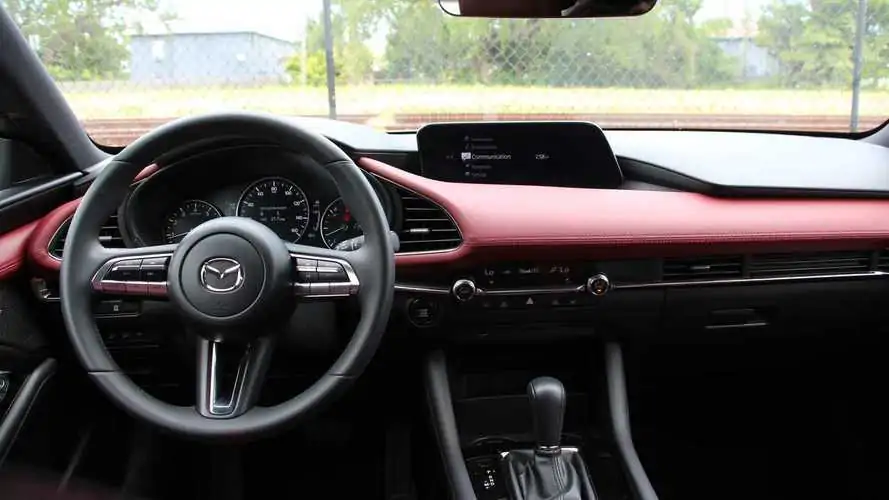
Inside, the differences between the two are a little harder to spot. The CX-30 gets a distinctive two-tone brown-and-black dashboard, black door panels, and white leather seats, with the latter being exclusive to the crossover. Mazda reserves red leather for the Mazda3 hatchback. Our CX-30 Premium also has a few convenience features that aren’t available on the 3, including rear air vents and a power liftgate. Even a fully loaded Mazda3 can’t be equipped with either.
Despite its crossover proportions, the CX-30 doesn’t offer dramatically more room for passengers than the lower-slung Mazda3. The CX-30 has slightly more headroom and a bit more rear-seat legroom, while the Mazda3 provides more legroom and shoulder room up front. Cargo capacity is nearly identical, too, with 20.1 cubic feet behind the rear seats in the Mazda3 and 20.2 cubic feet in the CX-30.
| Dimension | Mazda3 Hatchback | Mazda CX-30 |
| Front Headroom | 38.0 inches | 38.1 inches |
| Rear Headroom | 37.2 inches | 38.3 inches |
| Front Shoulder Room | 55.7 inches | 55.6 inches |
| Rear Shoulder Room | 53.4 inches | 53.6 inches |
| Front Hip Room | 54.6 inches | 54.6 inches |
| Rear Hip Room | 50.9 inches | 53.2 inches |
| Front Legroom | 42.3 inches | 41.7 inches |
| Rear Legroom | 35.1 inches | 36.3 inches |
| Cargo Space | 20.1 cu. ft. | 20.2 cu. ft. |
The two models share the same 2.5-liter engine and six-speed automatic transmission, with both examples also equipped with optional all-wheel drive. Fuel economy is nearly identical, although the CX-30 has a slight edge. The all-wheel-drive Mazda3 returns 24 mpg city, 32 highway, and 27 combined, while the CX-30 manages 25 mpg city, 32 highway, and 27 combined. Both models also have a 12.7-gallon fuel tank when equipped with AWD.
Pricing gives the CX-30 another advantage at the entry level. The 2020 Mazda3 hatchback starts at $23,700 with front-wheel drive, while the CX-30 comes in at $21,900. Adding all-wheel drive costs $1,400 on either model. At the top of the lineup, however, the Mazda3 Premium is actually less expensive, starting at $28,900 before options compared with $29,600 for the range-topping CX-30 Premium.
What They Have In Common
Despite the differences, the Mazda3 and CX-30 share far more than they don’t. Mazda’s signature “Kodo” design language carries over from the hatchback to the crossover, albeit with a few styling tweaks. More importantly, much of the hardware underneath is shared between the two models.
Both ride on the same platform and use the same 2.5-liter four-cylinder engine, which produces 186 horsepower and 186 pound-feet of torque. Front-wheel drive comes standard, while all-wheel drive is available for an additional $1,400. The two examples shown here are both equipped with the optional AWD system.
The similarities continue inside. Beyond their different color and trim treatments, the Mazda3 and CX-30 share the same steering wheel and 8.8-inch infotainment display with Mazda’s latest multimedia system. Both also feature a central digital instrument display that provides key information, including vehicle speed and safety-related alerts.
Powertrain Comparison
| Specification | Mazda3 Hatchback AWD | Mazda CX-30 AWD |
| Engine | 2.5-liter I4 | 2.5-liter I4 |
| Horsepower | 186 hp | 186 hp |
| Torque | 186 lb-ft | 186 lb-ft |
| Transmission | 6-speed automatic | 6-speed automatic |
| Drivetrain | AWD | AWD |
| Fuel Economy | 24/32/27 mpg | 25/32/27 mpg |
| Fuel Tank | 12.7 gallons | 12.7 gallons |
Which One Should You Choose?
Picking a winner between these two is surprisingly difficult. The Mazda3 and CX-30 share so much in terms of powertrain, interior space, and driving character that neither has a clear advantage in every category. They may belong to different segments, but their similar dimensions and shared hardware make the decision less straightforward than it might seem. If we had to choose, though, we’d give the CX-30 a slight edge.
Its taller ride height and elevated seating position make the CX-30 a little easier to live with day to day, while it retains much of the Mazda3’s engaging handling and sporty character. It gives up surprisingly little of the hatchback’s fun-to-drive nature, making the CX-30 our preferred choice by a narrow margin.
Still, there’s no wrong answer here. Both models offer sharp styling, enjoyable driving dynamics, reasonable pricing, and cabins that feel more upscale than their price tags suggest. Choose the CX-30 if you want a higher seating position and crossover proportions, or go with the Mazda3 if you prefer a lower, slightly sportier hatchback. Either way, you’re getting one of Mazda’s more compelling compact offerings.