How well can the crossover handle a weekend of towing and adventure gear?
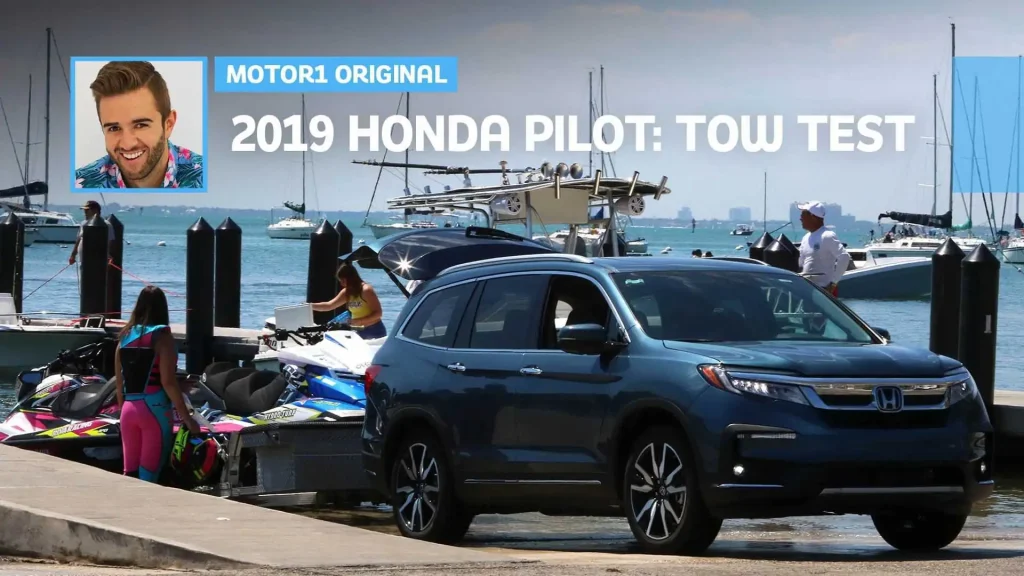
As car-like crossovers continue to replace traditional truck-based SUVs, automakers are finding ways to blend the comfort and efficiency of unibody construction with the capability buyers once associated with body-on-frame vehicles. Our long-term 2019 Honda Pilot is a good example. Although it rides on a unibody platform, the boxy three-row crossover can tow up to 5,000 pounds when properly equipped, matching the maximum towing capacity of the more truck-like Toyota 4Runner.
There is, however, an important catch. Not every Pilot is capable of towing 5,000 pounds. All-wheel drive is required, and while it comes standard on our Elite model, adding it to other Pilot trims costs $1,900. Buyers also need a dealer-installed tow hitch and an accessory transmission cooler to reach the maximum rating. Without that equipment, the Pilot’s towing capacity drops to 3,500 pounds. With the proper setup, though, the Honda sits comfortably alongside competitors such as the Chevrolet Traverse, Subaru Ascent, and Toyota Highlander.
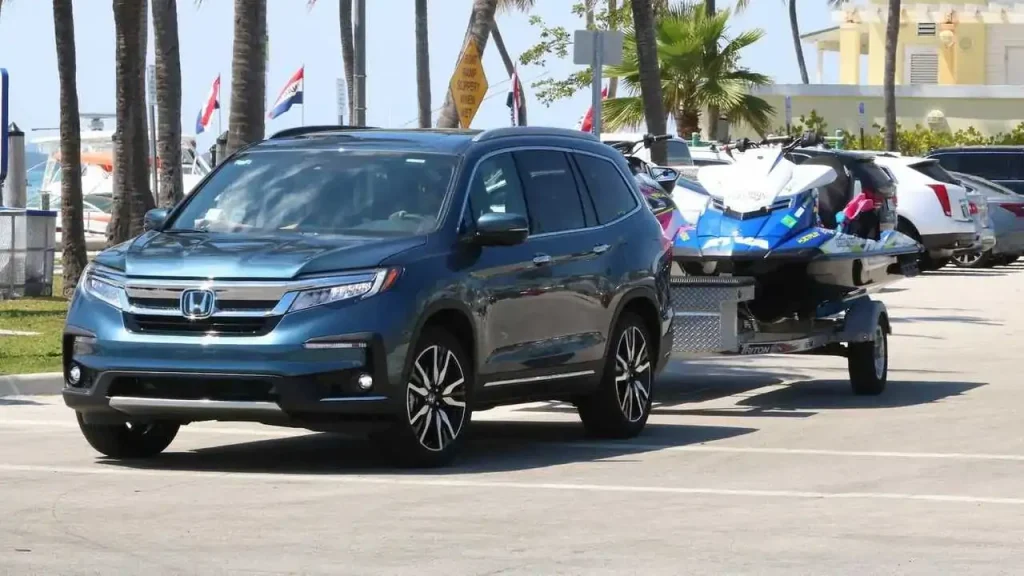
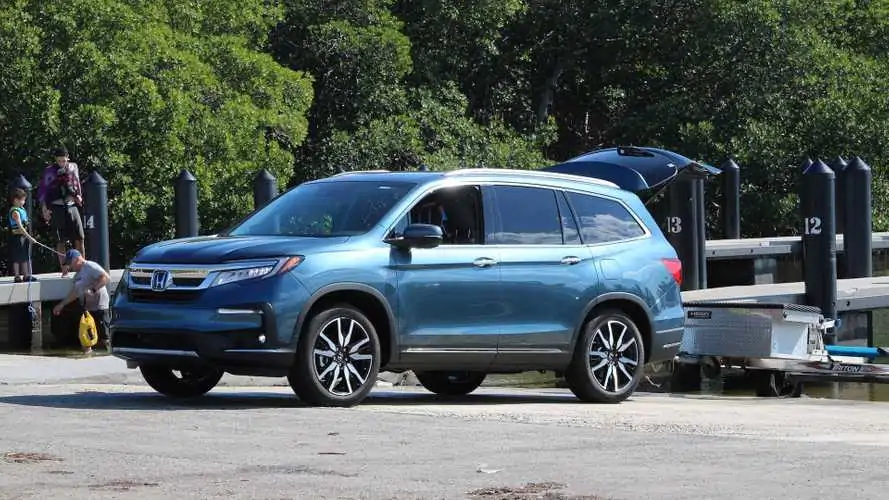
We wanted to find out what that 5,000-pound rating meant in the real world, so we put our Pilot to work in the best possible Florida fashion: towing a pair of high-performance Yamaha WaveRunners to the water. Southern Florida offers no shortage of boat ramps, and our destination was Key Biscayne, where we could give the Pilot a proper towing workout.
The WaveRunners belonged to fellow Motorsport Network employee Amanda LeCheminant. During the week, Amanda serves as the company’s vice president and general counsel, but weekends are a different story. She swaps her business attire for a bright pink racing helmet and heads to the water with her boyfriend, George, to compete in endurance races aboard their RIVA Racing-powered Yamaha WaveRunners.
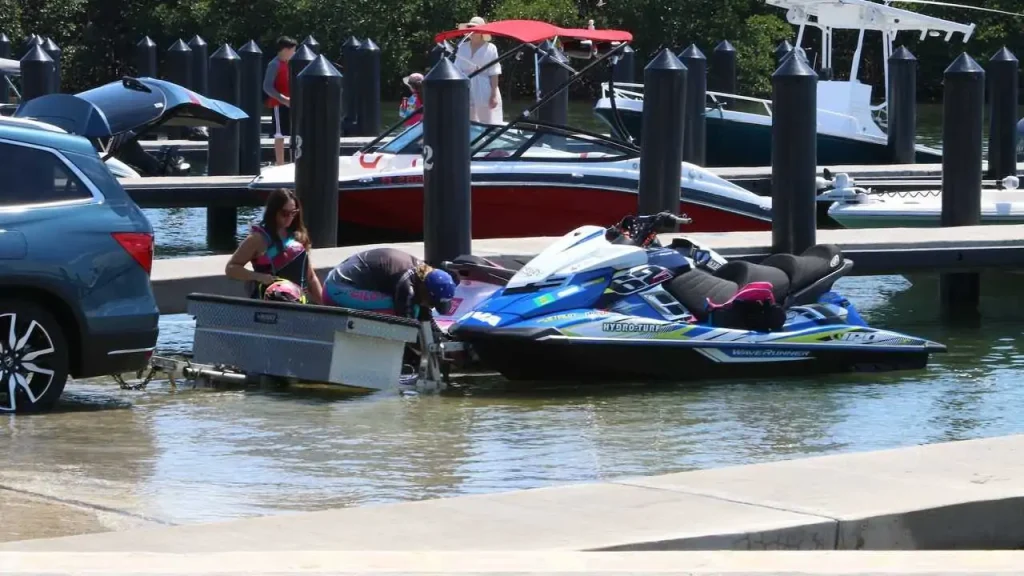
Each watercraft produces more than 200 horsepower, and the pair regularly compete at Amateur and Pro/Am levels at events around the country. Their home waters around Miami also provide an ideal place to train between races. For this particular outing, both WaveRunners were loaded onto a double trailer, with their fuel tanks full. Combined with the trailer, the total weight came to roughly 3,700 to 3,800 pounds.
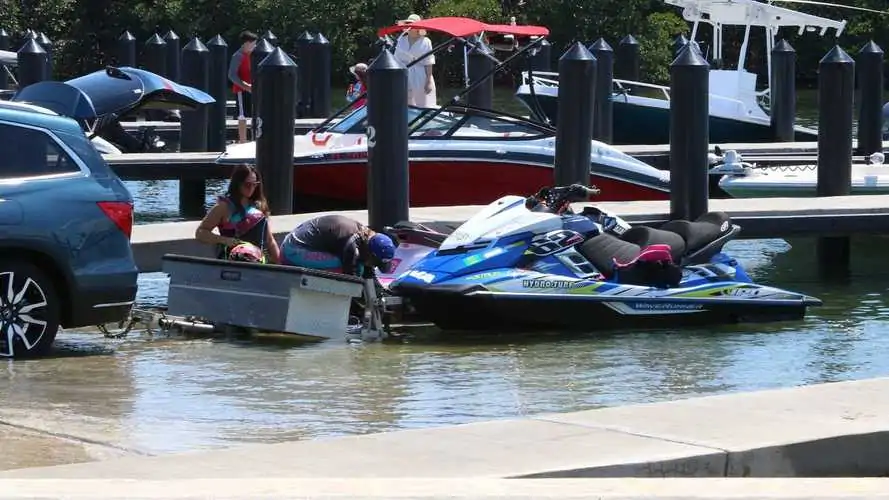
That figure represents about 75 percent of the Pilot’s maximum 5,000-pound towing capacity. In other words, we weren’t asking the Honda to operate at its absolute limit, but the load was substantial enough to provide a meaningful real-world test.
After connecting the trailer, we loaded the Pilot’s cargo area with the usual assortment of watersports equipment, including extra life jackets, wetsuits, and other essentials. With everything secured, we headed out from Boca Raton toward the boat ramps in Key Biscayne. The trip covered approximately 52 miles, giving us a mixture of city streets and highway driving to see how the Pilot handled the added weight.
The 3.5-liter V6 provides 280 horsepower and 262 pound-feet of torque, and under normal circumstances it has no trouble moving the Pilot briskly. With the trailer attached, however, the extra mass becomes immediately noticeable. The Honda still reaches highway speeds without much drama, but the engine has to work harder to maintain momentum and accelerate when needed.
That becomes especially apparent during highway passing. The V6 needs to dig deeper into its rev range to access its available power, with peak horsepower arriving at 6,000 rpm. The additional weight also changes the Pilot’s handling characteristics. The 245/50 all-season tires feel noticeably more loaded as the crossover negotiates tighter turns and the highway onramp leading to Interstate 95.
It’s a useful reminder that towing capacity isn’t simply a number on a specification sheet. A vehicle may be rated to pull 5,000 pounds, but the experience behind the wheel changes as the trailer gets heavier. Acceleration, braking, cornering, and overall stability all require more attention.
Still, the Pilot remained composed during the trip. The crossover doesn’t suddenly feel like a pickup truck when a trailer is attached, but it does demonstrate that Honda engineered it to handle more than the typical family-crossover workload.
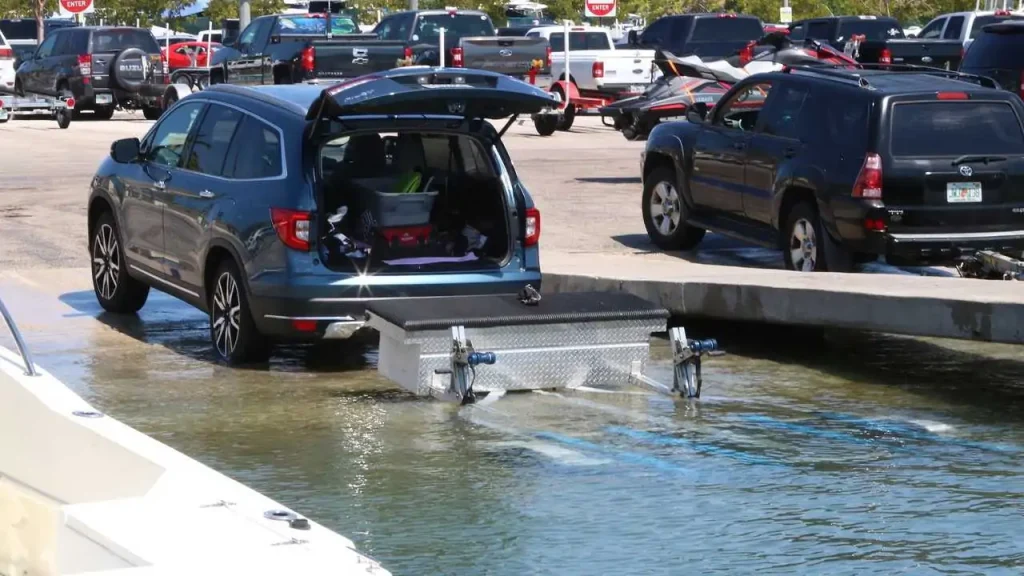
The real test came when we reached the Key Biscayne launch ramp. On a busy Saturday, the area was packed with families, boats, and personal watercraft, leaving little room for error while maneuvering the trailer into position. Amanda opened the Pilot’s tailgate to make it easier to see the trailer and guide it toward the water.
One feature we would have appreciated at that moment was a 360-degree camera. The Pilot has a multi-view camera system and a host of standard safety technologies, but it doesn’t offer a full surround-view camera. When backing a trailer down a crowded boat ramp, the additional visibility provided by a 360-degree system would have been particularly useful.
Boat ramps can also present another challenge: traction. Water, algae, and debris can make the surface surprisingly slippery, especially when a vehicle is trying to pull a heavy trailer back out of the water. Fortunately, the Pilot’s all-wheel-drive system proved valuable here.
After launching the WaveRunners, the Pilot climbed back up the Key Biscayne ramp without significant difficulty. The all-wheel-drive system provided the traction necessary to move the crossover and trailer back onto dry pavement, demonstrating one of the reasons Honda requires AWD for the Pilot’s maximum towing rating.
Our 3,700- to 3,800-pound load was well below the Pilot’s 5,000-pound maximum, so this wasn’t an attempt to determine how the crossover behaves at its absolute limit. Nevertheless, the experience provided a useful look at what the Pilot can realistically handle when properly equipped.
For families who occasionally tow a small boat, personal watercraft, camper, utility trailer, or similar recreational equipment, the Pilot makes a compelling case. It offers the comfort, interior space, and road manners expected from a modern crossover while providing towing capability that approaches that of some traditional SUVs.
The experience also highlights the importance of choosing the right equipment. Buyers who expect to tow should make sure their Pilot has all-wheel drive, the appropriate tow hitch, and the accessory transmission cooler needed to reach the 5,000-pound rating. Without those components, the maximum drops considerably.
After a 52-mile trip carrying nearly 3,800 pounds of WaveRunners and trailer, the 2019 Honda Pilot Elite emerged as a surprisingly capable tow vehicle. It isn’t a substitute for a full-size pickup when heavy-duty towing is required, but that’s not really its mission. Instead, it provides enough capability for the recreational equipment that many families actually need to haul, while retaining the comfort and practicality that make a crossover appealing in the first place.
For someone looking to combine daily family transportation with weekend adventures, that balance may be exactly what makes the Pilot such an appealing alternative to a traditional truck-based SUV.