
We spotted five amazing details—but chances are you’ll find even more.
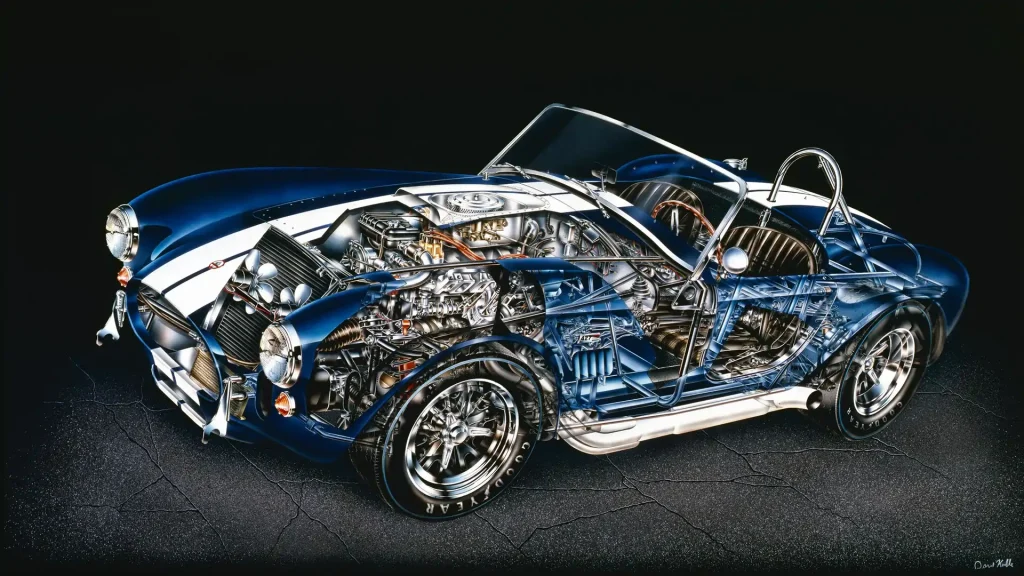
In an era of CAD software, digital renderings, and 3D-printed prototypes, it’s easy to forget that David Kimble’s legendary automotive cutaways are created almost entirely by hand. His illustration of the 1965 Shelby Cobra 427 S/C wasn’t built with a computer—it came to life through pencils, paint, paper, extraordinary patience, and a rare ability to blend artistic beauty with mechanical precision.
Of course, Kimble’s work isn’t driven by artistic talent alone. His drafting table is just as likely to hold rulers, scales, French curves, compasses, and engineering templates as it is brushes and colored pencils. A graduate of the Pasadena Academy of Technical Arts, Kimble spent years in technical illustration and engineering-related roles before launching his own illustration studio in 1976. That background gave him an uncommon ability to understand a machine as thoroughly as he could draw it.
That’s precisely why this Shelby Cobra cutaway is so captivating. It exists at the intersection of art and engineering, where every line is both aesthetically pleasing and mechanically accurate. Every bolt, bracket, wire, and body panel is positioned with the same care an engineer would demand and the same artistry a painter would admire.
To appreciate that craftsmanship, it’s worth slowing down and looking beyond the obvious. Yes, the perfectly rendered rivets in the hood scoop are remarkable. The reflections dancing across the headlight lenses are equally impressive. But those details are only the beginning. Spend a little more time exploring the illustration, and you’ll uncover dozens of tiny touches that reveal just how obsessive Kimble was in his pursuit of perfection. The deeper you look, the more extraordinary this Cobra becomes.
Before diving into Kimble’s illustration, it’s worth taking a closer look at the car itself. The Shelby Cobra is one of the most recognizable performance cars ever built, yet its engineering story is often overshadowed by the legend of its thunderous V8.
The popular version is simple enough: Carroll Shelby took the lightweight AC Ace roadster from England, stuffed a massive Ford V8 under its hood, and created an American icon. While that’s true in broad strokes, it leaves out the engineering transformation that made the Cobra more than just a small car with a big engine.
The earliest 260- and 289-powered Cobras were still heavily based on the AC Ace, a chassis originally designed around a modest inline-six and transverse leaf springs. It was light and nimble, but it wasn’t engineered to cope with the immense power that Shelby’s vision would ultimately demand. As horsepower climbed, the chassis had to evolve just as dramatically.
That evolution arrived in 1965 with the MkIII Cobra. To accommodate the fearsome 427-cubic-inch Ford FE V8, the car received an entirely new 4-inch tubular ladder frame that was significantly stronger than before. The suspension was redesigned with fully independent coil springs at all four corners, wider tracks, revised geometry, and stronger driveline components. These weren’t incremental upgrades—they fundamentally changed how the Cobra accelerated, cornered, and survived the punishment of racing.
In many ways, the Cobra’s greatest engineering achievement wasn’t squeezing a big-block into a tiny roadster. It was creating a chassis capable of harnessing all that power. Without the MkIII’s stronger frame and sophisticated suspension, the 427 Cobra would have been little more than an unruly handful. Shelby’s bold idea succeeded because meticulous engineering kept pace with raw horsepower.
That brings us back to the car in Kimble’s illustration: a rare 1965 Shelby Cobra 427 S/C. Only 51 examples were converted from unsold competition-spec cars into S/C, or “Semi-Competition,” models by fitting mufflers, a windshield, and other equipment required for street use. Today, they’re among the most coveted Cobras ever built.
Kimble’s cutaway captures far more than the Cobra’s famous V8. Follow the intricate lines of the MkIII chassis, trace the suspension mounting points, or study the web of tubes beneath the aluminum bodywork, and you’ll discover an illustration that’s as much an engineering blueprint as it is a work of art. The more closely you examine it, the more remarkable his accuracy becomes. To see what I mean, start with these four areas.
Weld Beads at Nearly Every Chassis Joint
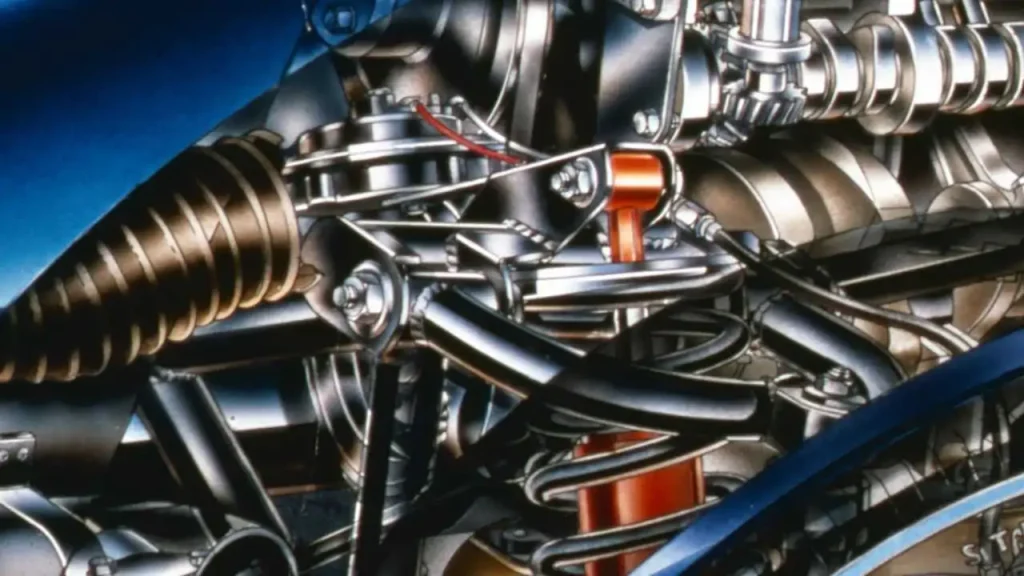
The first detail that caught my eye was the tiny weld bead securing the driver-side front shock mount. From there, they seemed to appear everywhere. The upper control arm features visible welds, the radiator support braces show neatly rendered joints where the tubes intersect, and a closer inspection of the chassis reveals the same meticulous treatment throughout. Everywhere two metal components would be welded together on the real car, Kimble has carefully illustrated the weld beads. They’re almost imperceptible at first glance, but once you notice them, you can’t help but appreciate the extraordinary level of craftsmanship behind the drawing.
The Hidden Wiring Harness Behind the Dashboard
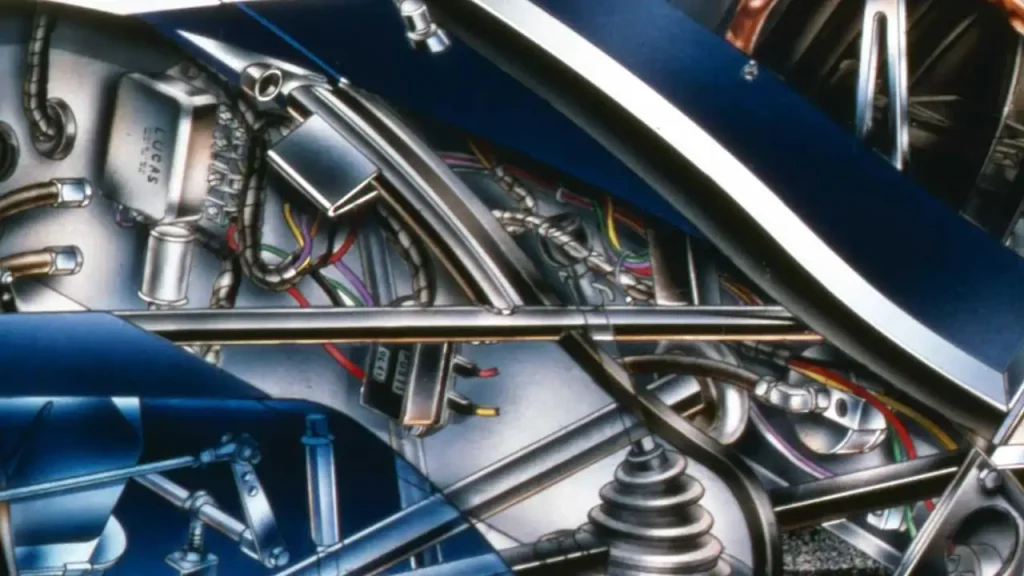
While following the maze of frame tubes and dashboard supports, I came across what initially looked like a mechanical linkage. A closer look told a different story. Starting at the center of the firewall and running toward the driver’s side, the line eventually branches into a bundle of color-coded wires behind the speedometer. It wasn’t a linkage at all—it was the car’s wiring harness.
The wiring harness is easy enough to spot in the engine bay, where it’s exposed and expected. But Kimble didn’t stop there. He continued it behind the dashboard, carefully illustrating the hidden wiring that most people would never think to look for, let alone expect to see in a hand-drawn cutaway.
A Fusible Link Protecting the Electric Fan Circuit
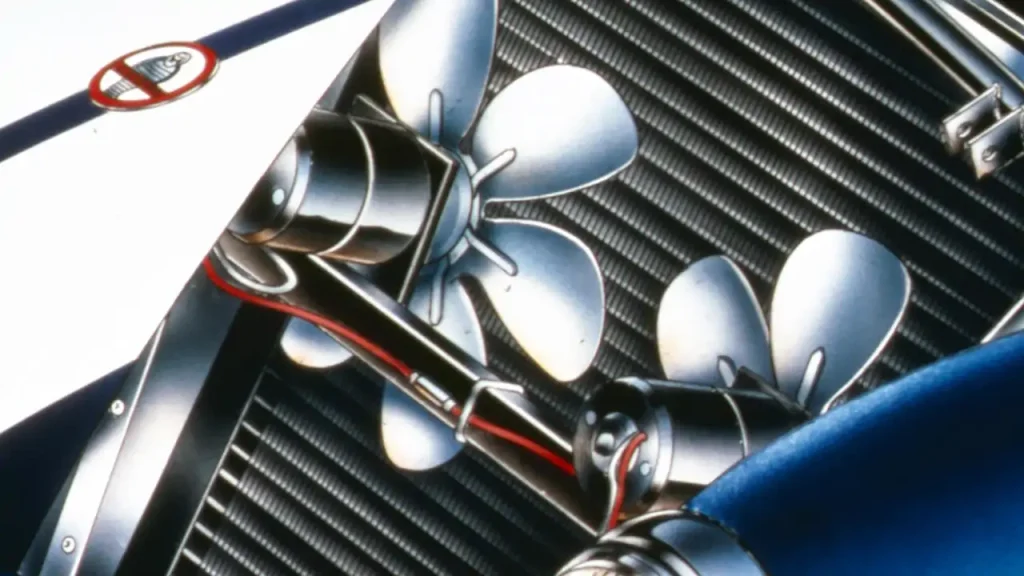
At first glance, it looks like nothing more than another wire running to the electric cooling fan. Look closer, however, and you’ll notice Kimble included a fusible link in the power lead—a tiny but critical safety component that protects the circuit from catastrophic electrical overloads. In the real car, a fusible link acts as a sacrificial conductor, melting before excessive current can damage the wiring harness or start an electrical fire. It’s the sort of detail that’s almost impossible to notice without magnification, yet Kimble took the time to include it anyway. Most artists would have been content drawing a simple wire. Kimble drew the wire—and the component protecting it.
The Toploader’s Inner Workings Are Fully Exposed
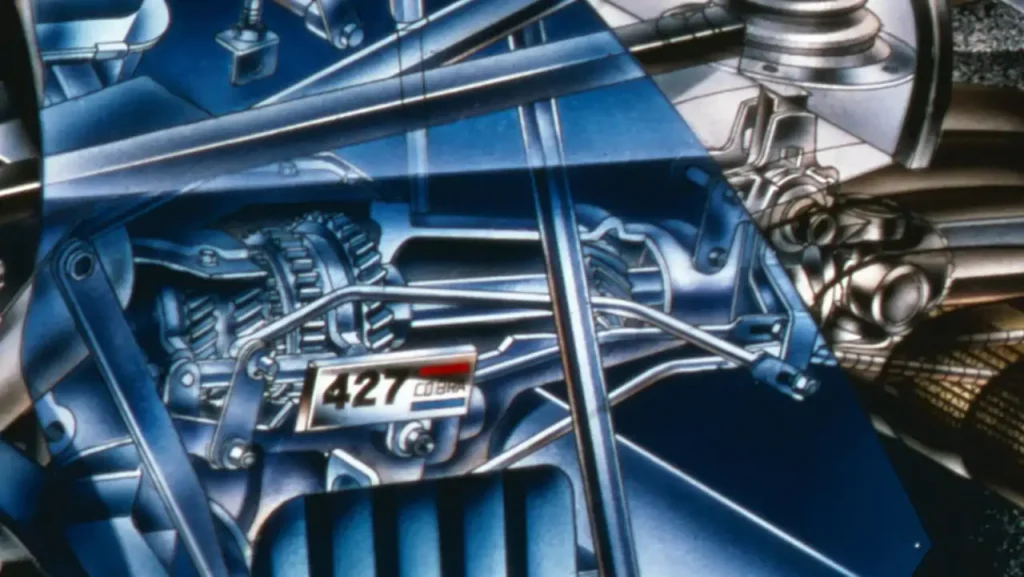
You’ll find exposed gearboxes in many of David Kimble’s cutaways, but this one feels especially deliberate. Rather than simply opening the transmission case, Kimble clearly wanted to showcase the Shelby Cobra’s legendary Ford Toploader four-speed, a gearbox introduced in 1964 that quickly earned a reputation for exceptional strength and durability. Through the cutaway, four meshing gears are visible inside the case, each accurately positioned with realistic tooth profiles and spacing. Just as impressive are the external shift rails, linkages, and selector levers surrounding the transmission, all carefully arranged around the Cobra’s iconic 427 badge.
It’s a detail most viewers will overlook, but it perfectly illustrates Kimble’s philosophy. He wasn’t interested in exposing parts for the sake of spectacle—he wanted to explain how the car worked. By revealing both the internal gearset and the external shifting mechanism, he transforms the Toploader from a simple transmission into one of the mechanical stars of the illustration.
The Tiny Distributor Drive Gear
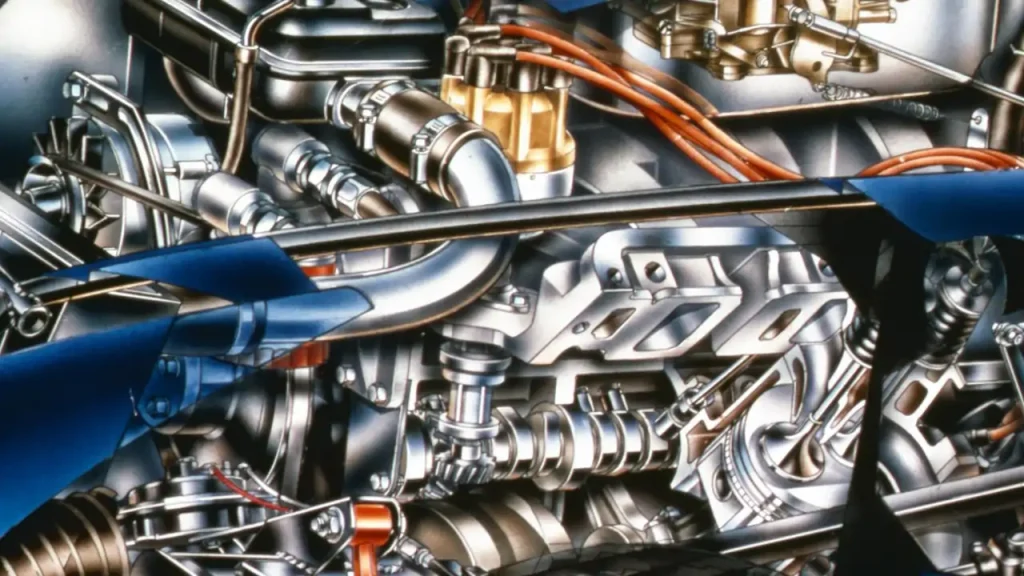
The 427 V8 may dominate the engine bay, but tucked beneath the yellow distributor is one of the cutaway’s easiest details to miss: the distributor drive gear. This small helical gear meshes with the camshaft, precisely timing the ignition so each spark plug fires at the right moment. It’s a tiny component with a vital job, and one most artists would never bother to illustrate. Yet Kimble included it anyway. Once you spot the gear, it’s impossible not to notice it every time you look at the engine—a perfect example of his remarkable blend of artistic skill and mechanical accuracy.
We found five—but how many can you find?
Of all of David Kimble’s cutaways, the Shelby Cobra remains one of my favorites. I’ve studied this illustration countless times over the years, yet I didn’t notice these five details until I stopped admiring it as a piece of art and started examining it as a piece of engineering. That’s the brilliance of Kimble’s work: every time you look closer, there’s something new to discover.
Now it’s your turn.
Forget that you’re looking at a 1965 Shelby Cobra 427 S/C for a moment. Instead, explore it component by component. Follow the chassis tubes. Study the suspension. Trace the wiring. Inspect the engine, transmission, brakes, and cockpit. You’ll quickly realize this isn’t just an illustration—it’s an incredibly faithful technical rendering of a real automobile, packed with details that reward careful observation.
We found five hidden gems, but we’re certain there are many more.
How many can you find? Let us know in the comments and share your favorite discovery. Chances are, you’ll spot something the rest of us missed.