
Numbers don’t lie: engines and chassis, tires, brakes, all have changed so much over time.
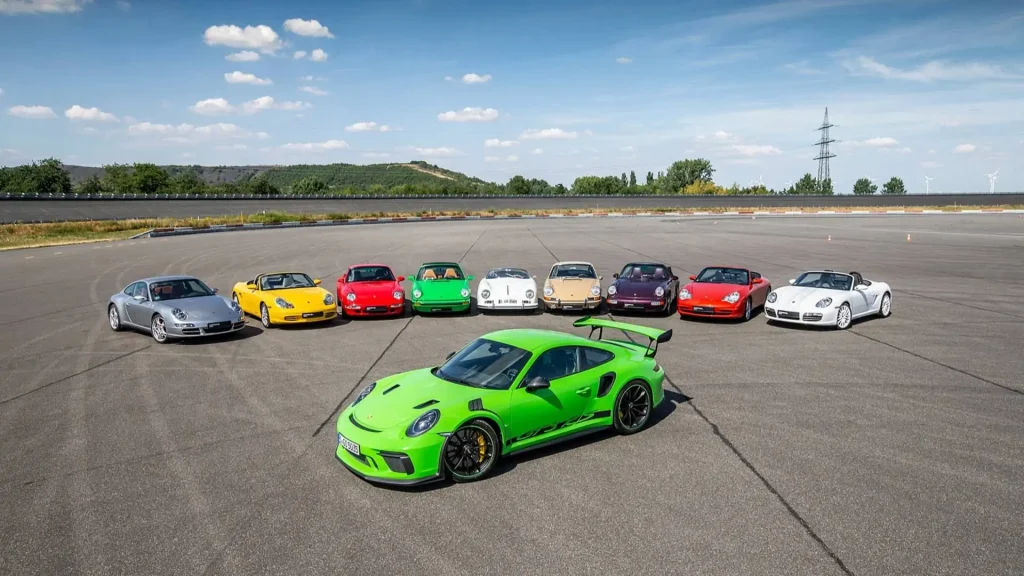
The Porsche 911 is one of the automotive world’s great survivors. Its shape has evolved, its dimensions have grown, its engines have changed, and its electronics have become vastly more sophisticated. Yet the basic recipe remains remarkably familiar: a low-slung 2+2 sports car with a flat-six engine mounted at the rear.
The story began before the 911, with the 356 and the 1948 356 No. 1 Roadster. Porsche continued refining that concept through cars such as the 356 B GS 2000 Carrera before unveiling the 901 at the 1963 Frankfurt Motor Show. When production began in 1964, it became the 911.
More than six decades later, the 911 has become faster and more capable than its creators could have imagined. The changes can be seen most clearly in the numbers: wheelbase, weight, tire width, suspension technology, braking hardware and Nürburgring lap times.
Table of Contents
The Porsche 911 Evolution At A Glance
| Year | Porsche milestone | Why it matters |
|---|---|---|
| 1948 | 356 No. 1 Roadster | Established Porsche’s lightweight sports-car philosophy |
| 1962 | 356 B GS 2000 Carrera | One of the final high-performance 356 developments |
| 1963/64 | Original 911 | The 911 formula is born |
| 1973 | G-Series 911 | Major safety and structural evolution |
| 1974 | 911 Turbo | Turbocharging becomes part of the 911 family |
| 1980 | 911 SC | Important development of the naturally aspirated 911 |
| 1986 | 959 | Technology laboratory for advanced Porsche systems |
| 1988 | 911 Carrera 4 | All-wheel drive enters the 911 family |
| 1993 | 993 Carrera | Final air-cooled 911 generation |
| 1997 | 996 Carrera | Water cooling transforms the 911 |
| 1999 | 996 GT3 | Nürburgring time drops below eight minutes |
| 2004 | 997 Carrera | Traditional styling returns with modern technology |
| 2006 | 997 Turbo | Variable turbine geometry reaches a production gasoline engine |
| 2008 | 997 Carrera | Direct injection and PDK arrive |
| 2011 | 991 | Major chassis and construction transformation |
| 2018 | 992 | Wider, more electronically sophisticated 911 |
| 2025 | 992 GT3 | Manual GT3 records a 6:56.294 Nürburgring lap |
The Original 911 Was Surprisingly Compact
The first 911 was a much smaller car than today’s model.
The original 911 had a 2,211-mm wheelbase, while the body measured 4,290 mm long and 1,610 mm wide. It was powered by a 2.0-liter air-cooled flat-six and relied heavily on mechanical engineering rather than electronic assistance.
Porsche quickly discovered that relatively small dimensional changes could have a major effect on the car’s behavior. For 1969, the wheelbase increased by 57 mm to 2,268 mm, improving stability without fundamentally changing the 911’s character.
That approach would become a recurring theme: make the 911 larger and more capable, but never allow it to lose its identity.
Weight: The 911 Grew, But Porsche Kept Fighting The Pounds
Weight is one of the most interesting trends in 911 history.
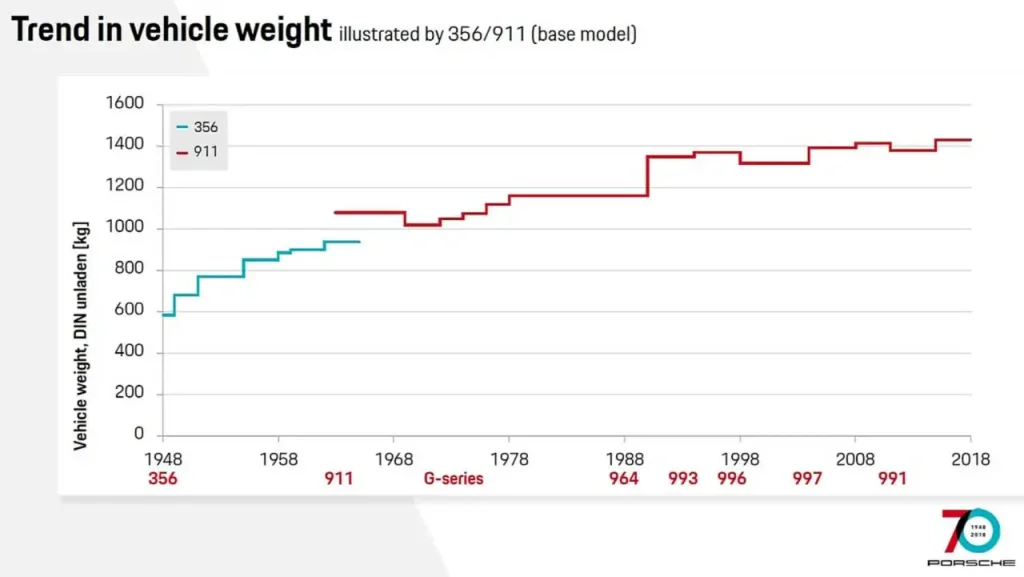
The early cars were remarkably light. The legendary Carrera RS 2.7 weighed around 1,000 kg, demonstrating just how far Porsche could take its lightweight philosophy.
Modern 911s are considerably heavier because they carry more safety equipment, larger brakes, bigger wheels, stronger structures, more electronics and substantially more performance hardware.
But Porsche has repeatedly tried to offset that growth.
The 991 generation was particularly important because its aluminum-steel construction reduced body weight by approximately 80 kg compared with its predecessor, despite the car becoming larger.
The GT3 demonstrates the same philosophy. The first 996 GT3 weighed 1,350 kg, while later generations added equipment and performance without allowing mass to spiral out of control. Porsche lists the 2024-spec manual 992 GT3 at 1,462 kg DIN.
So the weight trend isn’t simply upward. It is a constant battle between adding capability and removing unnecessary mass.
Wheelbase: Longer For Stability
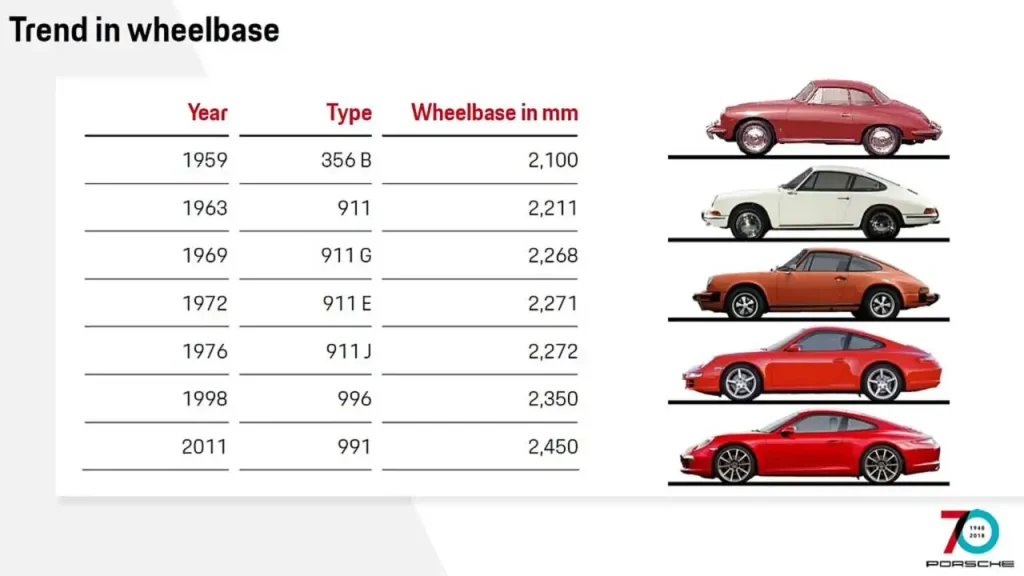
The 911’s wheelbase has grown significantly over the decades.
The original car started at 2,211 mm. The 1969 update pushed that to 2,268 mm, and the 996 generation increased it substantially again.
Today’s 911 GT3 has a 2,457-mm wheelbase.
A longer wheelbase brings several advantages. It can improve high-speed stability, create more usable interior space and provide engineers with a larger platform for suspension development.
But Porsche has been careful not to make the car feel like a large grand tourer.
The goal has always been to make the 911 more stable without sacrificing the agility expected from a sports car.
Tires: From Narrow Rubber To Serious Track Hardware
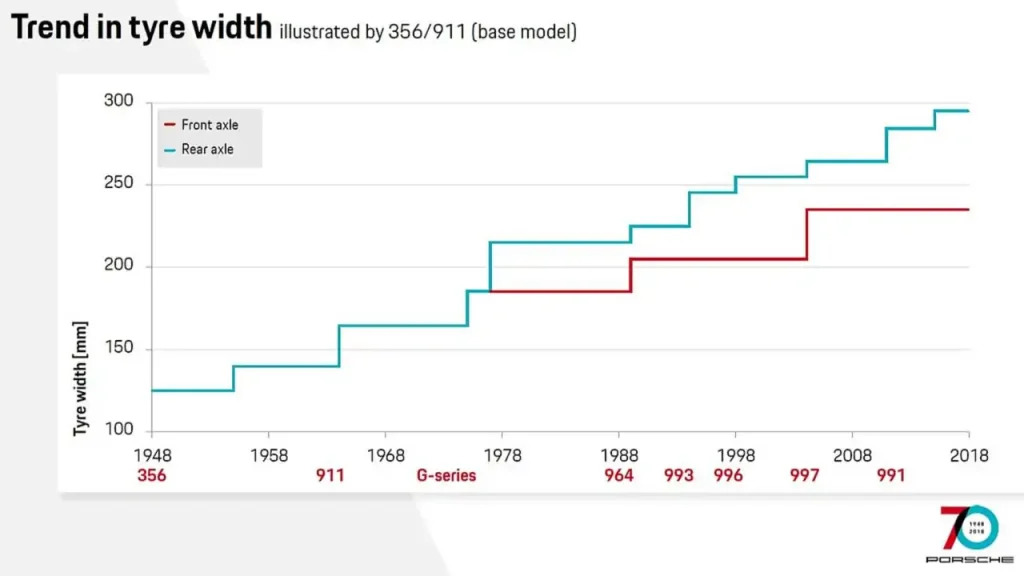
Few changes are more obvious than tire width.
Early 911s used comparatively narrow tires by today’s standards. Modern performance versions require dramatically wider rubber to put their power and cornering ability onto the road.
The latest 911 GT3 uses 255/35 ZR20 tires at the front and 315/30 ZR21 tires at the rear.
That is a remarkable transformation from the relatively narrow tires used on the original 911.
The reason isn’t simply appearance.
Wider, higher-performance tires provide more grip for acceleration, braking and cornering. They also allow Porsche’s suspension and electronic systems to operate closer to the car’s physical limits.
The tire is effectively the final connection between every piece of engineering in the car and the road.
Front Suspension: More Control, More Adjustability
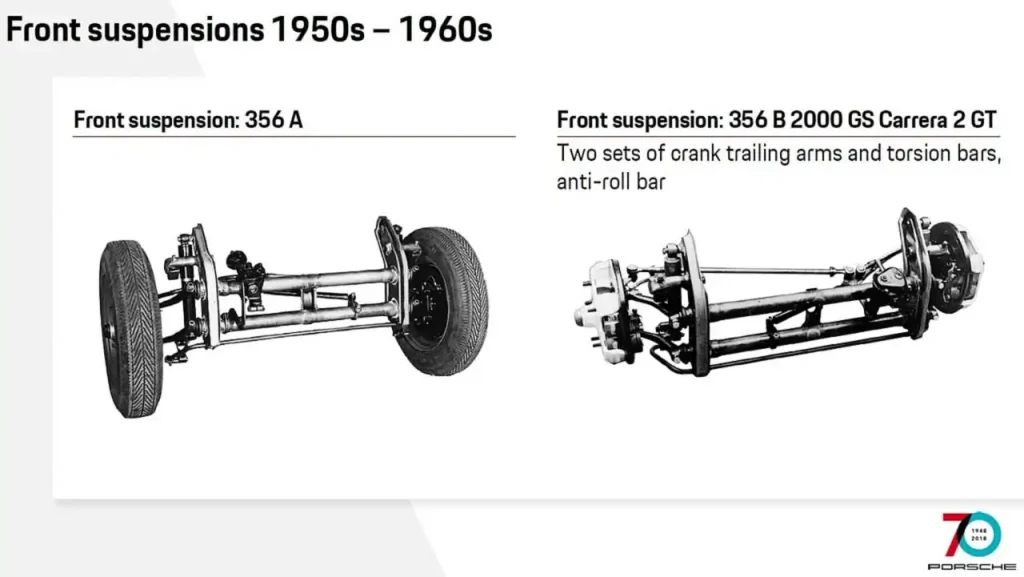
The early 911 depended primarily on mechanical suspension tuning.
Spring rates, dampers, anti-roll bars, alignment and tire characteristics determined how the car behaved.
As performance increased, Porsche began giving engineers and drivers far more control over those variables.
The GT3 became an especially important development platform. Modern GT3 models allow adjustments to parameters such as camber, toe, ride height and anti-roll-bar settings, allowing the car to be configured for different conditions.
That evolution is particularly important because the 911’s rear-engine layout places unusual demands on the front axle.
The front suspension must provide precise turn-in while coping with the weight distribution and enormous braking forces of a modern performance car.
Rear Suspension: Taming The Rear-Engine Formula
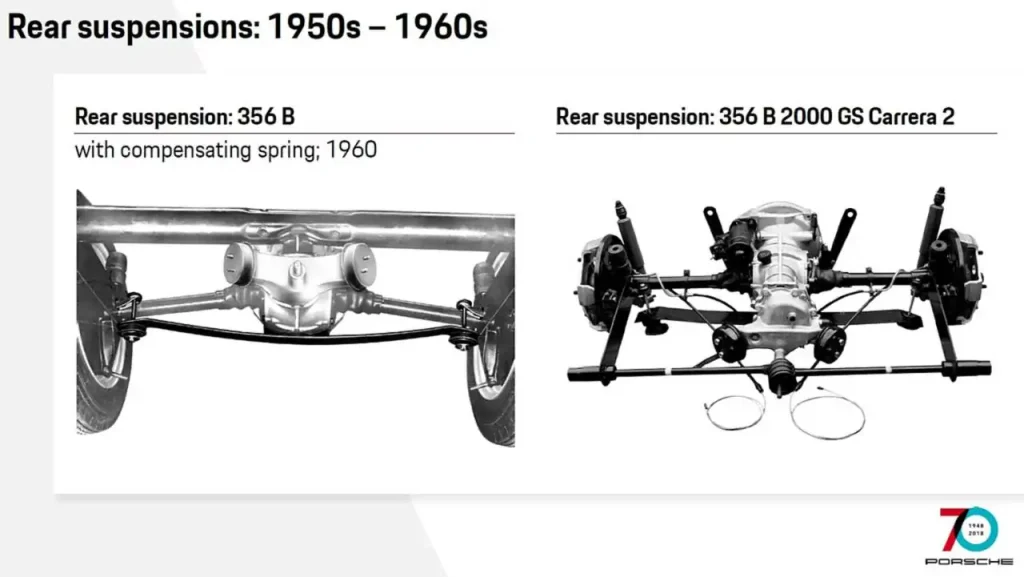
The rear suspension may be even more important to the 911 story.
Putting the engine behind the rear axle gives the 911 excellent traction when accelerating, but it also creates a distinctive weight distribution that Porsche engineers have spent decades refining.
The 993 was an important milestone, with a redesigned rear suspension that significantly improved the car’s behavior.
Later generations went further with electronic control and, eventually, rear-axle steering.
Rear-wheel steering allows the rear wheels to contribute to the car’s response. At lower speeds, they can help reduce the turning circle; at higher speeds, they can improve stability and responsiveness.
The result is a modern 911 that can feel considerably more neutral and predictable than early versions of the car.
The Rise Of Electronic Chassis Control
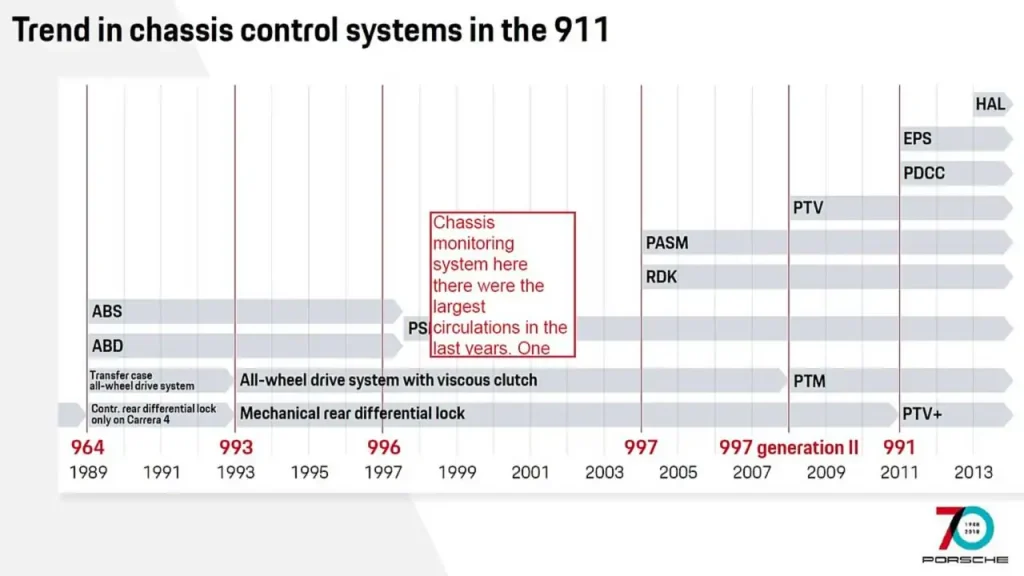
The earliest 911s were overwhelmingly mechanical machines.
Modern versions are not.
Porsche gradually added electronic stability control, traction management, active dampers, torque-vectoring systems, rear-wheel steering and active chassis technology.
The 991 generation was particularly significant because Porsche expanded technologies including Porsche Dynamic Chassis Control, rear-axle steering and active aerodynamics.
These systems don’t simply make the 911 easier to drive. They allow engineers to push the car’s mechanical limits further.
A modern 911 can monitor wheel speeds, steering inputs, acceleration and other parameters and make tiny adjustments far faster than a human driver could.
That electronic layer is one of the biggest differences between today’s 911 and the car launched in 1964.
Porsche Brake Development: From Discs To Carbon Ceramics
The 911’s brakes evolved alongside its speed.
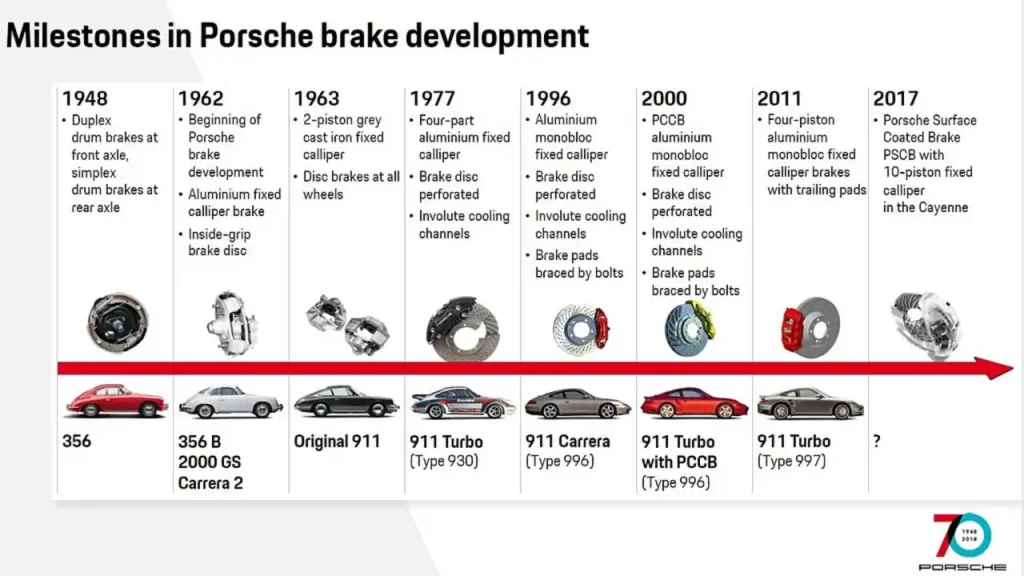
Early 911s already had four-wheel disc brakes, but the demands placed on the system have increased enormously.
Larger rotors, more powerful calipers, improved cooling and increasingly sophisticated ABS systems have allowed later cars to stop harder and repeatedly.
The 911 GT3 became an important showcase for brake development.
When Porsche introduced PCCB, or Porsche Ceramic Composite Brakes, to the GT3, the ceramic system reduced unsprung mass by approximately 18 kg compared with the conventional setup.
Modern GT3 hardware is on another level entirely. The current manual GT3 uses six-piston front calipers with 408-mm rotors and four-piston rear calipers with 380-mm rotors.
That’s a huge leap from the braking hardware of the original 911.
Braking Distance: The Missing Link Between Power And Performance
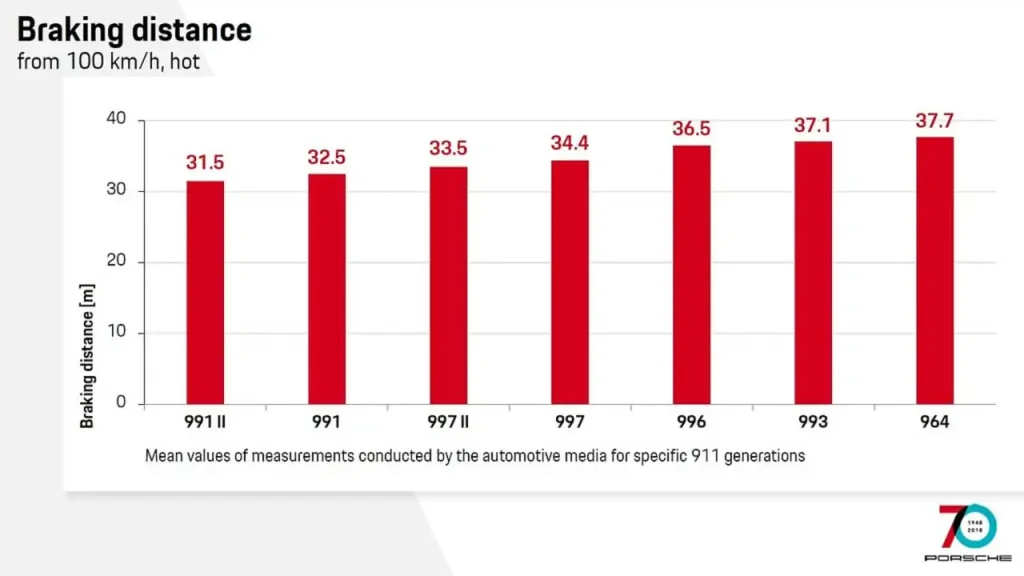
A faster car isn’t necessarily a faster track car if it cannot slow down effectively.
That’s why braking development has been just as important as engine development.
Stopping distance depends on much more than the brake rotor. Tire compound, tire width, road surface, vehicle weight, ABS calibration, brake temperature and aerodynamic load all play a role.
This makes direct comparisons between a 1960s 911 and a modern GT3 difficult unless both cars are tested under identical conditions.
The overall trend, however, is unmistakable: modern 911s can brake harder, maintain stability under heavy braking and repeat that performance more consistently.
That capability also allows drivers to brake later for corners, which can have a greater effect on lap time than simply adding horsepower.
Nürburgring: Where The Evolution Becomes A Number
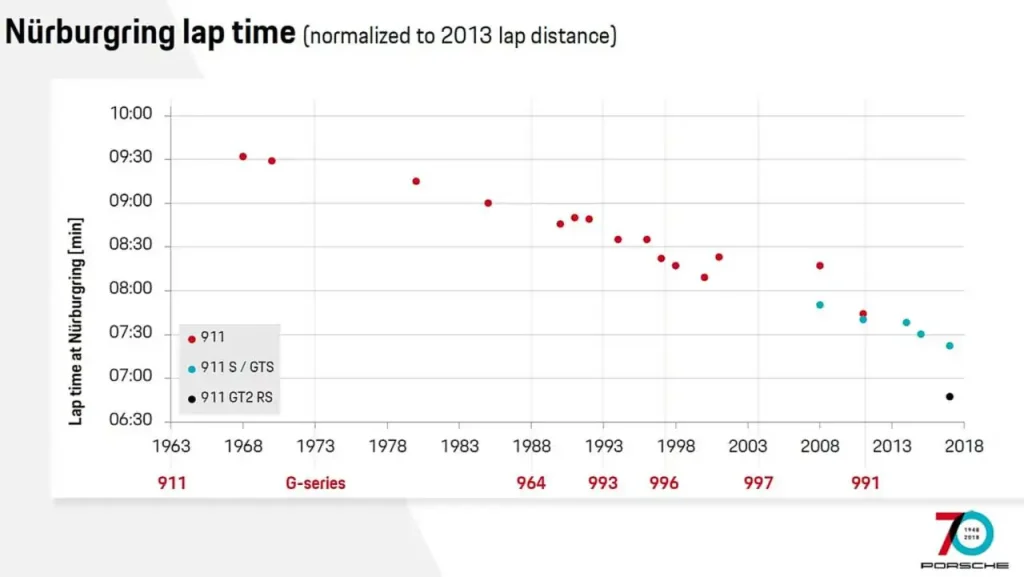
The Nürburgring Nordschleife provides perhaps the clearest demonstration of the 911’s development.
The first 911 GT3 arrived in 1999 with a 3.6-liter naturally aspirated flat-six producing 360 PS. It weighed 1,350 kg and was designed around motorsport-derived suspension, brakes and aerodynamics.
Walter Röhrl then drove it around the Nordschleife in 7:56.33.
That made it the first road-approved production car to officially lap the circuit in under eight minutes.
The improvement over the following generations was extraordinary.
| 911 GT3 | Nürburgring Nordschleife |
|---|---|
| 996 GT3, 1999 | 7:56.33 |
| 991.2 GT3, 2017 | 7:12.7 |
| 992 GT3, 2021 | 6:59.93 |
| 992 GT3, 2025 manual | 6:56.294 |
Porsche’s 2017 GT3 completed the lap in 7:12.7, improving the previous model’s time by 12.3 seconds.
The 992 GT3 then broke the seven-minute barrier, recording 6:59.93 on the current official configuration.
And in 2025, Porsche recorded 6:56.294 with a manual-transmission 911 GT3 equipped with the Weissach Package. Porsche said the car was approximately 3.6 seconds quicker than the preceding GT3 with PDK.
The important point is that these gains weren’t created by horsepower alone.
The modern GT3’s performance comes from the combined effect of suspension geometry, tire technology, aerodynamics, brakes, weight control, steering, drivetrain technology and electronic chassis management.
The Biggest Changes Happened Underneath
Looking at the 911 from the outside can make its evolution seem surprisingly slow.
Put a 1964 911 next to a current model and the family resemblance is obvious.
Underneath, however, the differences are enormous.
The wheelbase grew.
The body became wider.
The tires became dramatically wider.
The brakes became much larger.
The suspension became more sophisticated.
The engines progressed from air-cooled naturally aspirated flat-sixes to turbocharged and hybrid-assisted powertrains.
Electronic systems became an integral part of the chassis.
And the Nürburgring benchmark fell from nearly eight minutes with the first GT3 to comfortably below seven minutes with today’s car.
Six Decades, One Formula
The Porsche 911’s greatest achievement isn’t any individual engine, suspension system or lap time.
It is the fact that Porsche has continuously changed the car without abandoning the basic concept.
The 911 became bigger without becoming unwieldy. It became heavier while Porsche continued searching for weight savings. Its tires became wider, its brakes larger and its electronics more sophisticated, yet it remained recognizable as a 911.
The progression from the 356 to the original 911, from the 993 to the water-cooled 996, and eventually to today’s 992 GT3 shows how far Porsche can develop one fundamental architecture.
In 1963, the 911 was simply a compact rear-engine sports car.
More than six decades later, it is a machine capable of a 6:56.294 Nürburgring lap with a manual transmission.
That may be the clearest measure of how much the Porsche 911 has changed—and how little its fundamental identity has.