
Can an off-the-shelf RAV4 really double as America’s next unlikely road-going rally car?
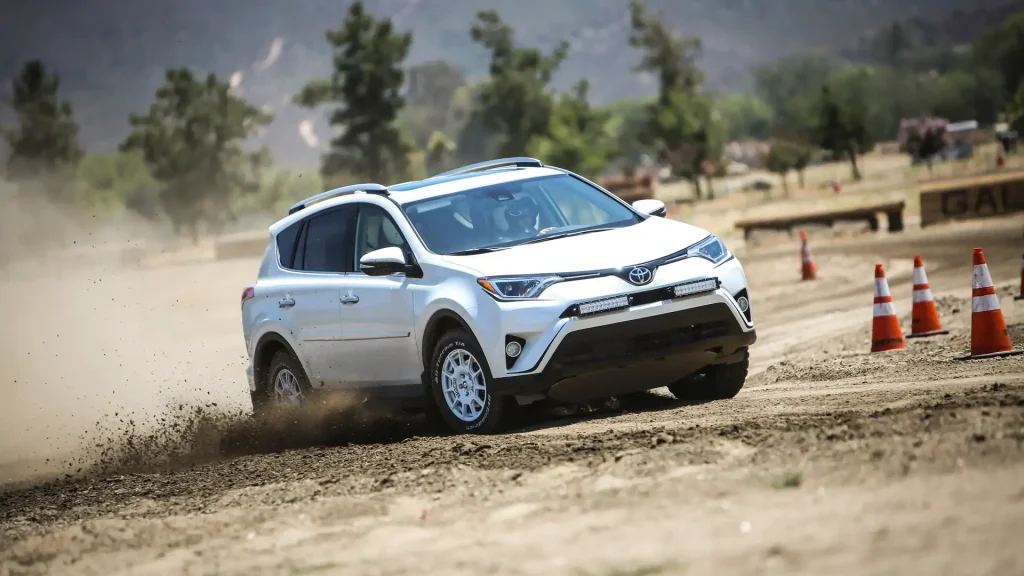
Could Toyota be preparing for a serious return to the performance spotlight? There are plenty of reasons to think so. The Toyota 86, originally launched as the Scion FR-S, delivers an entertaining driving experience despite sharing its fundamentals with its Subaru twin. Meanwhile, Lexus has kept enthusiasts happy with its F performance models. Rumors of a revived Supra have also been gathering steam, thanks in part to a series of exciting concept cars and increasingly convincing reports. Toyota has the pieces needed to build a compelling performance lineup again. The question is whether the company’s leadership will give that ambition the attention it deserves.
That possibility made me particularly eager when I received an invitation last month to a special Toyota event in Southern California centered on the automaker’s rally program. Toyota has a rich history in the World Rally Championship, especially during the 1990s. Rally legend Carlos Sainz claimed WRC titles in 1990 and 1992 behind the wheel of a Toyota Celica GT-Four. Juha Kankkunen added another championship with the Celica in 1993, Didier Auriol took the drivers’ title in 1994, and Toyota capped off the decade by winning the manufacturers’ championship in 1999 with the Corolla WRC.
With that kind of heritage, what sort of Toyota would carry the rally torch into a new era? Perhaps an all-wheel-drive Celica, a high-performance TRD Corolla, or a proper hot hatch based on the Yaris. Those all sound like promising candidates. But Toyota has a different idea for its next rally-inspired adventure: the RAV4 compact SUV.
Toyota has plenty of rally heritage, particularly from the 1990s, when Carlos Sainz won the World Rally Championship in 1990 and 1992 behind the wheel of a Toyota Celica GT-Four. So there is some historical justification for asking whether a RAV4 can handle a little sideways action.
The surprising part is that these aren’t heavily modified performance machines. The 2016 RAV4 SE used for this test has no major power upgrades, relying mainly on a slightly firmer suspension setup. A more upscale Limited model was also available for the same dirt exercise, with both crossovers tackling a specially prepared 2.1-mile rally course in Southern California’s Temecula Valley.
At first, sending ordinary RAV4s onto a rally stage sounds like an odd corporate experiment. But the idea becomes considerably more interesting once you learn what’s happening in actual competition.
Toyota was campaigning a factory-backed RAV4 in Rally America’s 2WD class during the 2016 season, with Ryan Millen behind the wheel. Millen comes from a family with serious motorsport credentials. His father, Rod Millen, is a renowned off-road racer, while his brother Rhys is also an accomplished driver who attacked Pikes Peak in a 1,600-horsepower electric race car.
Ryan’s RAV4 retains its original factory engine, transmission, and braking system, with no modifications to those components.
Before dismissing Ryan’s RAV4 as an odd choice for a rally car, consider his own racing résumé. He’s already won at both Pikes Peak and the Baja 1000, so he’s no stranger to serious competition. Ryan and co-driver Christina Fate were also tied for first in Rally America’s 2WD standings with three rounds remaining in the 2016 season. Their rivals weren’t exactly easy targets, either. The class featured plenty of skilled drivers, most of them piloting nimble hatchbacks weighing roughly half as much as the Toyota.
There’s another detail that makes the RAV4’s performance even more surprising: its engine, brakes, and transmission remain completely stock.
Under the hood sits Toyota’s 2.5-liter DOHC four-cylinder, producing 180 horsepower. The factory braking setup includes 11.7-inch rotors at the front and 11.2-inch discs at the rear. Power reaches the front wheels through a conventional six-speed automatic transmission. Curious about how well that gearbox had held up, I asked Ryan how many times the team had replaced or rebuilt it. His answer? Never. Since taking the wheel of the RAV4 in 2015, he estimated he’d covered around 5,000 competition miles on the original automatic.
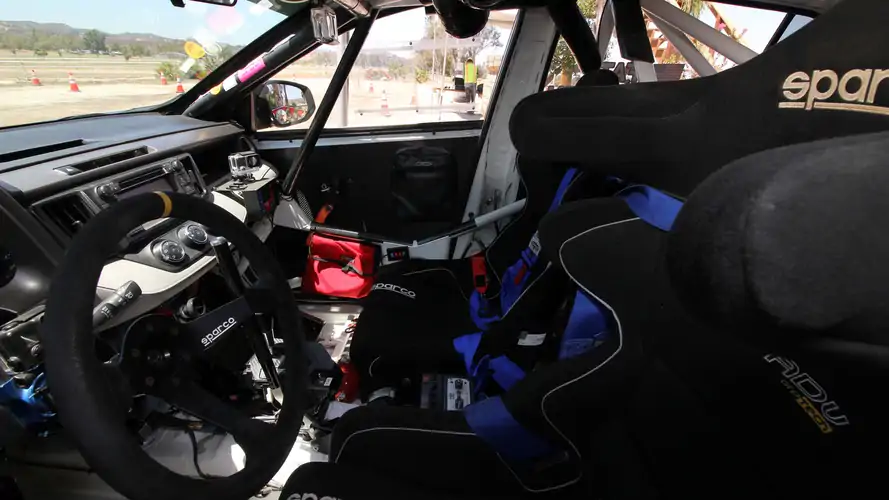
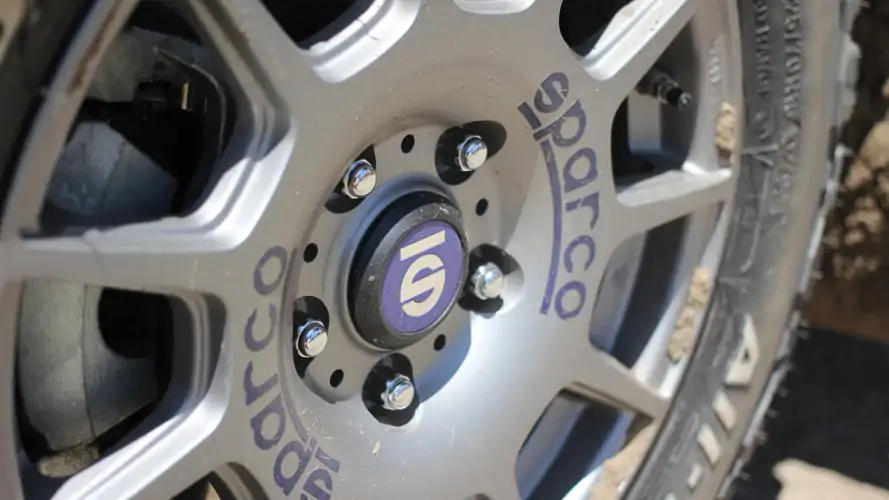
The RAV4’s suspension, however, has been upgraded to proper race-car specification, allowing it to launch off jumps, absorb hard landings, and carry on without missing a beat.
Of course, Ryan’s RAV4 isn’t completely stock. The interior has been stripped to shed several hundred pounds, and a full roll cage provides essential protection. Its suspension has been built to race-car standards, letting the SUV fly over jumps, take the impact on landing, and keep charging. The air conditioning system is gone, and a less restrictive exhaust helps the engine breathe, although output remains around 180 horsepower compared with the factory-rated 176.
The braking hardware is largely original, with stock rotors and calipers paired with competition-grade pads. The brake bias has also been adjusted to a more balanced front-to-rear split, allowing Ryan to use left-foot braking to help rotate the car through corners without constantly reaching for the handbrake. Since rally driving involves plenty of controlled sliding, the car also does without ABS, traction control, and stability control.
The team added an auxiliary transmission cooler and welded the differential after discovering that an aftermarket limited-slip unit wasn’t available for the RAV4. Riding along with Ryan for a fast lap showed just how well the setup works. The rally-prepped SUV dug into the loose surface and rotated predictably through corners, displaying agility you might not expect from a RAV4. The automatic transmission occasionally refused to downshift when Ryan wanted it to, but otherwise its shifts were sharp, and it held gears for as long as he needed.
But what does this rally machine tell us about the Toyota RAV4 sitting on dealership lots today?
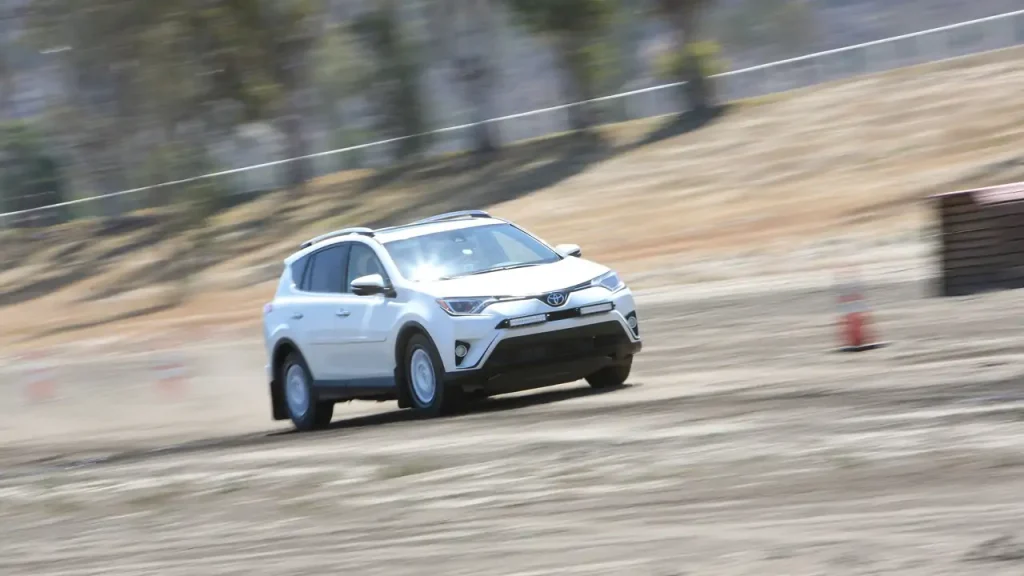
I have to admit, the RAV4 proved far more entertaining on dirt roads than I expected.
underbody skid plates and aggressive all-terrain tires. A group of journalists and I got the chance to push these SUVs around the same dirt course. Toyota’s goal was to demonstrate that the RAV4 could be more than practical family transportation, offering a playful driving experience that might appeal to younger buyers. Apparently, the company believes shoppers considering a $30,000 five-seat SUV might also appreciate the occasional handbrake turn.
After an afternoon of sliding around the course, I came away impressed by how much fun the RAV4 could be on loose surfaces. That’s saying something, considering I learned to drive on the rural back roads of Northern Michigan, some of which are now part of the Rally America series. The SE’s firmer suspension made it the most entertaining of the bunch. It was easier to provoke controllable lift-off oversteer, and it stayed flatter through the faster sections, with less body roll than its siblings.
The softer XLE and Limited trims were less eager to dance through corners, but they remained surprisingly composed rather than simply pushing straight ahead. Muddy turns were the exception: every version tended toward pronounced understeer when grip disappeared. The tires certainly influenced the outcome, but the RAV4 still displayed a reassuringly predictable balance that made it enjoyable to drive on dirt.
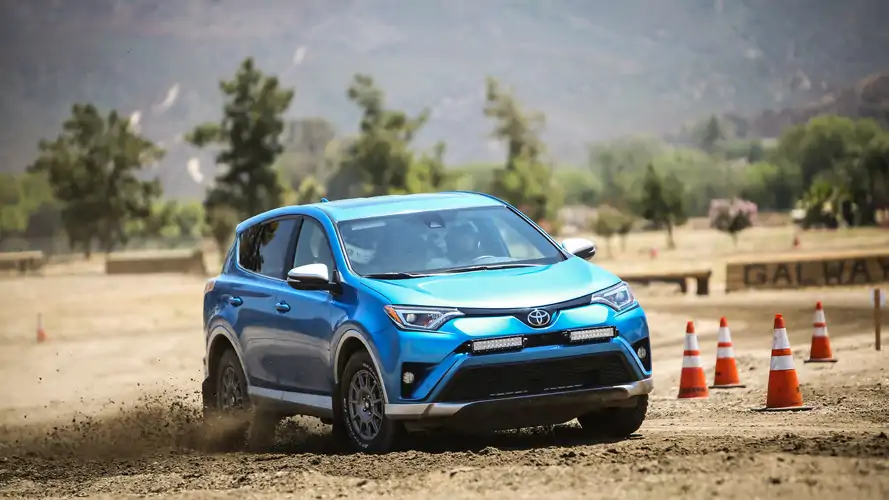
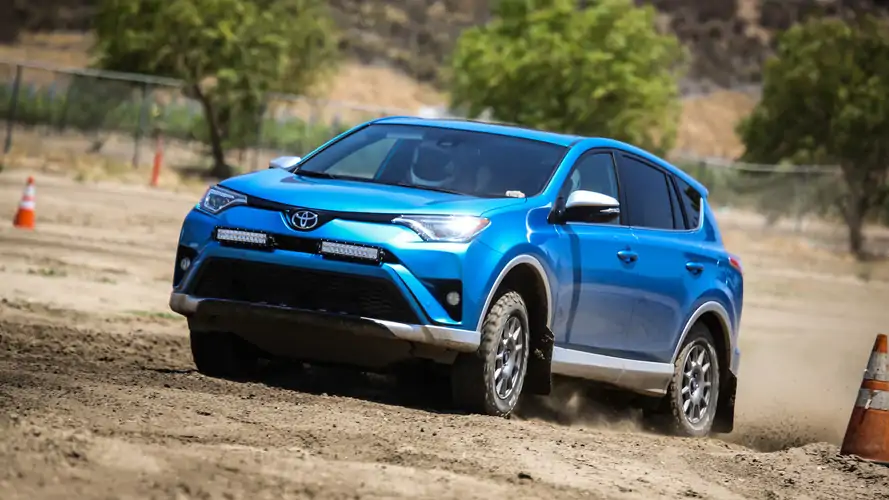
The 2016 RAV4 can manage a respectable handbrake turn, should a little dirt-road mischief be on your SUV wish list.
Every RAV4 on hand, apart from Ryan’s competition car, came with all-wheel drive and those chunky all-terrain tires. The combination delivered a surprising amount of grip on the loose course, letting the SUVs carve through corners far more confidently than I’d anticipated. I’m no rally pro, though I’ve dabbled in rallycross, and it took me several laps to adjust to how much speed I could carry into turns before the tires gave up. Throughout the day, the RAV4s handled the abuse without complaint, and the six-speed automatic generally responded just as I wanted. The 2016 model could even manage a respectable handbrake turn. If that kind of hooliganism appeals to you, I can confirm it’s good fun.
Back on pavement, the RAV4 returns to familiar Toyota territory. It’s comfortable, competent, and well-equipped, but it hardly encourages spirited driving. Instead, it’s happy to settle into a cruise with the air conditioning running. Even the firmer-suspended SE struggles to feel genuinely engaging. You can enjoy it through a series of corners if you try, but the experience is more like satisfying a deep-dish pizza craving with a frozen supermarket pie. It’ll do in a pinch, but sooner or later, you’ll want the authentic article.
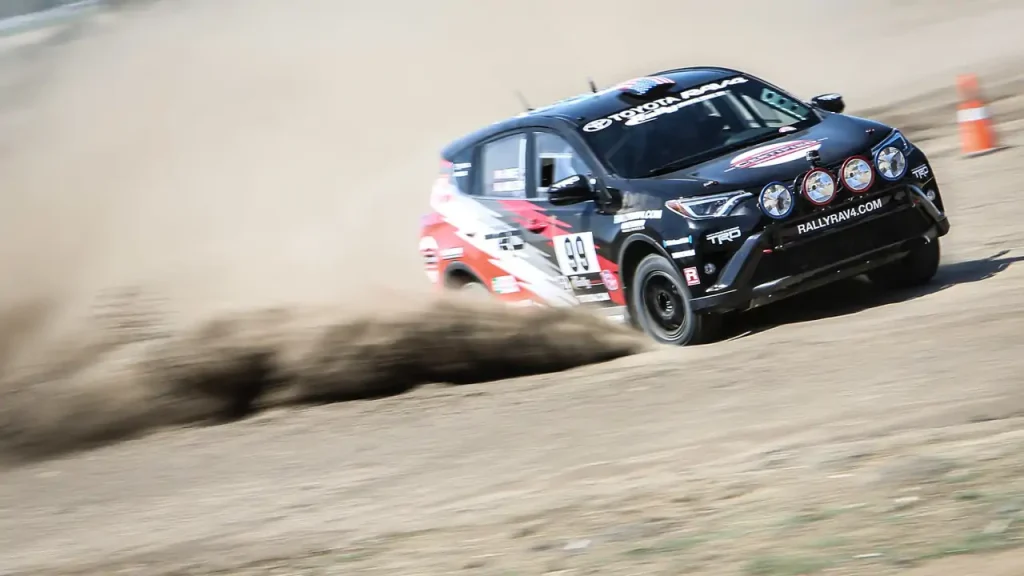
Toyota isn’t planning to turn the popular crossover into a hardcore rally machine. Instead, it hopes to attract younger buyers by promoting the RAV4 as a fun, adventure-ready vehicle suited to an active outdoor lifestyle.
Still, the real story isn’t about turning the RAV4 into a rally superstar. Nobody is likely to choose one because of its motorsports credentials. It’s too large and heavy, lacks serious power, has no conventional manual transmission, and comes with driver aids that can’t all be switched off. Yet Ryan Millen is fighting for the top spot in his Rally America class with a RAV4 that retains much of its factory hardware and suffers from several of those very limitations. That’s an impressive achievement, reflecting both Ryan’s talent behind the wheel and the underlying potential of Toyota’s crossover. With a little more power, an all-wheel-drive system biased further toward the rear, and the SE’s sharper suspension tuning, the RAV4 could become a seriously entertaining rally-inspired sport SUV. Toyota would have very little competition in that niche.
Toyota, however, has no apparent plans to build a hardcore rally version of its popular crossover. Its real objective is to connect with younger buyers by presenting the RAV4 as an adventurous vehicle for an active outdoor lifestyle. Rally competition is simply a way to get that message across. It’s not an unreasonable strategy: Subaru has long appealed to younger drivers who would rather spend their weekends hiking and camping than gaming or binge-watching Netflix.
The 2016 Toyota RAV4 may not be a rally car, but it has enough character to support the outdoor-focused image Toyota is trying to build. Will younger adventure seekers buy into the idea? If Ryan continues delivering strong results in his nearly stock RAV4, they might. At the very least, success in Rally America would demonstrate that the crossover can withstand plenty of punishment—an appealing quality for buyers of any age. Toyota has made its point.