
Two affordable electric hatchbacks go head-to-head on range, practicality, performance, and running costs.
Used examples of the Nissan Leaf and Volkswagen e-Golf can make practical, economical additions to a family fleet. Both are fully electric compact hatchbacks that offer inexpensive local transportation, although their driving ranges fall well short of what many newer EVs can deliver.
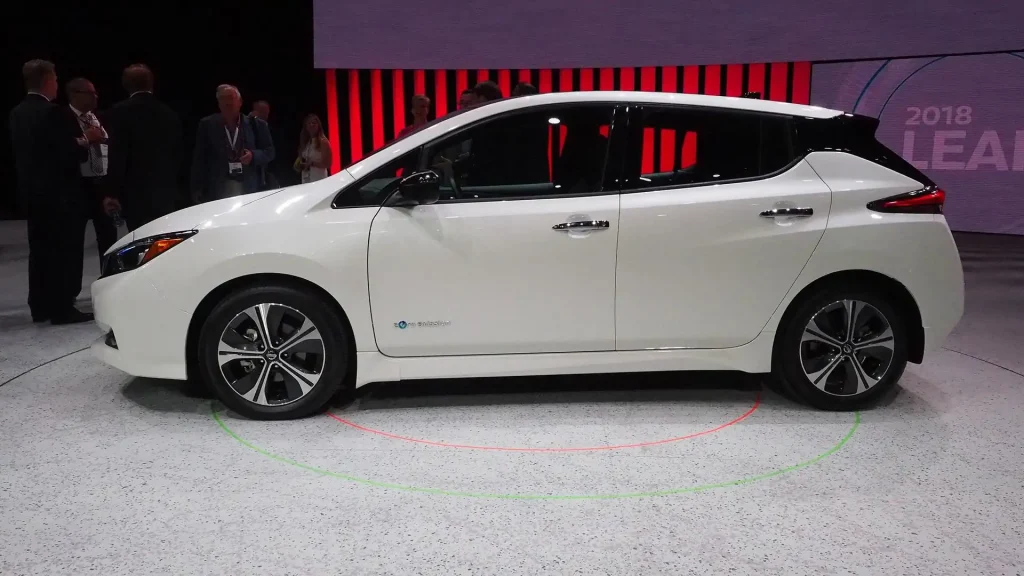
The Nissan Leaf arrived for the 2011 model year, making it one of the earliest mass-market electric cars in the modern era. It was sold nationwide, so used examples are relatively easy to find. Range varies considerably by model year, however, and older Leafs can suffer from battery degradation depending on mileage, climate, and charging history. At the time of the original listing, MyEV.com had 141 used Leafs available.
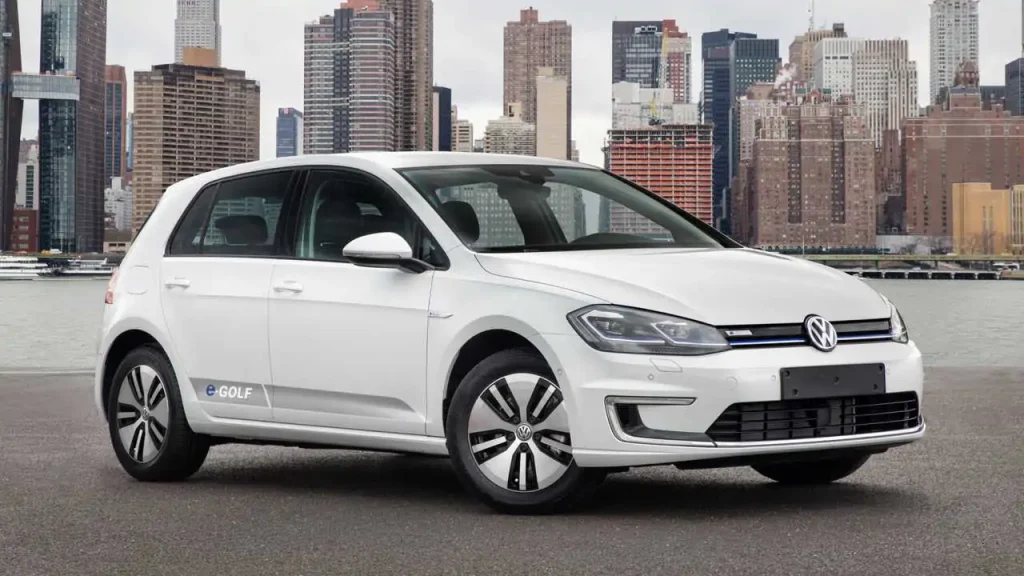
The Volkswagen e-Golf came later, launching for the 2015 model year, and used examples are considerably less common. Volkswagen initially sold the electric Golf only in selected markets, and overall sales were much lower than those of the Leaf. Used e-Golfs could still be found outside their original sales regions, including several examples in the Chicago area. MyEV.com listed 18 used e-Golfs at the time.
Styling
The first-generation Nissan Leaf has an unmistakable appearance, although its bulbous proportions aren’t for everyone. Tall, angular headlights stretch upward into the front fenders, while the rounded rear features narrow vertical taillights. Nissan gave the Leaf a substantial styling makeover for 2018, replacing many of the rounded surfaces with sharper lines and adding a more conventional front end. Inside, early Leafs have a distinctly futuristic cabin, with two digital displays ahead of the driver and a large central touchscreen surrounded by unconventional controls. The first-generation model provides 42.1 inches of rear legroom and 42.2 inches of rear headroom, while cargo capacity reaches 24.0 cubic feet with the rear seats folded. The redesigned 2018 Leaf adopted a more conventional interior and offered less rear passenger room, with 33.5 inches of legroom and 37.3 inches of headroom, but cargo capacity increased to 30.0 cubic feet.
The Volkswagen e-Golf takes a much more understated approach, looking almost identical to a conventional Golf from the outside. Its design features a broad front grille, slightly angular LED headlights, a wide lower intake, and a clean roofline that flows into a simple rear hatch. The cabin follows the same straightforward philosophy, combining easy-to-read gauges with an electric power display, a touchscreen, and traditional buttons and knobs. Rear passenger space is tighter than in the first-generation Leaf, with 35.6 inches of legroom and 38.1 inches of headroom, but the e-Golf makes up for it with impressive cargo capacity. Folding the rear seats opens up as much as 52.7 cubic feet of storage space.
Performance
The 2011 and 2012 Nissan Leaf used an electric motor producing 107 horsepower and 207 pound-feet of torque, with an estimated 73-mile range and EPA ratings of 106/92 MPGe city/highway. For 2013, range increased to 75 miles, while efficiency improved to 129/102 MPGe. Nissan also added a “B” driving mode for stronger regenerative braking and made a quick-charge port available. The 2014 and 2015 Leafs reached an estimated 84-mile range and returned 126/101 MPGe. For 2016 and 2017, the SV and SL versions received a larger battery that increased range to approximately 107 miles, with efficiency ratings of 124/101 MPGe. The 2018 redesign brought a new powertrain producing 147 hp and 236 lb-ft, along with an estimated 151-mile range and 125/100 MPGe ratings.
On the road, the Leaf is primarily tuned for relaxed everyday driving rather than excitement. It offers predictable handling, a comfortable ride, and a solid highway feel, while the 2018 model added Nissan’s e-Pedal system, allowing stronger regenerative braking and easier one-pedal driving. Leafs equipped for DC fast charging use the CHAdeMO connector.
The 2015 and 2016 Volkswagen e-Golf models produced 115 hp and 199 lb-ft of torque and had an estimated 83-mile range, with EPA ratings of 126/105 MPGe. For 2017 and 2018, Volkswagen increased the range to approximately 125 miles, while efficiency rose to 126/111 MPGe. Drivers can choose between three driving modes and adjust the amount of regenerative braking. Compared with the Leaf, the e-Golf has sharper handling and a more engaging driving character, making it the sportier choice between the two. SAE-based DC fast charging was also available as an option.
Features
Both EVs were offered in several trim levels, so equipment varies according to model year and specification. Used Leafs can be found with features such as automatic climate control, CD audio, push-button entry and start, automatic headlights, a rearview camera, navigation, and a universal garage-door opener. The redesigned 2018 Leaf added considerably more driver-assistance technology, including Nissan’s ProPilot Assist system, Lane Departure Warning, Automatic Emergency Braking with pedestrian detection, and Blind Spot Warning with Rear Cross Traffic Alert.
Used e-Golfs can also be equipped with a range of desirable features, including navigation, keyless entry, heated seats, Bluetooth connectivity, satellite radio, a rearview camera, and rear parking sensors. As with the Leaf, equipment depends heavily on the model year and trim level.
Pricing
The biggest attraction of an older Leaf is its low purchase price. Even with its limited range, an early example can work well as a second household vehicle for short errands, local commuting, or trips to a nearby train station. According to the original Kelley Blue Book estimates, a 2011 Leaf with a 73-mile range, average mileage, and good condition was worth roughly $5,700 at a Chicago-area dealership. A 2014 model with an 84-mile range was estimated at about $9,100, while a 2016 version capable of roughly 107 miles was around $13,400. A used 2018 Leaf with its 151-mile range was estimated at approximately $24,850, although the original pricing comparison noted that a new 2019 model started around $30,900 and could qualify for a $7,500 federal tax credit, potentially bringing its effective cost to about $23,400 for buyers eligible for the full credit.
The Volkswagen e-Golf generally commanded more money on the used market. A 2015 model with an 83-mile range, average mileage, and good condition was estimated at around $10,500, while the updated 2017 model with a 125-mile range was listed at approximately $26,067. The 2018 e-Golf was nearly identical at an estimated $26,098. For comparison, a new e-Golf carried a listed price of about $39,790, or approximately $32,990 after the federal tax credit cited in the original pricing data. Actual used-car prices naturally vary by condition, mileage, location, equipment, and negotiation.
Which Used EV Makes More Sense?
The Nissan Leaf is the stronger choice for buyers seeking maximum value and availability. Its long production history, nationwide sales, abundant used inventory, and significant depreciation make it one of the easiest ways to get into an inexpensive EV.
The Volkswagen e-Golf is the better fit for shoppers who value driving dynamics, interior quality, and familiar hatchback manners. It feels more like a conventional Golf, while still delivering the smoothness and instant torque of an electric motor.
The biggest deciding factor, however, should be battery condition rather than simply asking price.
A cheap used EV with severely reduced battery capacity may not be a bargain. Conversely, a well-maintained Leaf or e-Golf with a healthy battery can remain a highly practical commuter for drivers whose daily mileage fits within its capabilities.
For the lowest-cost entry into used EV ownership, the Leaf wins. For a more refined and engaging driving experience, the e-Golf has the edge. Either can make sense—but only after you verify the battery, charging equipment, and real-world range of the specific car you’re considering.