
They share a platform and plenty of features, but the three-row Atlas and sleeker Cross Sport are designed for different kinds of SUV buyers.
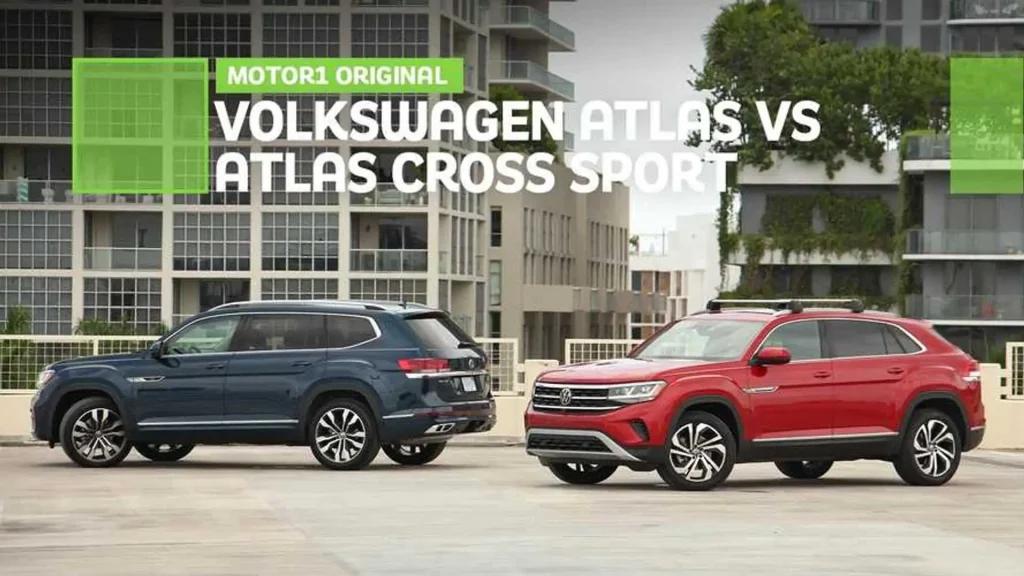
The Volkswagen Atlas arrived for the 2018 model year as Germany’s answer to popular three-row SUVs such as the Nissan Nissan Pathfinder, Ford Explorer, Honda Pilot. Built on Volkswagen’s flexible MQB platform, the Atlas quickly established itself as a major player in the midsize SUV segment. Volkswagen sold roughly 61,000 examples during its first full year, with sales later climbing to around 81,000 units.
Still, the competition remained fierce. The Honda Pilot outsold the Atlas by roughly two to one in 2018, while the Ford Explorer moved more than four times as many examples. Volkswagen’s answer was to expand the lineup with a second version of its family SUV: the Atlas Cross Sport.
At first glance, the Cross Sport looks like little more than a shorter, sportier Atlas. After spending more than 5,000 miles with a long-term Cross Sport SEL in July., however, it’s clear that the two SUVs have plenty in common. Put them side by side, and the similarities are obvious—but so are a few important differences.
How the Two SUVs Differ
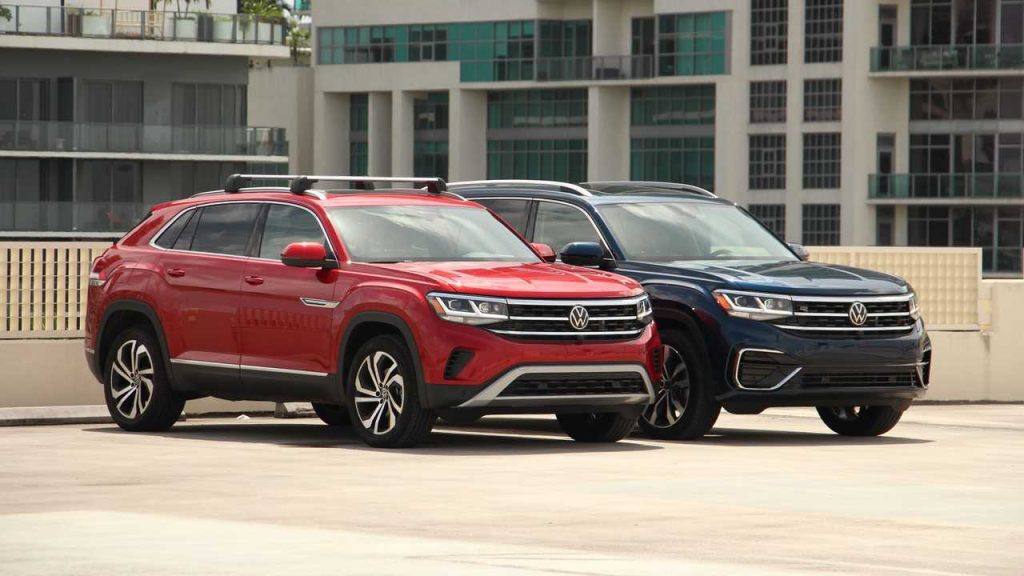
The biggest distinction is the body style. The Atlas is a traditional three-row SUV, while the Cross Sport drops the third row in favor of a sleeker roofline and more cargo-focused interior.
Both models share a 117.3-inch wheelbase, but the Cross Sport measures 195.5 inches long, making it nearly three inches shorter than the 198.3-inch Atlas. The Cross Sport is also slightly wider at 78.4 inches compared with 78.3 inches for the Atlas, while its lower roof gives it a height of 67.8 inches versus 70.0 inches for the three-row model.
That shorter body and lower roof give the Cross Sport a more athletic appearance, but the biggest consequence is what happens inside. The Cross Sport offers 40.3 cubic feet of cargo space behind the second row and 77.8 cubic feet with the rear seats folded. The three-row Atlas provides 20.6 cubic feet behind its third row, 55.5 cubic feet behind the second row, and up to 96.8 cubic feet with the rear seats folded.
For buyers who don’t need three rows, the Cross Sport’s cargo area is still generous. Families who regularly carry six or seven passengers, however, will find the standard Atlas considerably more versatile.
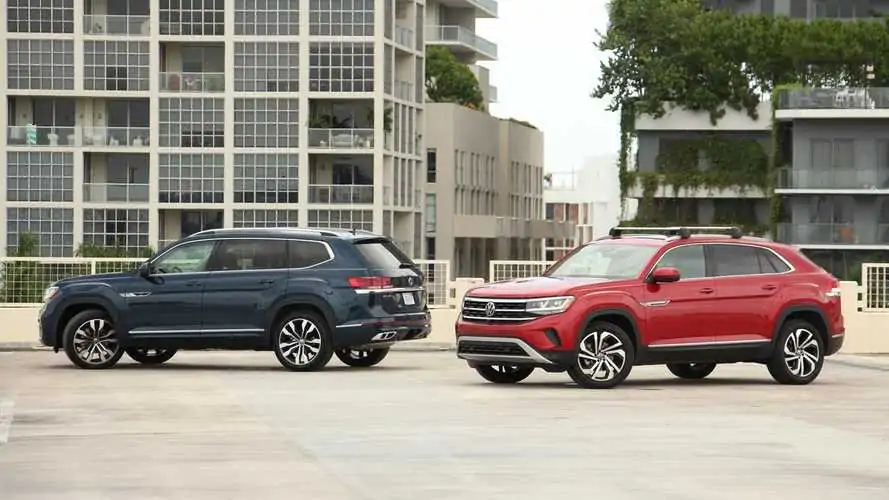
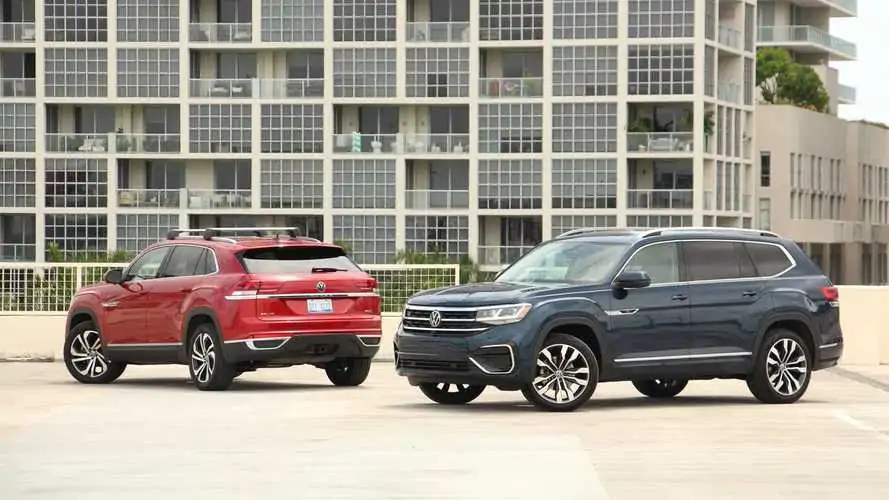
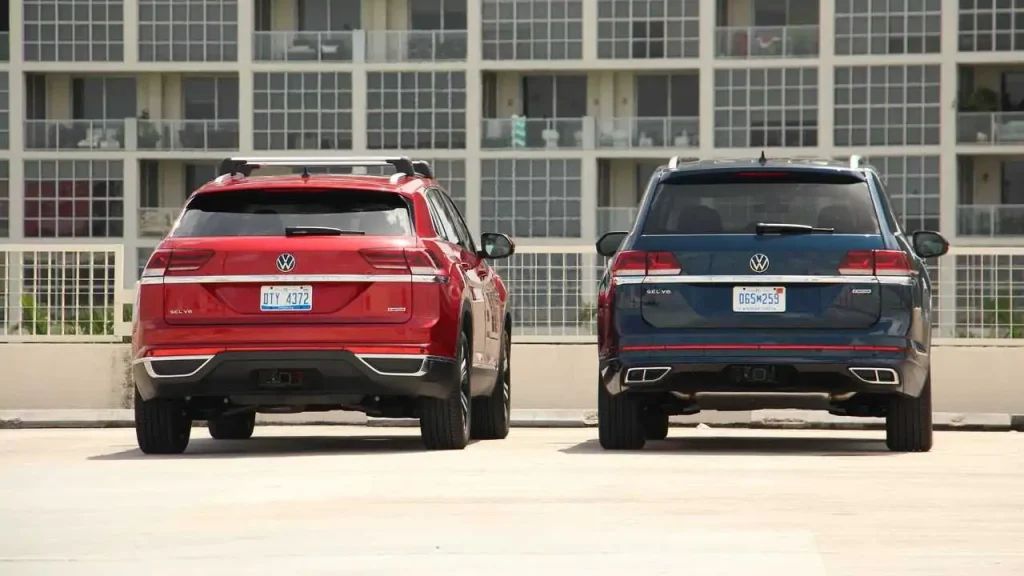
The Cross Sport shown here is a range-topping SEL Premium, equipped with the upgraded 3.6-liter V6 instead of the base four-cylinder. It also features Aurora Red Metallic paint, which adds $395, and rides on 20-inch alloy wheels. The three-row Atlas is likewise an SEL Premium with the V6, but it adds the optional R-Line package, Tourmaline Blue Metallic paint, and larger 21-inch wheels. Those bigger wheels are standard with the R-Line package, which isn’t fitted to the Cross Sport.
At a glance, the two crossovers look remarkably similar aside from their different colors and wheel designs. Look closer, however, and there are several subtle styling differences.
For starters, the Cross Sport has a gray lower trim piece beneath the grille that extends downward and mimics the appearance of a skid plate. The Atlas R-Line takes a sportier approach, replacing it with a sleeker black opening accented by bright silver trim at each corner.
These differences are largely dependent on trim and engine choice. Most Atlas versions use the same gray lower trim seen on the Cross Sport, while select V6-powered models—including the SE and R-Line—receive a revised front fascia. Because this Cross Sport is an SEL without the R-Line package, it retains the more understated front-end design. The R-Line package also brings a subtly revised look to the rear diffuser.
The Numbers at a Glance
| Volkswagen Atlas | Atlas Cross Sport | |
| Wheelbase | 117.3 in. | 117.3 in. |
| Length | 198.3 in. | 195.5 in. |
| Width | 78.3 in. | 78.4 in. |
| Height | 70.0 in. | 67.8 in. |
| Max Cargo Space | 96.8 cu. ft. | 77.8 cu. ft. |
| Engine | 3.6L V6 | 3.6L V6 |
| Horsepower | 276 hp | 276 hp |
| Torque | 266 lb-ft | 266 lb-ft |
| Transmission | 8-speed automatic | 8-speed automatic |
From the front doors rearward, however, the differences between the two SUVs become much more noticeable. Both share the same 117.3-inch wheelbase, but the Cross Sport is nearly 3.0 inches shorter overall, measuring 195.5 inches compared with the Atlas at 198.3 inches.
That shorter body comes at the expense of the third row, but the Cross Sport makes up for it with a generous 40.3 cubic feet of cargo space behind the second row and 77.8 cubic feet with the rear seats folded. The standard Atlas remains the more spacious option, offering 20.6 cubic feet behind the third row, 55.5 cubic feet behind the second row, and up to 96.8 cubic feet behind the first row. For buyers who don’t need three rows, though, the Cross Sport’s ample cargo capacity is more than enough for everyday hauling.
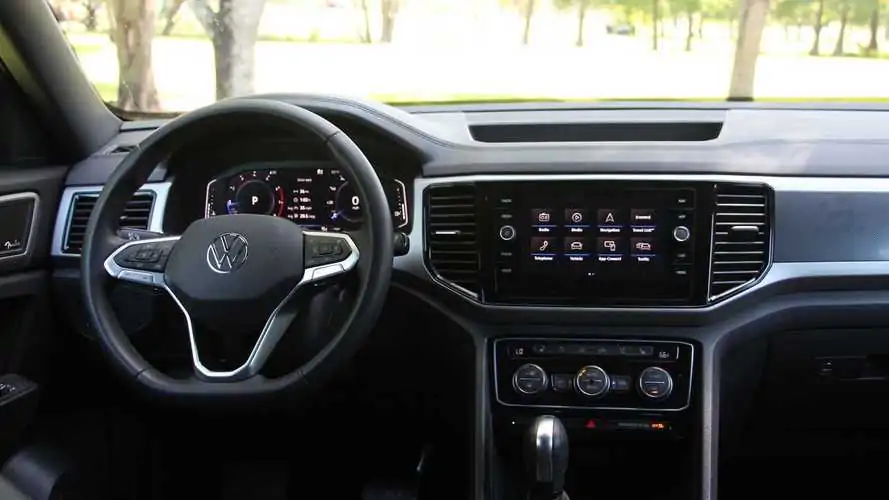
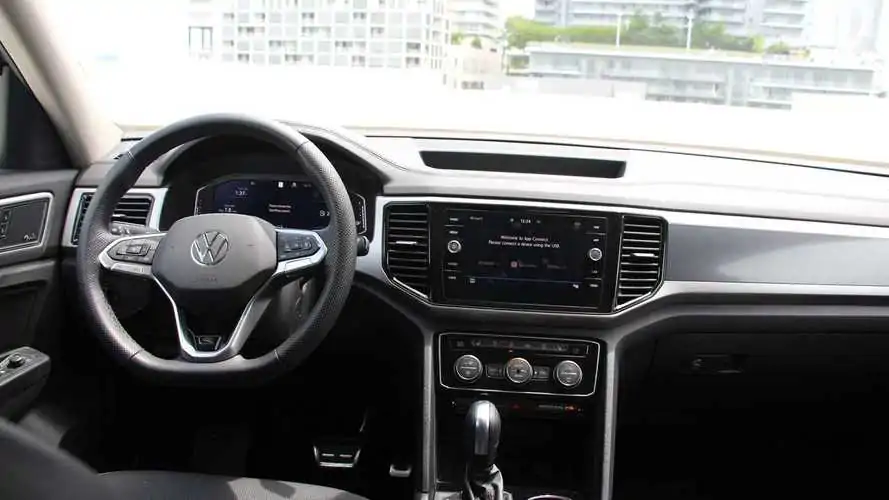
Inside, the Atlas and Atlas Cross Sport are largely identical, with only a few differences for rear passengers. The Atlas R-Line features a dedicated screen on the back of the center console that allows second-row passengers to control the rear climate system, and it’s included with the R-Line package. The SEL Premium Cross Sport takes a simpler approach, giving rear passengers controls for seat heating instead.
What They Have In Common
Despite the obvious exterior differences—including the body style, wheels, and front bumper design, the latter two varying by trim—the Atlas and Atlas Cross Sport share plenty of similarities. Both feature the same vertical-slat grille, LED headlights and taillights, along with several of the same silver-colored trim elements along the sides and rear. As noted earlier, they also ride on an identical 117.3-inch wheelbase.
The two versions featured here are mechanically similar as well. Both use a 3.6-liter narrow-angle VR6 producing 276 horsepower and 266 pound-feet of torque, paired with an eight-speed automatic transmission. Both also come standard with 4Motion all-wheel drive in these configurations, while AWD remains an optional upgrade on lower trim levels.
| Model | Engine | Horsepower | Torque | Transmission |
|---|---|---|---|---|
| Atlas | 3.6L V6 | 276 hp | 266 lb-ft | 8-speed automatic |
| Atlas Cross Sport | 3.6L V6 | 276 hp | 266 lb-ft | 8-speed automatic |
All SEL models come standard with Volkswagen’s Digital Cockpit instrument cluster. The 10.0-inch display sits behind the steering wheel and provides the driver with key information such as speed and fuel economy. Both Atlas models shown here also feature a standard 8.0-inch central touchscreen, which replaces the 6.5-inch unit found in the base model and adds Apple CarPlay, Android Auto, and built-in navigation.
Which Atlas Makes More Sense?
The Volkswagen Atlas and Atlas Cross Sport are both comfortable, attractive, and well-equipped with technology, particularly in the higher trims shown here. However, the two SUVs are so closely matched in both features and pricing that choosing the Cross Sport means giving up some practicality without saving much money.
The base Atlas Cross Sport with the four-cylinder engine starts at $30,545, while the equivalent three-row Atlas starts at $31,545—just a $1,000 difference. That relatively small gap remains even as you move up the trim ladder and add more equipment, making the larger Atlas the more compelling choice for buyers who value maximum passenger and cargo space.
The Atlas V6 SEL Premium R-Line tested here carries a $51,715 price tag with no additional options. The Atlas Cross Sport V6 SEL Premium shown here is slightly cheaper at $49,510, with only the $395 Aurora Red paint adding to the price. With just over $2,000 separating the two, the larger three-row Atlas looks like the better value, especially for buyers who want the added passenger and cargo space.