
Fifty years after Volkswagen’s legendary Baja success, I headed into the desert to put a fleet of off-road buggies through their paces. The experience was equal parts exhilarating and brutal—by the end of the day, I was wondering if anyone had seen my kidneys.
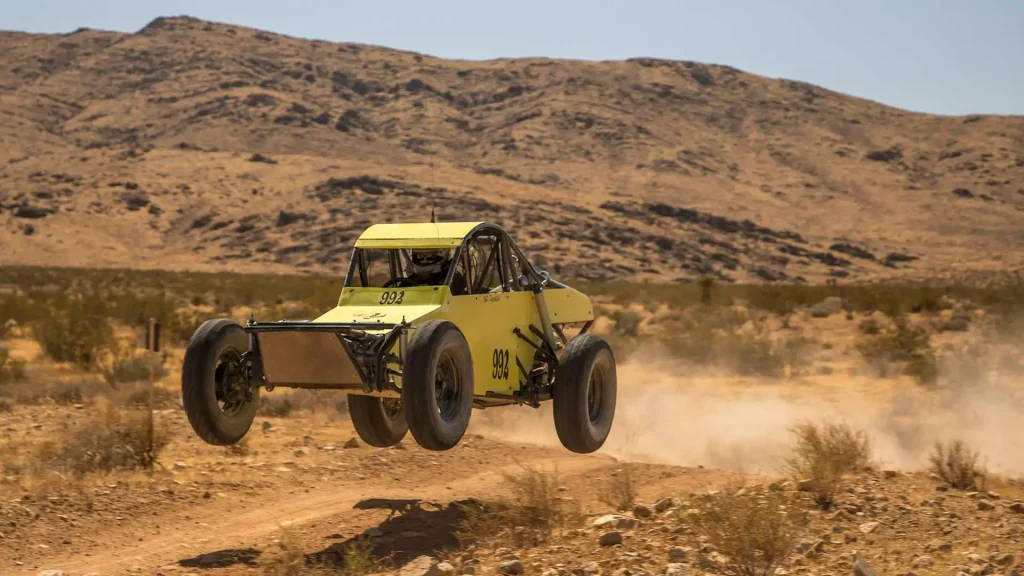
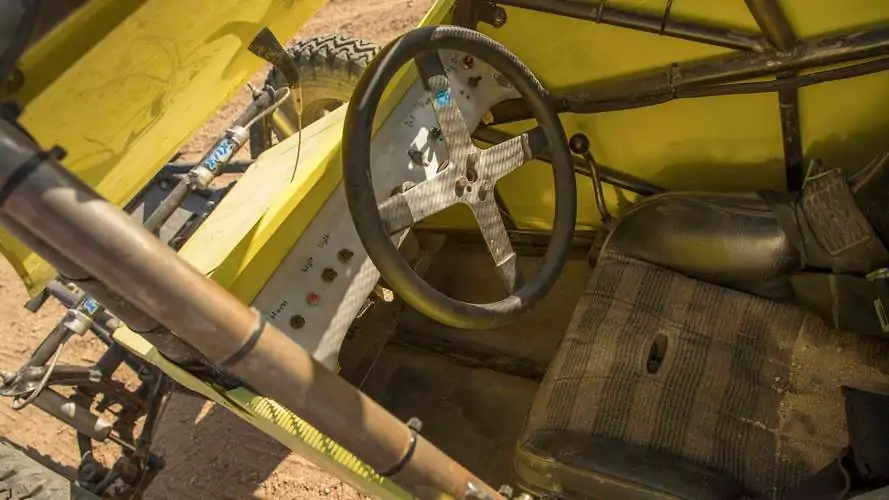
I’m already covered in a miserable combination of sweat and desert dust when Cody Jeffers gives me the most important piece of advice I’ll hear all day: “Whatever you do, don’t wrap your thumbs around the steering wheel.” Jeffers, who is with the Mojave Off-Road Racing Enthusiasts, isn’t offering some obscure piece of racing etiquette. He’s talking about the four-spoke steering wheel in front of me, attached to an open-wheel Baja race car that looks like it was designed specifically to make bad decisions hurt. According to Cody, the steering kickback can be so violent when the front wheels hit rocks and ruts that the metal spokes can break your thumbs if you use the conventional ten-and-two grip. Suddenly, the basic rules of driving have changed. Keep your thumbs outside the wheel, don’t fight the steering, and try not to think too much about all the other things that could potentially go wrong. Considering the number of ways this bright-yellow Baja machine appears capable of maiming me, I’m actually grateful that at least one of them can be avoided by changing the way I hold the wheel. Still, there’s a larger question hanging over the whole experience: What exactly have I gotten myself into?
The story behind these cars stretches back 50 years, to Bruce Meyers and the little dune buggy that helped create an entire branch of motorsport. Meyers drove his Volkswagen Beetle-based Meyers Manx from La Paz to Tijuana in less than 35 hours, covering roughly 950 miles of desert terrain along the way. The route was hardly what anyone would call a road. There were stretches of sand, rocky sections, mountain passes and deeply rutted two-track trails that demanded considerably more from a vehicle than ordinary highway driving. That remarkable run helped inspire the race that was originally known as the Mexican 1000 and would eventually become the Baja 1000. It also helped establish the Meyers Manx as an off-road icon and gave modified Volkswagen Beetles a permanent place in desert racing. Baja Bugs became increasingly common in competition, and half a century later, with the anniversary of that first Mexican 1000 approaching, I find myself standing in the desert outside Barstow, California, surrounded by Volkswagen representatives, Jeffers and three very different machines that all trace their roots back to that strange little Beetle-based idea. Champagne would probably be the appropriate drink for celebrating such an important anniversary, but we’re standing in the middle of the California desert, so I’ll gladly settle for Gatorade.
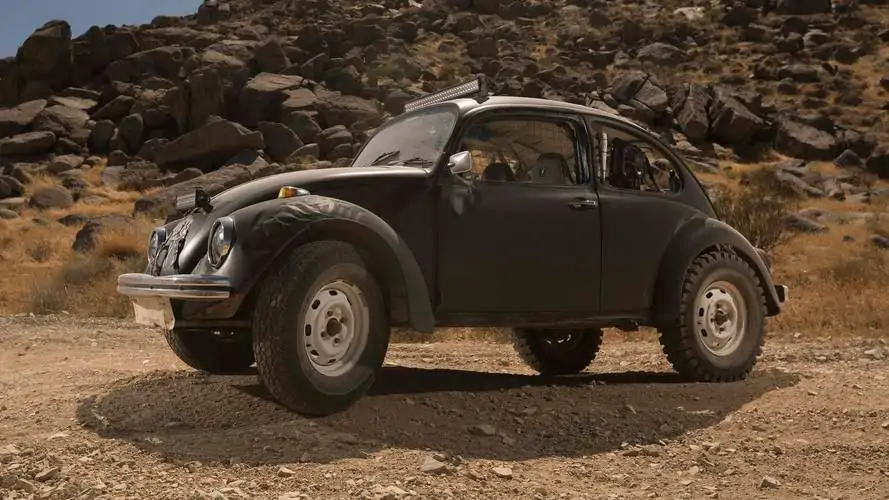
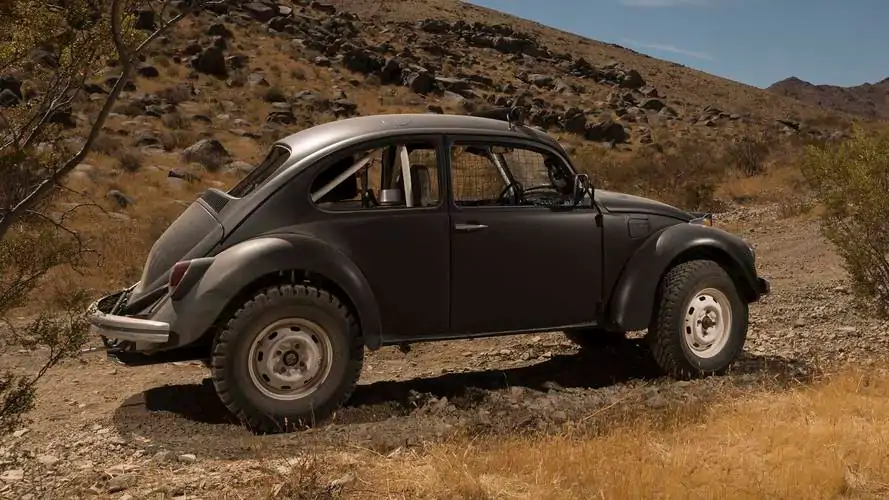
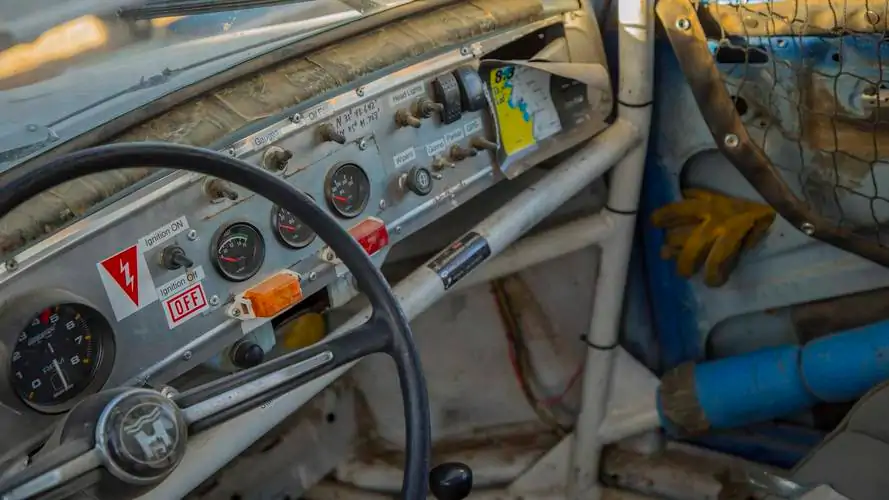
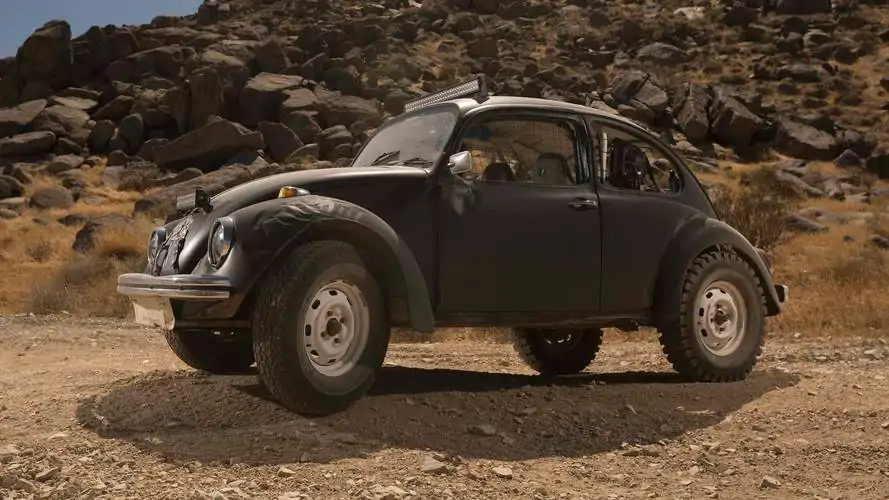
The first car waiting near the staging area is a Baja Bug from Volkswagen’s heritage collection. It’s a Class 11 racer, meaning it retains the basic Beetle body, and it looks almost exactly like what you’d expect from a desert race car that has spent years being thrown across rocks and sand. It has the rough, purposeful appearance of something that could have been assembled by a group of enthusiastic guys in a desert garage, but this particular car comes from Desert Dingo Racing in Santa Cruz, California, and it has competed in events including the legendary Mint 400. The sticker on the hood provides a proud reminder of its racing history. Jeffers climbs behind the wheel while I wrestle with the five-point harness and attempt to figure out exactly how I’m supposed to sit inside this thing. Before long, my helmet is connected to the radio, the engine is running and we’re bouncing away from the staging area toward a 10-mile trail disappearing into the desert. This is supposed to be a reconnaissance lap, so I’m not driving yet, but that doesn’t make it a casual sightseeing trip. I’m listening carefully to every instruction Jeffers gives me because I’m going to be behind the wheel on the next run, and I’d prefer not to discover the course’s biggest hazards through personal experience.
“Don’t hit any rock bigger than a basketball,” Jeffers tells me as we crash across a field of stones.
That’s useful information, although it would have been more useful before we started driving over them. The 15-inch wheels and knobby tires bounce from one rock to the next while the suspension works continuously beneath us. Despite the car’s competition modifications, much of the suspension remains surprisingly close to Beetle hardware. There’s additional ground clearance at the front and stronger shock towers, but the basic architecture is still recognizably Volkswagen. Power comes from a 1.6-liter engine producing roughly 75 horsepower, which doesn’t sound like much until you consider what that little engine is being asked to do. Jeffers keeps the revs high in second gear as we work our way through the rough stuff. The four-speed manual has an enormous gap between second and third, creating a strange situation where second gear feels like it’s asking too much from the engine while third drops the revs enough to make the car feel almost asleep. Jeffers uses third only briefly on a longer gravel section toward the end of the course. Fourth gear, the top gear, never enters the conversation. There simply isn’t enough room or reason to go that fast.
The Class 11 feels increasingly like a machine held together by determination, mechanical simplicity and perhaps a little luck. Every impact produces another rattle, vibration or noise, and I keep expecting something important to detach itself from the car. My imagination has already progressed to the point where I’m picturing myself stranded somewhere in the desert while vultures circle overhead. Then we return to camp and I discover that the car has actually lost a light bar and one of its headlights during the reconnaissance lap. So, naturally, I’m completely confident that everything is going to work out wonderfully when I take over.
My turn comes immediately.
I engage first gear and pull away from camp, and for a few moments the Class 11 feels remarkably ordinary. The engine responds like an old Beetle, the clutch behaves predictably and the car moves down the trail without much drama. Then the terrain opens up, and I start getting a feel for what the Bug can actually do. On loose sand and gravel, it’s genuinely entertaining. The steering is vague enough that the wheel seems to have its own ideas about where the car should go, while the suspension allows the Beetle to bounce over small rises and follow the curved ruts carved into the desert. I’m beginning to understand why people become addicted to this kind of driving. The car isn’t fast by modern standards, but speed isn’t really the point. You’re constantly working with the terrain, feeling the tires search for traction and trying to keep the chassis settled while the suspension absorbs everything beneath you.
That confidence lasts until I reach the first serious rock section.
I’m carrying too much speed, and the Bug immediately punishes me for it. The steering wheel starts moving violently between my hands, my arms begin flailing as the front suspension reacts to the rocks, and I quickly back out of the throttle. It takes only a few seconds to understand how much difference there is between driving quickly across smooth terrain and trying to maintain speed over a field of rocks. The Class 11 may look primitive, but it is remarkably capable. Even with an inexperienced driver behind the wheel, it continues attacking the course. I gather some courage—or perhaps temporarily forget my survival instincts—and accelerate toward an abrupt crest. The front end rises, the rear follows and suddenly all four wheels are off the ground. It’s not something I expected to experience in a Beetle-shaped race car, and for a brief moment the entire desert seems to disappear beneath me.
I manage to get the car settled again and even slide the rear slightly through a softer corner. Then the “Mile 7” sign appears. Only three miles remain. I’m actually disappointed. My spine, however, is delighted by the thought of the folding chairs waiting underneath the shade back at camp. My body is beginning to understand what the suspension has been doing all day. Unfortunately, the break is short-lived because Jeffers has another car waiting.
“This one is a bit more…” he says, pausing before finding the right word. “Punishing.”
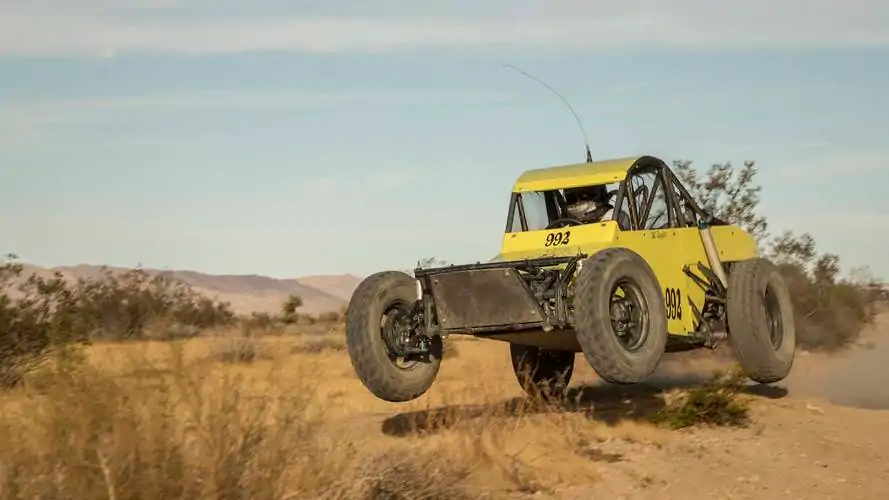
He’s talking about the Class 9 racer, and the warning is accurate. Class 9 is an open-wheel racing class, and this particular machine is built with very little concern for comfort. Jeffers explains that the car can high-side if I attack a bump too quickly, that it is harder on the driver’s body and that it has a greater tendency to roll. There’s also the small matter of the steering wheel. The kickback is severe enough that holding it incorrectly can turn a simple mistake into a painful injury. And unlike the Class 11, Jeffers won’t be sitting beside me this time. The car is a single-seater, so I’m going out there alone. I’ll have the radio, but otherwise, I’m on my own.
Excellent.
The Class 9 doesn’t even pretend to be a road car. There’s no conventional hood, and the small roof panel above the driver’s head doubles as the way into and out of the cockpit. The engine sits directly behind me, close enough that I can hear every mechanical vibration and feel the powertrain working as I prepare to head out. It’s still based around a 1.6-liter air-cooled four-cylinder engine like the Beetle’s, and it retains a four-speed manual transmission, but aftermarket camshafts and cylinder heads help produce more power. The entire car is lighter than the Class 11, and it gets a racing clutch designed for competition use. There’s no windshield to block the dust, and the rear suspension has considerably more travel, with Fox shocks helping the car deal with the kind of terrain that would overwhelm an ordinary road-going vehicle.
The steering is another matter. It carries over from the Beetle concept, but there’s virtually no isolation between what’s happening at the front tires and what I’m feeling through the wheel. Every rock, rut and abrupt change in direction has a direct line to my hands. This is why Jeffers was so insistent about my thumbs. If I wrap them around the wheel and the front suspension suddenly gets kicked sideways by a rock, the steering wheel can snap back with enough force to hurt me badly.
Getting into the car is an athletic exercise. I climb onto one of the rear wheels, step across the fuel cell, work my way through the roll cage and lower myself into the single seat. The seat slides forward to accommodate my less-than-towering height, which feels like a remarkable luxury in a machine that otherwise has almost no creature comforts. Jeffers gives me another mechanical instruction before I leave: when I shift, the clutch pedal needs to reach the floor completely or the transmission won’t cooperate. I push it down and immediately decide that it might be the heaviest clutch I’ve ever encountered. My left leg is already tired, and I haven’t even started the engine.
All of that discomfort disappears the moment the car starts moving.
The Class 9 is a completely different animal. It attacks the desert rather than simply driving through it. The buggy launches over jumps, slides through corners and hammers across rocks with an energy that makes the Class 11 seem almost civilized. The lighter construction and longer-travel suspension allow it to carry considerably more speed, but that performance comes with a price. The car demands constant attention. It is always moving, always communicating and always trying to find another way to surprise me.
There is no filter between me and the terrain.
When the front wheels hit sharp rocks, the steering wheel kicks back violently. When the rear suspension compresses over a rut, the chassis reacts immediately. When I get on the throttle, the car changes attitude almost instantly. I have to keep my thumbs away from the spokes and allow the wheel to move rather than trying to wrestle it into submission.
And somehow, I’m having an incredible time.
The Class 9 is brutal, noisy and physically exhausting, but it’s also hilarious. I’m bouncing across the desert, sliding the car around corners and launching over rises while trying to remember every warning Jeffers gave me. I’m laughing and hurting at the same time. I’m accelerating, steering, bouncing and grinning so hard that I’m fairly certain my kidneys have already left their original positions.
I don’t care.
The car is faster than the Class 11, but the bigger difference is how much more demanding it is to drive. The Class 11 lets you make mistakes and occasionally gets away with them. The Class 9 demands that you pay attention. Every input matters, and every mistake arrives immediately through the chassis. By the time my lap ends, my body is begging for mercy, but my brain is already thinking about another run.
Then comes the final drive of the day.
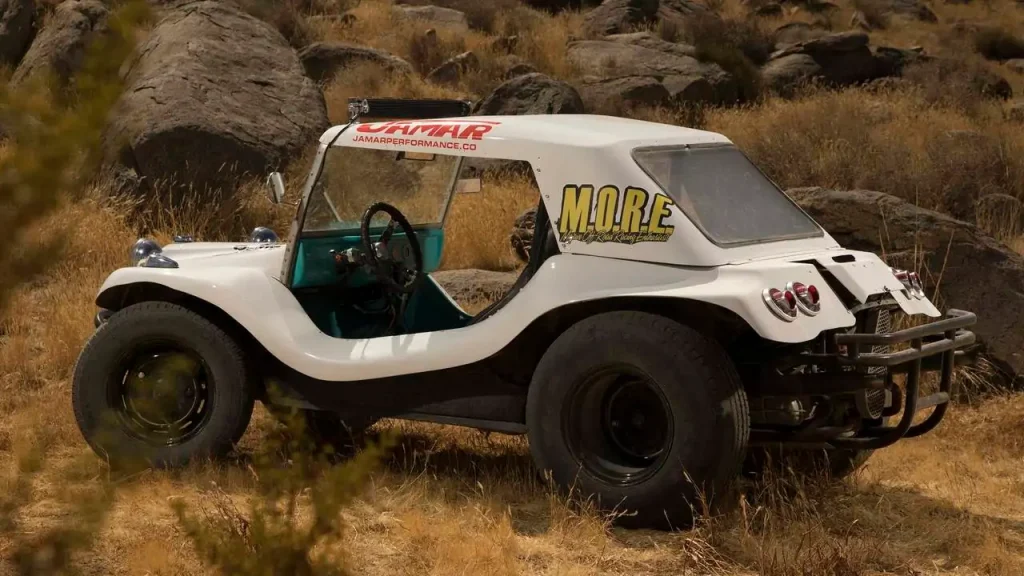
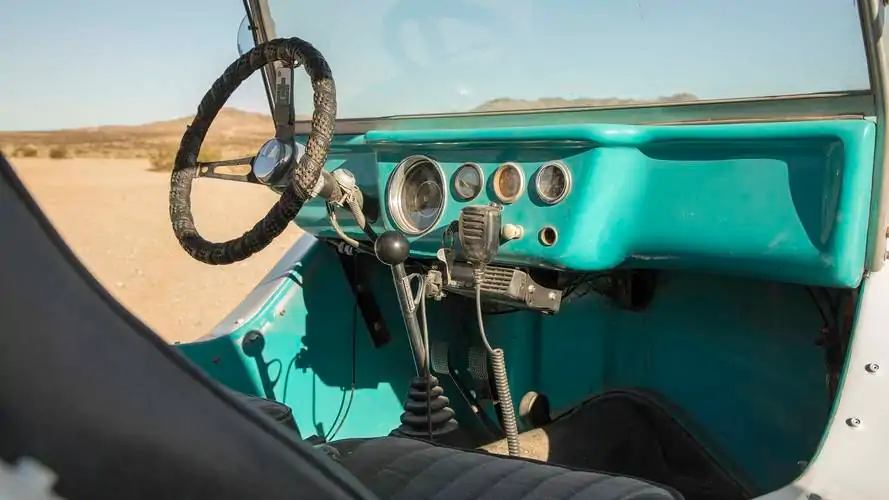
I’m back in a modified Meyers Manx, the dune buggy that helped start this entire story. After the Class 9, the Manx feels almost luxurious. It’s slower and far less precise, but that’s part of its charm. The steering wheel doesn’t always seem perfectly connected to the front wheels. The tires scrape against the wheel wells. Body panels shake and rattle over bumps, occasionally producing noises that make me wonder whether something important is coming loose.
Instead of worrying, I laugh.
After spending the day being hammered around by dedicated desert racers, the Manx feels almost relaxing. It reminds me why these machines became so popular in the first place. There’s something wonderfully simple about pointing a lightweight dune buggy into the desert and letting it bounce its way through the landscape.
Eventually, the Manx brings me back toward camp, and I’m ready for the most important parts of any successful off-road adventure: food, something cold to drink and a shower. After roughly 30-something miles of desert driving, I’m exhausted, sore and covered in enough dust to qualify as part of the landscape.
The experience also leaves me with a much deeper respect for the people who race these machines professionally. I’ve spent only a fraction of the time in the desert that competitors face during races such as the Baja 1000. They don’t drive for a few miles and then return to a shaded tent. They spend hundreds, and sometimes thousands, of miles dealing with heat, dust, rocks, jumps, ruts, mechanical problems and the constant physical punishment of high-speed desert racing.
The Baja 1000 is only a few weeks away, and soon the desert will once again be filled with the sound of Class 9 buggies and Class 11 Beetles charging across the terrain. Their drivers will willingly climb into these machines and subject themselves to hours of punishment because, somehow, the suffering is part of the appeal.
After one day and a few dozen miles, I think I finally understand it.
Baja racing isn’t comfortable, civilized or particularly kind to the human body. It shakes your bones, attacks your muscles and can punish even the smallest mistake. But when a lightweight race car is sliding through the dirt with the engine screaming behind you and the desert flying past the roll cage, it’s almost impossible not to have a huge smile on your face.
Just remember one thing before you go:
Keep your thumbs outside the wheel.